

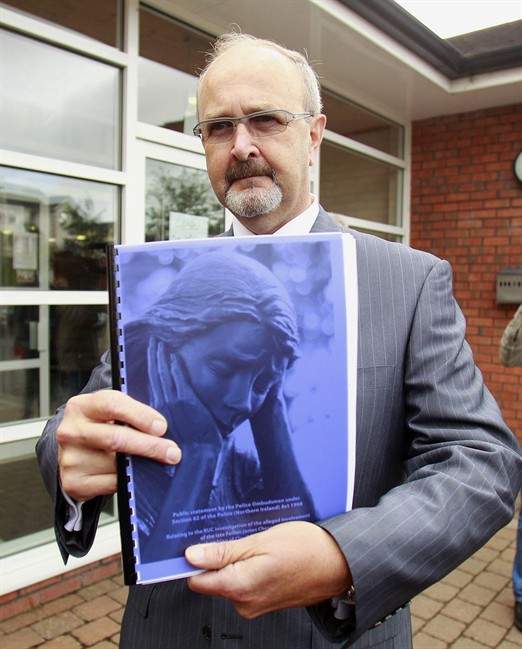
A Canadian man who has risen to the top of Northern Ireland’s police watchdog agency now finds himself entangled in several decades of the region’s blood-soaked past.

Former RCMP officer Al Hutchinson faces mounting pressure to resign his post as police ombudsman amid accusations he failed to properly investigate complaints of police wrongdoing during the violent era known as “the Troubles.”
As ombudsman, his job is to handle any and all complaints against Northern Ireland’s police force – including those that occurred during the tumultuous years from the 1960s to the late 1990s.
The Brampton, Ont., native maintains that bringing closure to such a stormy period of Irish history is an impossible task.
“We aren’t equipped for it,” he told The Canadian Press in a telephone interview.
“It puts us in the middle of a historic debate with two sides with firmly held beliefs. It was so tragic, and so many people died, and for us to investigate it’s just impossible.”
Over 3,500 people died during the period of violent clashes between the region’s Catholic nationalist groups and Protestant factions loyal to the United Kingdom. Police officers and security forces were involved in hundreds of those deaths, either as victims or as the accused.
Hutchinson has 125 cases to investigate. The process has yielded very few arrests – a fact now fuelling accusations that he overlooked serious police misconduct.
But he chalks it up to the problem of investigating cold cases.
“Memories fail, a lot of the people involved are deceased,” he said. That, combined with many destroyed documents and “appalling” record-keeping, makes it difficult to conduct an evidence-based investigation, he says.

Get breaking National news
“People suffer from what I call the ‘CSI effect,'” he said.
“They watch these forensic shows and think we have all this evidence at our fingertips. They forget that even 20 years ago, there were no cell-phone records.”
Hutchinson is no stranger to Northern Ireland’s complicated history, having lived in the region since 2001.
At the time, the nation was recruiting high-ranking Canadian and American officers to serve as impartial experts who could help overhaul the police force as part of the peace process.
Hutchinson, then the RCMP’s assistant commissioner, had served across Canada in diverse areas such as general policing, economic crime, drug enforcement and public order.
After being offered a position on the police oversight committee, he first took a trip to see the region firsthand. To his initial surprise, he found the place very safe and the people warm and welcoming. His wife, a retired teacher, felt ready for an adventure, and they quickly accepted.
He says it was an appealing opportunity, despite the obvious difficulty of remaking the former Royal Ulster Constabulary into an accountable, representative police force that citizens would trust.
“It was such an incredible global challenge,” he said.
“And after 34 years as a police officer, I don’t think the word ‘trepidation’ was even in my vocabulary.”
What was supposed to be a three-year stint soon turned into six when he was promoted to oversight commissioner. Hutchinson was preparing to return to Canada in 2007 when the job of ombudsman came up.


His office now responds to approximately 3,000 complaints that are levelled yearly against the police. Last year, his 144-member unit conducted about 1,000 investigations, which resulted in charges against 13 police officers.
Hutchinson says that most of the complaints he receives are for relatively minor offences, falling under the categories of “failure of duty” or “oppressive behaviour.” He also investigates more serious events, including all tasering incidents, use of rubber bullets, or police shootings.
In addition, the ombudsman’s office can make policy recommendations, conduct academic research and recommend disciplinary action against police officers.
“We provide the accountablility,” he said.
Hutchinson is philosophical about the mounting criticism – levelled both against his office and against him personally.
Recently, three human-rights groups and several politicians openly called for his resignation over his handling of events related to the Troubles.
“Me, I can take the hits,” he said.
“But it affects current police investigations, and it undermines the public confidence in this office,” he said.
Nevertheless, he says he will complete the 15 months remaining in his term before he moves back to Ottawa for good.
In the next two weeks, he plans to appear before a parliamentary justice committee to defend his actions.
But he holds no illusions about turning the page, once and for all, on such a painful period of history and the lingering hope for justice.
“This is something that’s been going on for 400 years,” Hutchinson said of strife in the region. “I can’t be the arbiter of societal issues.”
He believes any examination of historic wrongs would be better handled by an International Truth Commission, or a similar model that “moves the issue ahead to reconciliation.”
He would rather focus on current cases needing his attention, and leave the history to be dealt with through other channels.
“The only problem,” he says, “is that right now there is nobody else to do it.”


Comments
Want to discuss? Please read our Commenting Policy first.