

TORONTO – When Steve Cooper was 12, he set up a roadside stand to sell the sweet corn he had grown on his family’s farm and made enough money to spend a day at Canada’s Wonderland amusement park.

Now 40 and owner of his own farm, Cooper tends a much larger operation. On his 101-hectare spread at Zephyr, Ont., northeast of Toronto, he grows everything from asparagus to zucchini in a 12-hectare market garden and has 12 hectares of sweet corn.
There’s something quintessentially Canadian about biting into a cob of corn, with its burst of juicy sweetness. Once the harvest comes on, people snap up cobs by the dozens at roadside stands and farmers markets across the country.
“The picking started at the normal time for us, the 20th of July,” Cooper says. To maintain a steady supply of sweet corn through to Thanksgiving, he starts planting in mid-April and continues every week to 10 days, right through the middle of July.
Selling fresh produce at farmers markets has been a big part of Cooper’s business. But he and wife Lisa, who were named Canada’s Outstanding Young Farmers for 2010, have branched out into other endeavours, including community-supported agriculture, in which members purchase shares and receive fresh produce, and agri-entertainment, which includes tours and a chance to go through a four-hectare corn maze.
“We’re trying to get people to come to the farm and have some fun,” says Cooper.
This year, the theme of the maze is the logo for the Heart and Stroke Foundation, and a portion of the $8 entry fee goes to the charity. Past themes have included a Canadian flag and the logo for the Toronto Maple Leafs hockey team.
But the best part of growing corn is eating it, and Cooper’s tastes are simple.

Get daily National news
“How do I like it? Pick it. Just have the water boiling. Put it in for five minutes, yank it out, a little bit of salt and butter. That’s it,” he says.
Olivia Bolano, executive chef of All The Best Fine Foods in Toronto, also loves eating corn straight from the cob. “But if you want to inject different flavours to your corn, do it with compound butters,” she suggests.
The butters are easy to create and you’re only limited by your imagination, the 31-year-old says. Season room-temperature butter with salt and pepper, then make it spicy, herby or garlicky to suit your taste and menu. If you want to evoke flavours of Latin America, for example, opt for lime and hot paprika, or maybe mix it up with some ancho chili, she suggests. Another combination is thyme, parsley and chives or use chopped chives alone.
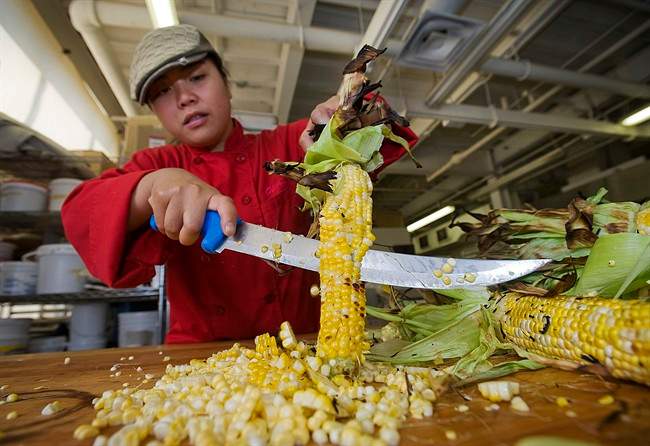
Fresh corn can also be used as an ingredient. At the food specialty company where Bolano works, a customer favourite is a grilled corn and lima bean salad.
Another popular dish is succotash. “Succotash is a native Indian word that means ‘little bits,'” Bolano explains. “It looks like a salsa, but it’s hot. It’s got corn in it, peppers, beans – lima or fava – and mushrooms. It’s a perfect side dish.”
Corn can also be ground and used in polenta or grits, Bolano says, adding that a recent trip to the southern U.S. has inspired the company’s pastry chef to use cornmeal to create breakfast corn muffins, which are infused with blueberries or bacon and green onions.
Cooper recommends visiting a farmers market for the best selection.
“Get there real early in the morning and look at how everyone is setting up.” If the corn comes in on the back of a pickup truck in bushel baskets, chances are it’s been picked that day or the night before by the grower. Wholesale sweet corn is generally packaged in green mesh bags that hold five dozen cobs.
“As a farmer, I would never put my own corn in a green mesh bag because it’s too hard to get it out … If it’s in a green mesh bag, chances are they’re not growing it.”
Peek at the kernels of a couple of cobs. Kernels should be uniform, rounded, not overly large and firm, but not rubbery, which means the corn is probably overly mature and starchy. If you see dented kernels, the corn is way past maturity, explains Cooper, whose farm is in Ontario’s Greenbelt, which extends from Rice Lake in the eastern province through to the Niagara River and includes some of the most valuable agricultural lands in Canada.
There is some etiquette when it comes to choosing corn.
“I always recommend to people not to rip open a cob of corn. You’re going to really tick off a lot of guys if you rip open a cob right to the bottom,” Cooper says.
“You don’t want to make it unmarketable for the farmer. It’s corn politeness. You gotta have corn etiquette. They take a lot of pride in their corn. They don’t want it ripped open.”
Meanwhile, the Coopers are gearing up for visitors to the maze.
“It’s a true puzzle. You go in there and get lost,” he says.
“I’ve had people hoof it through the whole thing in 45 minutes and I’ve had people take hours, three or four hours. We literally go out and have to escort them out. It blows me away how some people can’t look up and identify where my house is, where the trees are. They’re constantly looking down at the ground and go in circles,” says Cooper.
“We go through and harvest the grain crop afterward. I get a normal grain crop out of it. I use it for feed.”
—
Online:
Cooper’s CSA Farm and Maze, http://www.coopersfarm.ca
All The Best Fine Foods, http://www.allthebestfinefoods.com


Comments
Want to discuss? Please read our Commenting Policy first.