


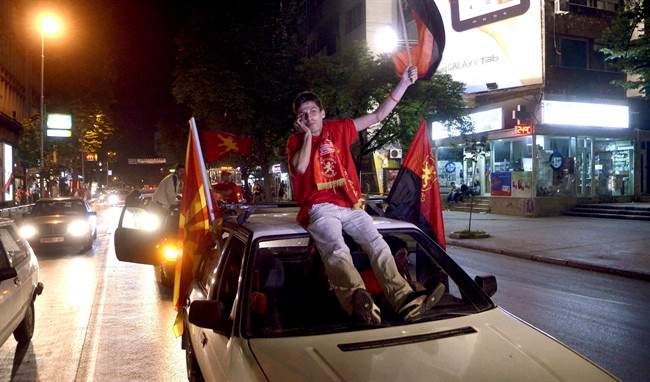
SKOPJE, Macedonia – Macedonia’s conservative prime minister won a general election in the Balkan country, but will need to form a coalition to govern for another four-year term, according to final results released Monday by the State Electoral Commission.

Prime Minister Nikola Gruevski called the election a year early, following an opposition walkout in Parliament sparked by the jailing of a popular TV channel boss for alleged fraud.
A new government in this country of 2.1 million people will have to deal with a weak economy, a bitter name dispute with neighbouring Greece and ongoing tensions with the ethnic Albanian minority that makes up roughly a quarter of the population.
Currently, unemployment stands at a staggering 32 per cent in a country with an average monthly salary of wage of €320 ($466).
Monday’s final results showed Gruevski’s VMRO DPMNE party won with 39 per cent of the vote, giving him 56 seats in the 123-seat Parliament, including three seats from the diaspora, said State Electoral Commission chief Boris Kondarko. Gruevski would have needed 62 seats to form a government alone.
The main rival Social Democrats, led by former prime minister and president Branko Crvenkovski, garnered 32.7 per cent and 42 seats.

Get breaking National news
The conservatives’ previous coalition partner, the ethnic Albanian DUI party, got 10.2 per cent, giving it 15 seats in Parliament, easily defeating its main ethnic minority rival, the DPA, which got 5.9 per cent and eight seats. The remaining two seats went to the small ethnic Albanian National Democratic Revival party.
Turnout was 63.4 per cent.
International observers from the Organization for Security and Co-operation in Europe said the election had been “competitive, transparent and well-administered throughout the country.”
The observers said voters were able to cast their ballots “in a peaceful atmosphere, despite some irresponsible claims of irregularities by political parties.”
The last general election in 2008 was marred by violence when gunfights erupted on polling day in ethnic Albanian areas, leaving one person dead and eight wounded.
Biljana Vankovska, a prominent political analyst, told The Associated Press that if Gruevski manages as expected to form another coalition government, he will probably maintain his uncompromising style of leadership.
“I am a little worried now that Gruevski has secured the third mandate. His VMRO was reluctant to listen to different ideas and proposals. Now I fear they will slide toward autocracy,” she said, adding that the result suggests Macedonia has become increasingly polarized, with conservative splinter parties wiped out.


The political crisis leading to the snap election was sparked by an opposition walkout from Parliament, claiming that the crackdown on the private A1 television station in January and the arrest of its media magnate, Velija Ramkovski, were politically motivated. Authorities insisted they were investigating tax fraud.
Ramkovski’s arrest led to protests and weeks of A1 TV broadcasting its news bulletins from the street outside government buildings.
Vankovska predicted Gruevski would rejoin DUI, its previous coalition partner led by Ali Ahmeti, a rebel commander in a 2001 ethnic Albanian insurgency.
Macedonia has had a turbulent history since the former Yugoslav republic declared independence in 1991.
An ethnic Albanian uprising against government forces in 2001 ended with the intervention of a NATO cease-fire monitoring force. Macedonia’s government agreed to devolve greater political power and cultural recognition to the Albanian minority, which agreed for its part to fully recognize all Macedonian institutions.
Macedonia also has been at odds with Greece over the former Yugoslav republic’s name since it gained independence. Greece’s government says use of the name implies territorial claims on the northern Greek province of Macedonia. Skopje denies that. But earlier this year, NATO-member Greece blocked Macedonia’s bid to join the alliance over the dispute.


Comments
Want to discuss? Please read our Commenting Policy first.