

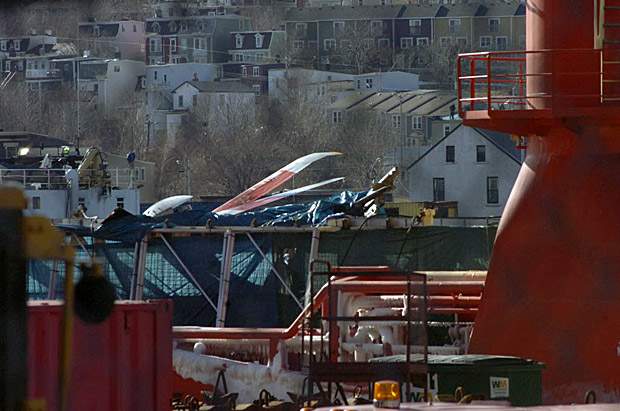
HALIFAX – The widow of a passenger who died in a chopper crash off Newfoundland two years ago says she is frustrated by Ottawa’s plans to consult foreign regulators before requiring changes to the gearbox that was a cause of the disaster.
Lori Chynn, whose husband John Pelley was aboard Cougar Flight 491, said the time has come for Transport Canada to order improvements on the crucial component instead of setting up more focus groups and meetings.
"There’s been enough discussion," she said in a telephone interview from her home in Deer Lake, N.L.
"Let’s have some action."
Transport Canada said Tuesday it will first consult with American and European regulators before ordering any changes to a gearbox that lost oil and was a cause in the March 12, 2009, helicopter crash.
The federal department is responding to recommendations by the Transportation Safety Board of Canada on the crash that killed 17 people.
In a report released in February, the safety board said the primary cause of the crash was a massive loss of oil to the chopper’s main gearbox after two of three titanium studs snapped off the oil filter assembly during flight. Those studs have since been replaced with steel parts on Sikorsky S-92 helicopters worldwide.
The safety board recommended that Transport Canada change regulations so that offshore helicopters are capable of flying without oil in the main gearbox for at least 30 minutes.
The Sikorsky S-92 lost control and hit the North Atlantic with devastating force 11 minutes after the pilots reported losing oil pressure east of St. John’s.
Transport Canada posted its response on its website Monday night, but words were missing and a spokeswoman sent an email Tuesday to clarify.
In her email, Maryse Durette says Transport Canada will meet with the U.S. Federal Aviation Administration and the European regulator to discuss whether rules need to be changed to ensure the gearboxes are capable of operating for 30 minutes if they lose oil pressure.
"As all three authorities have regulations for these helicopters, an international approach is required," Durette said.
Lawyer Joe Fiorante, who represents the sole survivor of the crash and the families of 14 passengers who were killed in the crash, said Transport Canada has long known of the problem and should have ordered changes to the gearbox by now.
"This is essentially just telling us they will undertake further reviews," he said.
"It’s been over two years since the accident and there’s been no positive steps taken by Transport Canada to deal with the fundamental problem with that gearbox."
The Federal Aviation Administration originally granted Sikorsky a 30-minute run-dry certification in 2004, basing it on an assumption that the chances of an oil leak were "extremely remote" – a term defined as an incident expected once in every 10 million flight hours.
Transport Canada then followed with its own review and granted a permit allowing the helicopter to fly in Canada.
Chynn has argued that the premise for the certification wasn’t valid after studs holding the oil filter bowl to a helicopter’s main gearbox broke in July 2008 in Australia – about nine months before the Newfoundland crash.
She and other family members wrote a letter to the federal transportation minister in February asking for a probe into how the gearbox was certified in Canada.
Chynn said she hasn’t received a response to her letter yet.
"Canada takes a lead on a lot of other things, so why not this?" she asked.
"We’re talking about safety. The bottom line is safety for workers. We don’t want this to happen to anybody else."
Durette said questions about the certification process of the S-92 are before the courts in a lawsuit and it would be inappropriate for Ottawa to comment.
She also said the families’ letter had been received but "due to a series of unique circumstances, including the minister’s departure, the election and the transition to a new minister, the response to this correspondence is pending."
Transport Canada also says it will review the safety board’s recommendations that emergency air be supplied on flights that require survival suits and that flights be grounded over seas that are too rough for a survivable ditching.
It says it will assemble a focus group to consider those recommendations and devise an advisory bulletin on those issues based on the talks with the aviation and oil industries.



Comments
Want to discuss? Please read our Commenting Policy first.