


Edmonton’s oldest historic site served as a place to remember the history of Canada’s Indigenous people on the sixth annual National Day of Truth and Reconciliation.

The day is a sombre remembrance of 150,000 Indigenous children who suffered malnutrition and abuse over decades in Canada’s residential school system.
“Days like today are not necessarily happy days for us — they’re actually quite sad and heavy,” said Jasmine Hannig, an Indigenous social worker who took in the commemorative event at Fort Edmonton Park.
Many at the gathering wore bright orange shirts, the symbol for the children who attended residential schools. Some ate bannock and sipped on warm beverages on the chilly autumn morning.
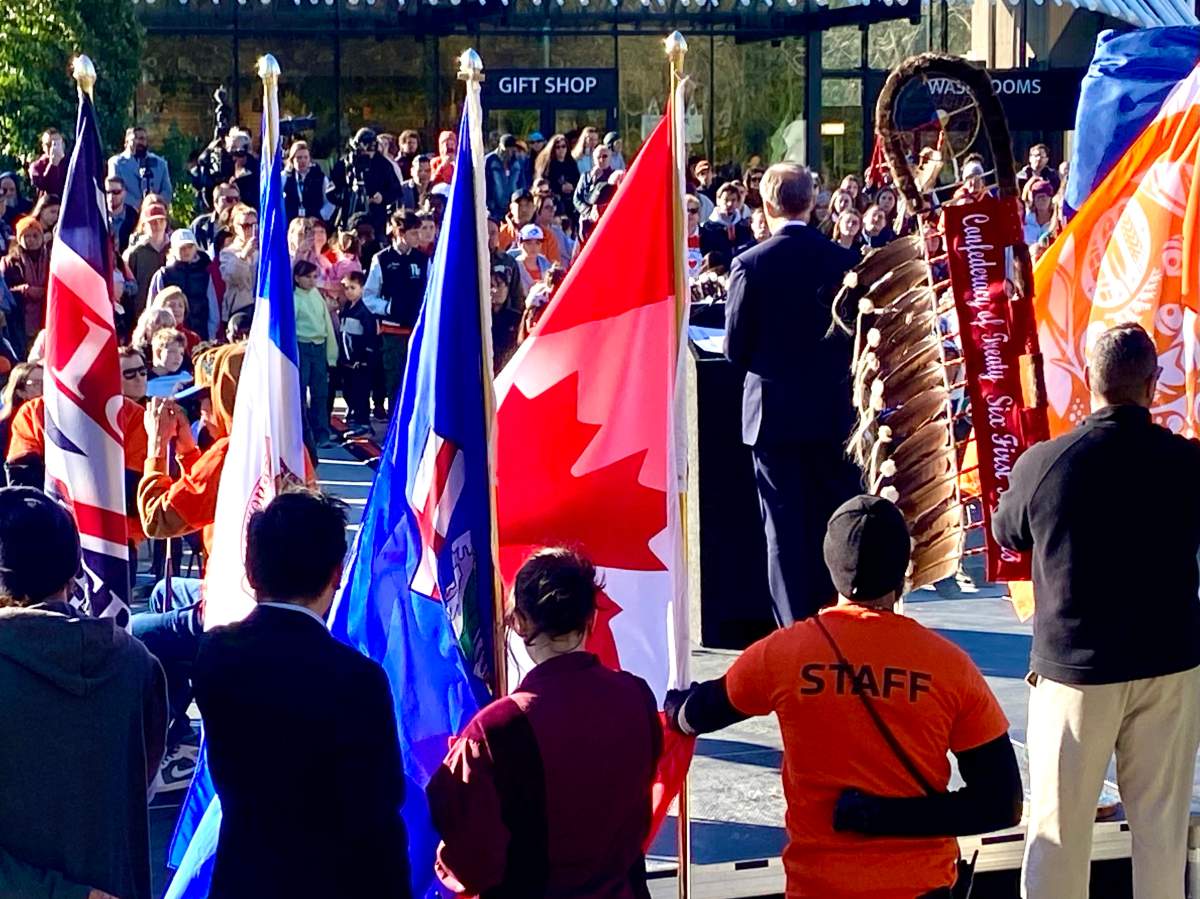
The Federal statutory holiday was established after the Truth and Reconciliation Commission called on the Canadian government to recognize the impact residential schools had on survivors, their families and their communities.
In 2015, the commission concluded the schools were central to a state-backed policy of cultural genocide.
“Truth and reconciliation, definitely for Indigenous people, is not just one day. It’s a life that we live,” said Chief Desmond Bull from the Louis Bull First Nation in Maskwacis. “More importantly, the acknowledgement of our ancestors that went through residential school.”
Experts and First Nations advocates have cited the violence and abuse inflicted upon several generations of Indigenous children at the schools as the reason why Indigenous communities experience disproportionately higher rates of violence, psychological distress and substance use and abuse.
The trauma was compounded by events like the Sixties Scoop — a government policy that forcibly removed Indigenous children from their birth parents and sent to foster homes and other families for adoption.
Hannig wants people to know the day commemorates more than just Canada’s dark history with residential school.

Get daily National news
“Not only residential schooling had an impact, but so did the Sixties Scoop, day schools, boarding schools, the 90s scoop and many other colonial aspects,” she said of the intergenerational trauma Indigenous peoples have suffered.
“I think it’s really important we talk about the impact of all that harm collectively, and the echoes that has had within our community.”

The day is full of mixed feelings for Hannig.
“In one way, it’s really emotional because it’s so beautiful that we’re having this conversation — finally. But another way, I feel like there’s a lot of conversations that we’re not having collectively.”
On Wednesday, about 2,000 people were expected to walk through the Indigenous People’s Experience at Fort Edmonton Park, which is opened year-round.
“The immersive experience in here is really about the fact that you’re learning about us in a broader sense,” Evert Poor, an event manager at Fort Edmonton Park, said of the exhibit.
“A lot of people have a lot of myths and stereotypes about Indigenous people.
“This space basically teaches you the true history of our people.”

-
![]() Indigenous Peoples Experience at the heart of Fort Edmonton Park reopening
Indigenous Peoples Experience at the heart of Fort Edmonton Park reopening -
![]() Indigenous Peoples Experience tells First Nations, Metis stories at Fort Edmonton Park
Indigenous Peoples Experience tells First Nations, Metis stories at Fort Edmonton Park -
![]() New Indigenous Peoples Experience the centerpiece of revamped Fort Edmonton Park
New Indigenous Peoples Experience the centerpiece of revamped Fort Edmonton Park -
![]() Fort Edmonton Park ready to reopen with new Indigenous Peoples Experience
Fort Edmonton Park ready to reopen with new Indigenous Peoples Experience -
![]() University of Alberta law students experience blanket exercise
University of Alberta law students experience blanket exercise


Chief Bull said listening to those whose lives were impacted is also encouraged.
“There’s much more you can learn from sitting down with a person of Indigenous background and hearing their story of where they are now, and how they came about where they are,” Bull said.
Prime Minister Mark Carney, Opposition Leader Pierre Poilievre, Mayor Andrew Knack, leaders from First Nations near Edmonton and other officials took part in a commemorative ceremony at the interactive historical site.
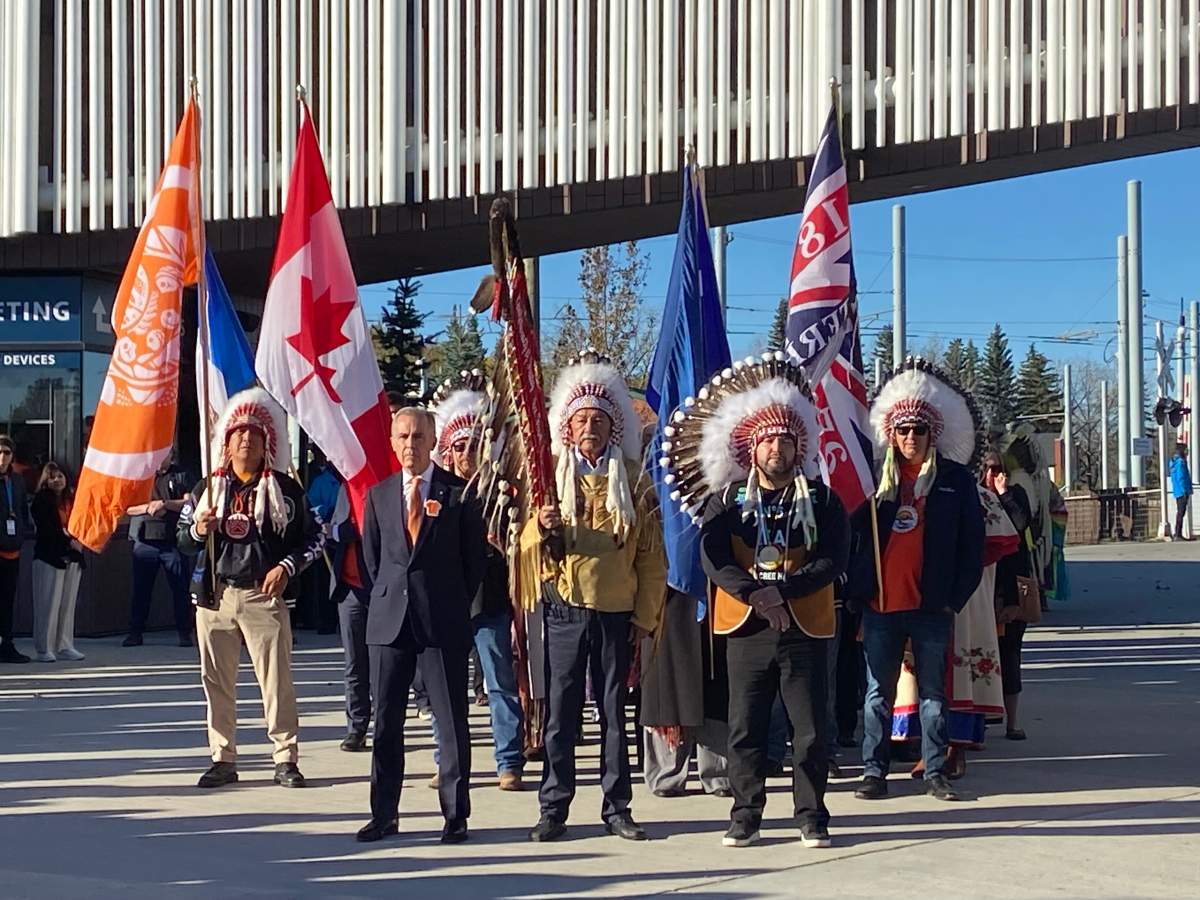
Carney, who was born in the Northwest Territories and raised in Edmonton, recalled in his speech the numerous visits to Fort Edmonton in his youth.
Carney said the ceremony urged everyone to hear the stories of those affected by the residential school system and “reflect on a dark chapter in Canada’s past and to commit to move forward together.”
“This is not a distant chapter in Canada’s past, but a truth that endures,” said Carney, who wore an orange tie and a pin of a beaded orange T-shirt on his lapel.
“Reconciliation is a journey, not a destination. It’s an attitude, not an achievement. Our job is to move together as far and as fast down the path as we can.”

Alberta’s Minister of Indigenous Relations released a statement about the day.
“Reconciliation is about more than a single day,” the statement from Rajan Sawhney said. “Reconciliation takes time, care and sustained effort. It is shaped by relationships built on listening, respect and a willingness to learn, and by supporting Indigenous-led knowledge, perspectives and priorities.”
Anyone experiencing pain or distress as a result of their residential school experience can access this 24-hour, toll-free and confidential National Indian Residential School Crisis Line at 1-866-925-4419.
With files from Daniela Germano, The Canadian Press
-
![]() Calls to vote continue with advance polls open in Alberta referendum
Calls to vote continue with advance polls open in Alberta referendum -
![]() City of Edmonton helps businesses be more inclusive with ‘Rainbow Registered’
City of Edmonton helps businesses be more inclusive with ‘Rainbow Registered’ -
![]() ‘Movement is medicine’: Edmonton women foster reconciliation with fitness
‘Movement is medicine’: Edmonton women foster reconciliation with fitness -
![]() Transgender Albertans concerned with wrong name, gender on referendum mail-in ballots
Transgender Albertans concerned with wrong name, gender on referendum mail-in ballots




Comments
Comments closed.
Due to the sensitive and/or legal subject matter of some of the content on globalnews.ca, we reserve the ability to disable comments from time to time.
Please see our Commenting Policy for more.