


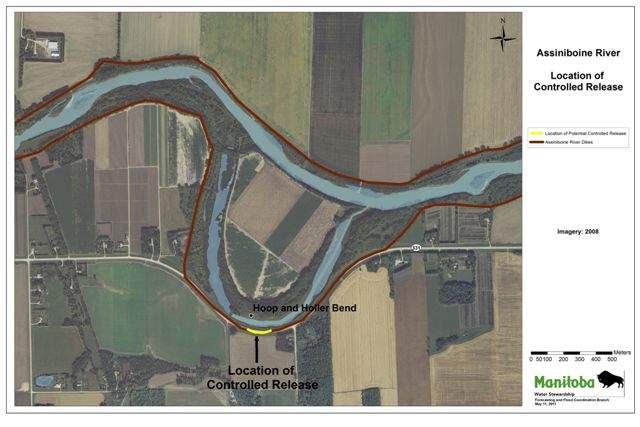
Manitoba provincial officials say they may intentionally breach the Assiniboine River dike on Thursday morning, cutting a 65-metre hole through the structure at the Hoop and Holler Bend to release some of the flood waters from the swollen river. The idea is that the “controlled breach” would prevent the river from overtopping the dike or breaching the dike at an unknown spot along the river.
Many people in the path of this new man-made river, residents of the RMs of Portage La Prairie, McDonald and Elie, are upset that their homes are being sacrificed for the sake of more densely-populated communities, but at least one academic says the Province has made the right decision.
Jay Doering, professor of civil engineering at the University of Manitoba, said the best option is to alleviate some of the record-high flow along the Assiniboine is to ensure the water stays within the banks from downstream of the Portage diversion. He said it is much better to take control of the situation and decide where that flow is going to go, than to have it arbitrarily break the dike or flow over at some point.
Right or wrong, here’s how the controlled breach would work:
“¢ Officials calculate the best location and size for the opening to achieve the proper flow; in this case, they have settled on a 65-metre opening at the Hoop and Holler Bend. “If they know the size of the opening and they know where the elevation of the bottom of that opening is and how wide that opening is, they can figure out the mathematical calculation of how much water will pour through that opening,” Doering explained.
“¢ Officials would reinforce the area surrounding the site of the planned breach with “Rip-Rap.” Rip-rap is a material – usually made of granite or limestone – that is used to armour shorelines, streambeds, bridge abutments, pilings and dikes against water or ice erosion. The size and mass of the rip-rap absorbs and deflects the impact of waves, absorbing the impact energy, while gaps between the rocks trap and slow the flow of water, decreasing the water’s ability to erode soil or structures. Without Rip-Rap, the water would rush through the newly-created opening in the dike, and erode the surrounding areas.
“¢ They would use a backhoe and other heavy equipment to breach the dike. On May 2, 2011, U.S. Army Corps of Engineers blew a two-mile hole in the Birds Point levee using explosives to save Cairo, Illinois from flooding, while inundating 130,000 acres of Missouri farmland with the floodwaters.



Comments
Want to discuss? Please read our Commenting Policy first.