


Dangerous avalanche conditions in parts of southwestern Alberta and southeastern B.C. have prompted Avalanche Canada to warn people to avoid the backcountry.

“The biggest avalanche cycle of the season” has also prompted the temporary closure of several roads in the mountains while avalanche control efforts are underway.
Among them, Highway 93 between Lake Louise and Jasper has been closed through Saturday.
In a post on social media, Parks Canada said that “avalanche conditions are rated as extreme across Banff, Kootenay and Yoho National Parks” and visitor safety specialists have observed multiple natural avalanches, some of which have reached valley bottoms.
Temporary closures have also been periodically put in place along parts of the Trans Canada Highway between Revelstoke and Lake Louise.
On Thursday, Parks Canada also ordered the road to the Sunshine Village ski resort, just west of Banff, to be closed for avalanche control.
Sunshine Village said the decision was made “out of an abundance of caution” and the road was reopened on Friday.
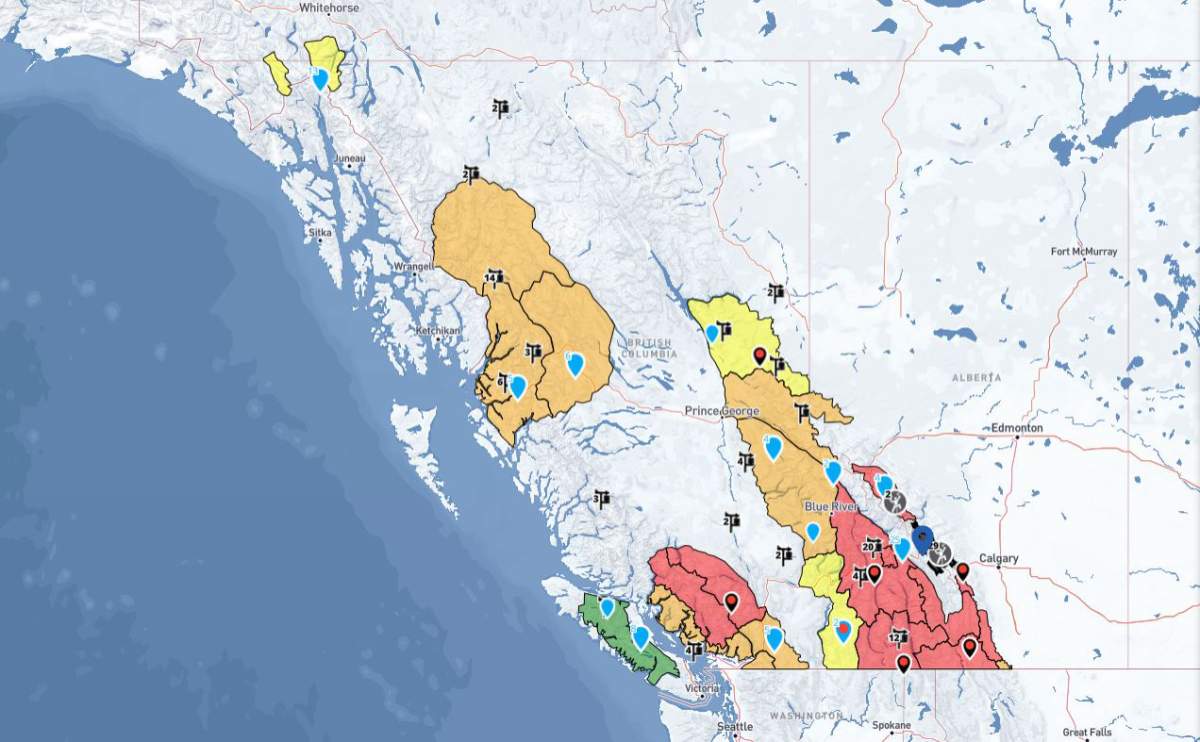
With an atmospheric river expected to bring up to 70 mm of rain to parts of the B.C. Interior, as well as snow at higher elevations, Environment and Climate Change Canada has issued a series of rainfall warnings and special weather statements for much of southeastern B.C. and southwestern Alberta.

Get daily National news
“The second wave of the atmospheric river event that most of British Columbia has been experiencing this week is pushing a little bit further inland than the first, so the Rockies are being significantly impacted,” said Tyson Rettie, an avalanche forecaster with Avalanche Canada.

Rettie said the extreme weather swings in recent weeks, including temperature swings, heavy rains, snow at higher elevations and strong winds all contribute to weakening the snowpack and increasing the avalanche danger.
“It’s similar to what you will see on your front lawn during event like that. If you have snow across your yard, and then all of a sudden it gets soaked with rain, it is a sloppy mess. Well, now imagine that’s a two or three meter deep snowpack sitting on a steep slope. It’s going to want to go somewhere,” said Rettie.


“And at higher elevations, where it’s falling as snow and where we have strong to extreme wind, all of that snow has weight to it, especially if we have weak layers in the snowpack and you have all that snow being blown around. All that weight building up on a snowpack that contains weak layers, at some point, you’re probably going to have a failure and large slab avalanches will be produced.”
Rettie said the extreme swings in the weather mean conditions can change quickly, so it’s important for anyone thinking of heading into the mountains to check the forecast, make sure you have the proper rescue gear and take a course so you know how to use it.
Even at lower elevations, he said, there can be a risk.
“Once the snowpack is quite deep, once weak layers are potentially buried deeply in the snow pack, we can get large or very large avalanches and those have the potential to run to very low elevations and could impact people who are taking in activities that they don’t always associate with avalanche hazards, like snowshoeing, cross-country skiing, and hiking — especially during weather like what we’re having right now.”
The warnings also cover a large swath of Vancouver Island and the coastal mountains, north of Vancouver.
The heavy rain has also prompted Environment Canada to warn of the possibility of localized flooding in some areas of Vancouver Island, the Lower Mainland, North Coast and Fraser Valley.



Comments
Want to discuss? Please read our Commenting Policy first.