

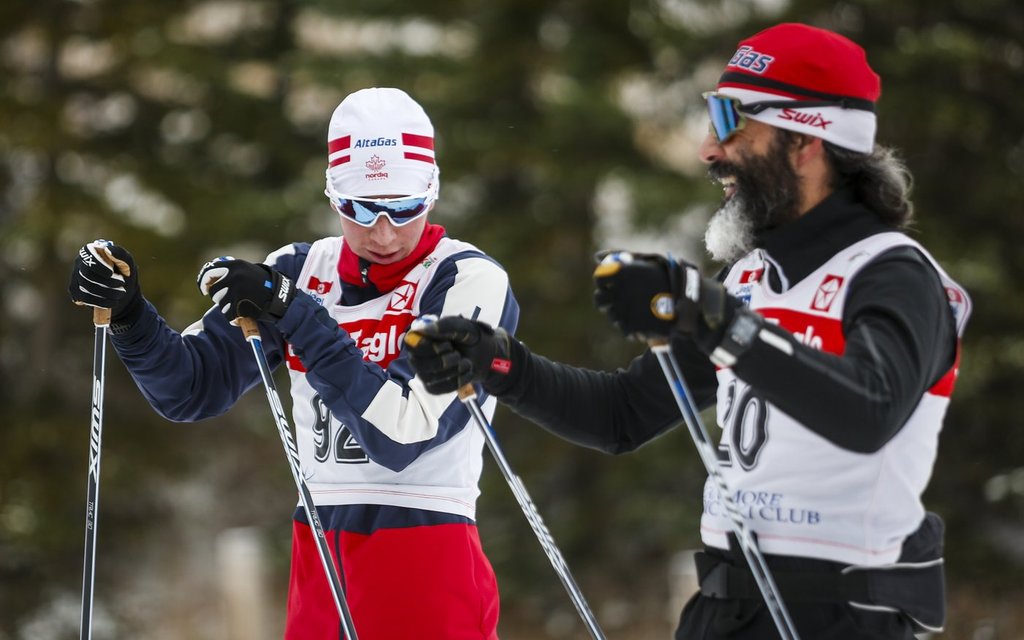
Xavier McKeever’s relief at qualifying for the Olympic Games was hard to miss.

Face down in the snow, an exhausted McKeever screamed in celebration after holding off Graham Ritchie to win the men’s sprint free event by a single boot length in a photo finish at the Nordiq Canada Olympic Winter Games Trials.
The pressure was immense.
The Dec. 16 race in Vernon, B.C., was a win-or-go-home affair for the 22-year-old from Canmore, Alta., whose roots in the sport run deep.
McKeever’s parents were both cross-country ski Olympians.
His mother, Milaine Thériault, competed at Nagano in 1998, Salt Lake City in 2002, and Turin in 2006. His father, Robin McKeever, competed in Nagano before becoming the guide for his brother, Brian McKeever, who won 16 gold, two silver and two bronze medals across six Paralympic Winter Games.
“A lot of pressure,” Xavier McKeever recalled. “Big trials. I wasn’t really super-happy with my performance on the first two days and kind of knew going into that race I had to win.”
Nordiq Canada had learned the night before that it had received a fifth men’s quota spot at the Olympics.
“So we were actually racing for an official spot in the Olympics,” said McKeever.
“To have that much pressure and then perform and win takes a really strong mental capacity,” said Canada coach Julia Mehre Ystgaard.
Four years working with a sports psychologist helped McKeever deal with the stress. So did Lego.
“Lego, for me, is something that kind of takes my brain away from whatever I’m thinking about and just lets me focus on what I’m building,” he explained. “I’ve kind of used that as a strategy as of late as well.”

-
![]() Milano-Cortina Olympics: Team Canada to take on U.S. for men’s hockey gold medal
Milano-Cortina Olympics: Team Canada to take on U.S. for men’s hockey gold medal -
![]() Edmontonians flock to bars to cheer on Team Canada Men’s Hockey
Edmontonians flock to bars to cheer on Team Canada Men’s Hockey -
![]() ‘Everybody had a shot’: Canadian women’s speedskating team humble in gold medal win
‘Everybody had a shot’: Canadian women’s speedskating team humble in gold medal win -
![]() ‘You have to be confident’: Canada’s Grondin speaks silver medal win in Men’s Snowboard Cross
‘You have to be confident’: Canada’s Grondin speaks silver medal win in Men’s Snowboard Cross -
![]() Canadian skier Kingsbury ‘very happy’ with silver medal win in Olympic Men’s Moguls
Canadian skier Kingsbury ‘very happy’ with silver medal win in Olympic Men’s Moguls -
![]() Canada wins silver in short-track speedskating mixed team relay
Canada wins silver in short-track speedskating mixed team relay -
![]() Winter Olympics 2026: Canada’s Megan Oldham wins bronze in women’s freeski slopestyle
Winter Olympics 2026: Canada’s Megan Oldham wins bronze in women’s freeski slopestyle -
![]() Team USA Olympians, protesters speak out against ICE presence in Milan
Team USA Olympians, protesters speak out against ICE presence in Milan -
![]() What to expect from the Milano-Cortina Olympics
What to expect from the Milano-Cortina Olympics -
![]() Canadian Olympic snowboarder, medal hopeful Mark McMorris suffers ‘heavy crash’ in training
Canadian Olympic snowboarder, medal hopeful Mark McMorris suffers ‘heavy crash’ in training


McKeever started including Lego in his preparations some three years ago, having bought a Lego set on the road. He has kept going, usually with sets of some 200 pieces to make a small race car.

Get daily National news
Having played with Lego since he was a kid, there was no shortage of pieces in the family basement when he ran out.


During the Olympic trials, he was working on a McLaren Formula One car set purchased in Lahti, Finland, at the end of the previous World Cup season. It travelled with him to the U.S. and New Zealand before he opened it in Vernon, and the set made it to Europe while McKeever was preparing for the Olympics.
By finishing runner-up in the 1.1-kilometre sprint, Ritchie was nominated as an Olympic team alternate. No small feat considering the 27-year-old from Parry Sound, Ont., missed an entire season after injuring an ankle while jogging in Sweden in December 2023 after the first World Cup of the season. Ritchie required surgery to insert a plate and five screws into his ankle.
Canada has hopes in the Olympic relays.
“We’ve had great success in the relays as Canadians in the past,” said McKeever. “And I think part of it is we’re living on the road away from home for so many months during the winter that we just create this massive bond between us. I think that just makes us care extra about the relay, because that’s the only race where the name on the results sheet doesn’t say your name. It says Canada.”
McKeever, whose main coach is Norwegian Tormod Vatten, says while his parents and uncle are valuable resources in the sport, he looks to forge his own path.
“I’m my own athlete … It really takes me to figure out what works for me and what doesn’t,” he said.


McKeever, who is working on a degree in aviation management at Mount Royal University, enjoys the travel that comes with his sport.
“It’s really easy to do something if you enjoy it,” said McKeever, who hopes to get his pilot’s licence in the future. “Some people might not like travelling. They see it as a drag. But I love it.”
But it appears cross-country skiers don’t travel light. With different races and courses requiring different skis, McKeever travels with 40 pairs of skis.
“For a given race, I will probably test around 10 pairs,” he said.
On race day, that number will be reduced to usually two or three pairs before he and his wax technicians decide on the final set.
Because the Olympic trials were back home in Canada, McKeever crossed the Atlantic with 30 pairs of skis. The good news is that in Europe, the team has a truck to transport such gear.
Both his parents and maternal grandmother will be in Italy, cheering him on.
McKeever turned heads as a junior, competing in his first of five FIS Junior World Championships in 2019. A year later, he combined with Olivier Leveille, Tom Stephen and Remi Drolet to win silver in the men’s 4×5-kilometre relay, Canada’s first-ever world championship cross-country skiing relay medal at any level.
In 2022, he posted top-six finishes in individual events, the men’s 30-kilometre mass start free and men’s 10-kilometre classic, as well as a fourth-place finish in the men’s relay.
McKeever made his debut at the FIS World Cup in March 2022 and the senior FIS World Championships in 2023 when he was 19. He was part of back-to-back fifth-place finishes in the men’s relay in 2023 and 2025.
More recently, McKeever posted a personal best in finishing 13th during Stage 3 of the Tour de Ski in Toblach, Italy, on Dec. 31.
McKeever and Antoine Cyr combined to finish ninth in the Jan. 23 team sprint free event at a World Cup stop in Goms, Switzerland. McKeever was 19th in the 20-kilometre mass start classic event two days later in Goms.
The Tesero Cross-Country Skiing Stadium will host the Olympic cross-country skiing and Nordic combined events, as well as the Paralympic biathlon and cross-country skiing.
McKeever opened his Olympic Games on Sunday with an impressive 13th-place finish in the men’s skiathlon in Tesero, the first men’s cross-country skiing event of the competition.
—
This report by The Canadian Press was first published Feb. 8, 2026
Comments
Want to discuss? Please read our Commenting Policy first.