


City of Calgary officials are working on plans to implement key recommendations included in an independent panel’s report on the 2024 failure of the Bearspaw feeder main, a report that shows the city’s water utility has “steadily eroded” amid “chronic underinvesting” over the last 20 years.

The report, released publicly Wednesday, highlighted “systemic gaps” in the city’s water utility caused by external pressures, issues with risk and asset integrity processes, ineffective management, unclear accountability and a lack of effective governance oversight.
It said those factors over two decades eventually resulted in the critical rupture of the Bearpsaw feeder main in June 2024.

City council went late into Wednesday night asking questions of the panel, before unanimously directing city administration to come back with recommendations on how to implement a series of recommendations included in the panel’s report.
“In some ways, we’re all playing chicken with the state of repair of our infrastructure and when you do that for long enough, the odds tell you that things are going to break down,” said Matti Siemiatycki, director of the Infrastructure Institute at the University of Toronto.

As part of its nine-month investigation, the panel did an “historical evolution” of the city’s water utility, which included city budgets and external pressures like population growth.

Get breaking National news
The report showed between 2000 and 2010, the city’s water utility experienced “a stable environment” with Calgary’s population growing by 25 per cent, while water consumption declined by 30 per cent due to water efficiency planning.
However, offsite levies paid by developers did not include water or wastewater so the utility “had become over reliant on debt financing” to fund growth projects, which put it in “a weakened financial position.”
The report also shows council did not approve a water utility rate increase in 2008 due to economic pressures.
Over the next decade, as population growth slowed to 20 per cent, the report said the water utility identified financial stress caused by rising debt, and the city re-established offsite levies to cover water and wastewater infrastructure, “gradually stabilizing” funding.


A funding shortfall was created in 2017, according to the report, due to reduced development amid an economic slowdown.
“This uneven fiscal recovery coincided with a period of weakening system resilience as the water utility was repeatedly asked to ‘do more with less,'” the report said.
Water rates were also held flat due to “poor economic conditions,” the report showed, and only increased between zero and two per cent between 2012 and 2020.
A timeline in the report also showed zero-based reviews of city spending found millions of dollars in “cost avoidance” between 2017 and 2021.
“The city was growing at a remarkable pace, and quite often growth investments overtook some of the resilience and redundancy investments that should have been undertaken at the time,” Siegfried Kiefer, who chaired the independent panel, told reporters Wednesday.
Between 2020 and 2024, the report said the city’s population grew by 15 per cent which increased water demand. The water utility’s operating and maintenance costs quickly surpassed the national average, which the report said “underscore a system under mounting strain.”
Kerry Black, a civil engineering professor at the University of Calgary, said a lack of resources is a challenge for public works departments.
“You don’t get elected on raising water rates, and you don’t get on fixing pipes underground that nobody sees,” she said. “That is really important for people to understand, it is not easy to work in public works and it’s not a sexy topic that people care about and that’s why often it gets forgotten.”
The report also found the water utility only spent its entire capital budget twice in the last 20 years, in 2016 and 2024,which the report said was “chronically underinvesting and deferring important projects that could have increased the resilience of the system to outages.”
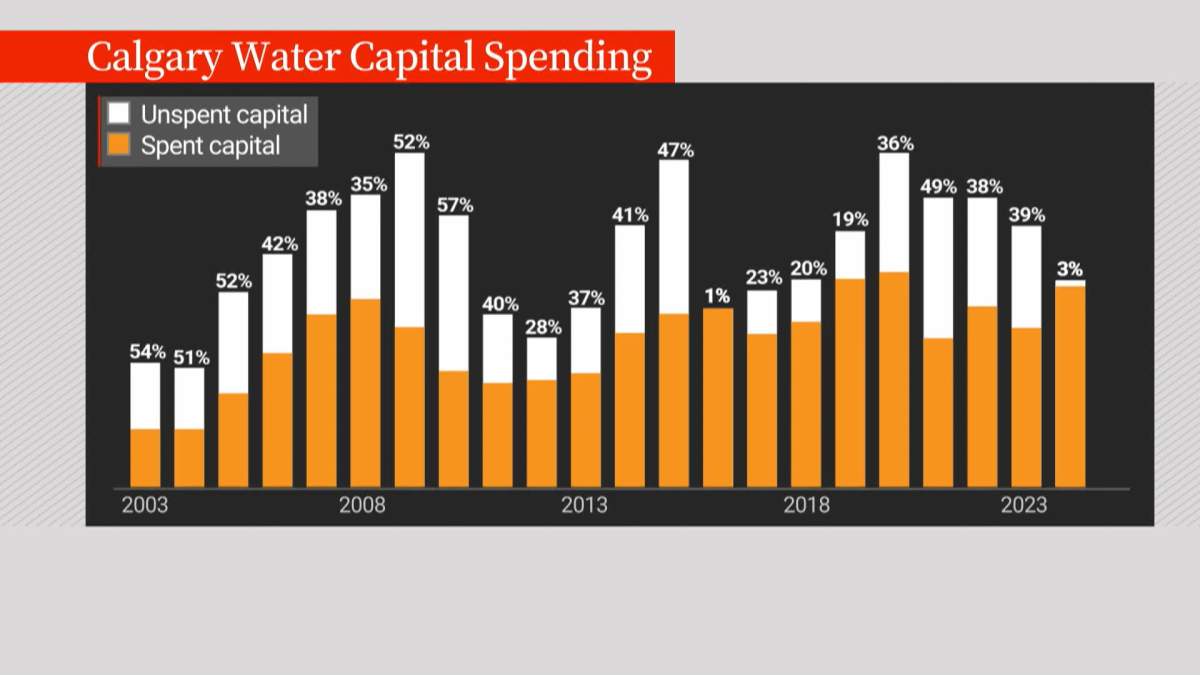
Michael Thompson, the city’s infrastructure services general manager, said the city has historically been spending roughly 60 per cent of its capital budget every year, but that number has improved to 90 per cent in recent years.
“We re-focused our efforts to make sure we were really delivering the investments that council had made,” he said. “There have been a number of issues across the city that kept our capital delivery lower.”
Ward 6 Coun. John Pantazolpoulos said he found the report “quite sobering,” including a lack of a mechanism for concerns to be escalated to decision-makers at city hall.
“Imagine a situation when you have a couple of directors talking about capital spending, and not one person advocating, whether it’s from a risk mitigation perspective or just capital costs,” he said. “It was clearly not one single decision that was made during that last 21 years, it was a combination.”
Making changes to the governance structure is amongst the several recommendations included in the report, like the creation of a dedicated water utility department with a single executive, as well as an independent expert water utility oversight board.
Pantazopoulos said he believes an independent board would help with long-term planning based on expert input and data.
“Now we have a clear path, we’re going to have experts coming in based on the capital needs of water for the next 20, 30, 40 years, well beyond my council term,” he said.
“You’re going to take politics out of it and you’re going to come down to the facts.”



Comments
Want to discuss? Please read our Commenting Policy first.