


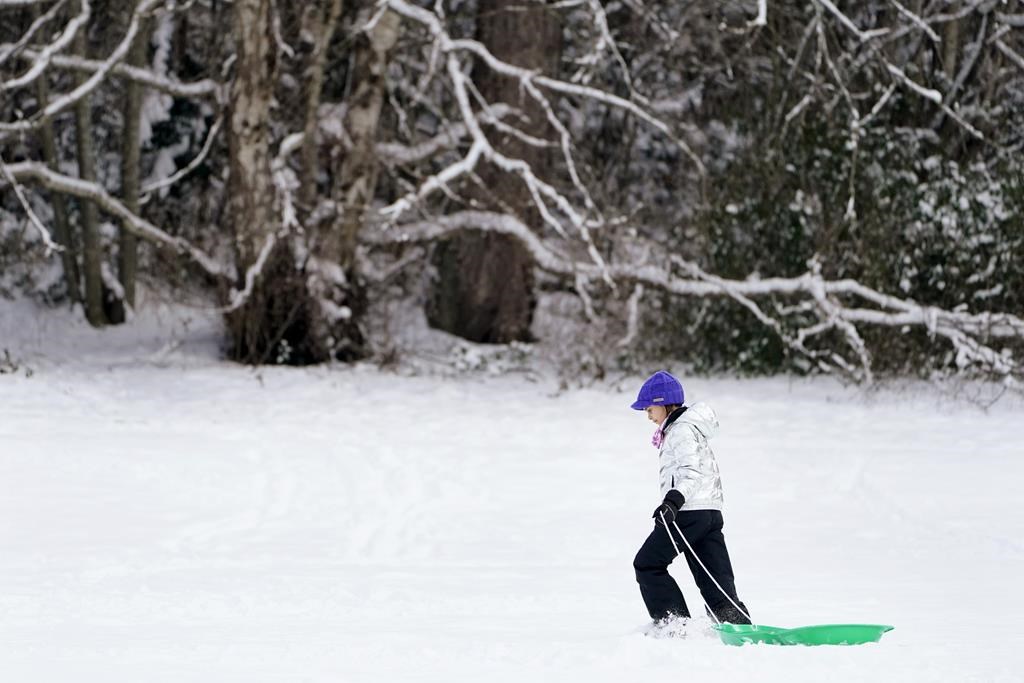
Quebec school insurers have published new recommendations on how snowbanks should be constructed on school grounds.

In a memo distributed to school principals provincewide, the Quebec Reciprocal School Insurance Union (URASQ) said snowbanks intended for sledding should measure between 1.8 and three metres in height, feature a gentle incline of roughly 25 per cent, and include clearly marked areas for climbing and waiting.
URASQ, which provides liability coverage for school boards, also recommends keeping snowbanks away from fences, carrying out daily safety checks, and implementing supervision plans and schedules to prevent overcrowding.

According to the insurer, helmets are not required when snowbanks comply with the suggested standards, which it says are appropriate for beginner-level sledding.


However, if the criteria are not respected, URASQ advises that children wear protective helmets.

Get breaking National news
In a statement sent to Global, the URASQ said its full list of recommendations are as follows:
- Hill height between 1.8 and 3 metres (corresponding to a beginner level)
- Slope of approximately 25 per cent
- Clearly defined run and waiting areas
- Daily inspection and log (safety, snow conditions, imperfections, presence of water and ice, etc.)
- Supervision plan
- Hill usage schedule (rotation by age and skill level)
- Communication plan for parents
“These are risk-mitigation measures. URASQ’s recommendations do not impose a new burden on school staff,” the statement said.


Comments
Want to discuss? Please read our Commenting Policy first.