

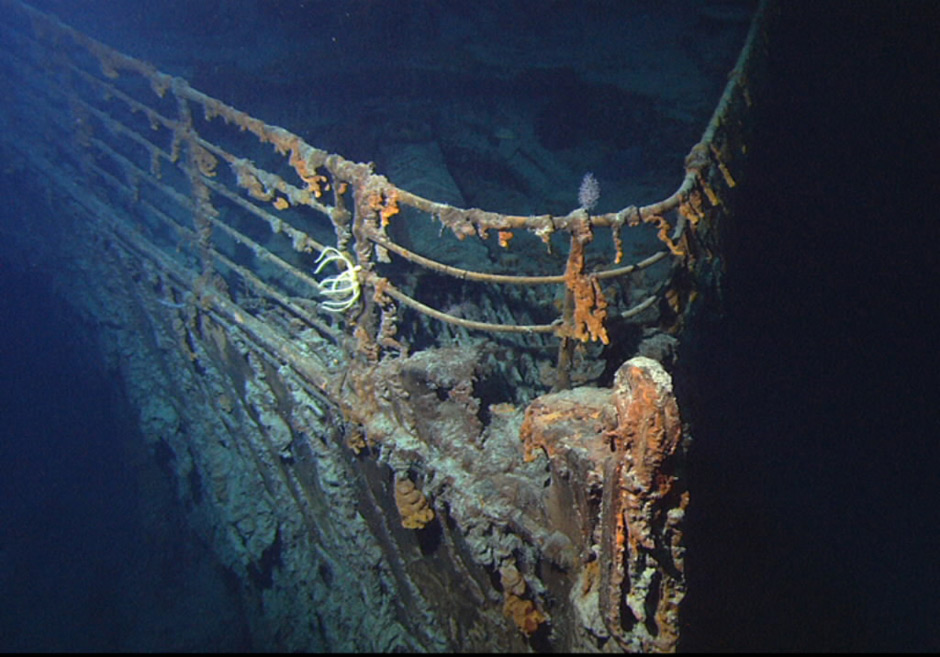
Not long after the Titanic sank in 1912, people started talking about finding the wreck on the ocean floor.
No one had any success until 1985. That year, Jean-Louis Michel and Dr. Robert Ballard searched for the wreck from a French ship equipped with side-scan sonar.
When the ship was recalled, Ballard and few of his team members transferred to an American research vessel called Knorr. Using an unmanned submersible, Ballard’s team found what they were looking for on Sept. 1, 1985.
Michel spotted the wreck just after Ballard had stepped out of the control room. Summoned by the cook, Ballard ran into the control centre. He saw the Titanic’s distinct boiler.
"We were very excited," Ballard later told reporters. ”Then it hit us. Someone looked at the clock and said, ‘You know, it’s 2 o’clock and the Titanic sank at 2:40.’ With that we quieted and went out on the fantail and had a private service.”
The wreck of the Titanic was located 4 km below the surface of the ocean, more than 600 km southeast of Mistaken Point, Nfld. That position is 21 km from the place where the ship was previously thought to have sunk.
Video cameras on the submersible captured images of the Titanic. The public was fascinated with the pictures, which appeared in National Geographic in December 1985.
Ballard returned to the site a year later, to conduct the first manned dives to the wreck. He brought a deep-diving submersible that could hold a small crew and a small remotely operated vehicle that could fit through tiny openings in the wreckage of the ship.
His team found the stern and bow sections of the ship laying 600m apart on the ocean floor, facing in opposite directions. This indicated the Titanic had split in two, discrediting the long-held notion that it had gone down in one piece.
The bow was in much better condition than the stern, which had been torn apart during its descent. The ship was surrounded by a large debris field that included pieces of the ship, cutlery, furniture and even personal items.
Ballard’s team members didn’t collect any of the artifacts, feeling it would have been tantamount to grave robbing.
Salvaging rights
In 1994, RMS Titanic Inc., a private salvage company, was awarded ownership and salvaging rights of the wreck. Since then, the company has conducted seven expeditions and salvaged about 6,000 historic objects. Many of these items are part of travelling museum exhibitions.
Much to the dismay of scientists, salvage companies and others have contributed to the deterioration of the Titanic’s remains.
Russian submarines have taken people to wreck, and reportedly collided with the hull. Cruise ships have circled the site, and one couple arranged to get married on the bow of the Titanic.
Scientists say the hull and structure of the ship could collapse within the next 50 years.
“Titanic is showing its age,” marine scientist David Gallo told the Australian Broadcasting Corporation. “It’s actually being eaten bit by bit by bacteria, so the hull itself is eroding away.”
In August 2010, scientists launched an expedition to assess the deterioration and move closer to establishing a long-term maintenance plan. Using sonar and advanced HD 3D camera technology, scientists also collected data, to create a detailed three-dimensional map for the public.



Comments
Want to discuss? Please read our Commenting Policy first.