



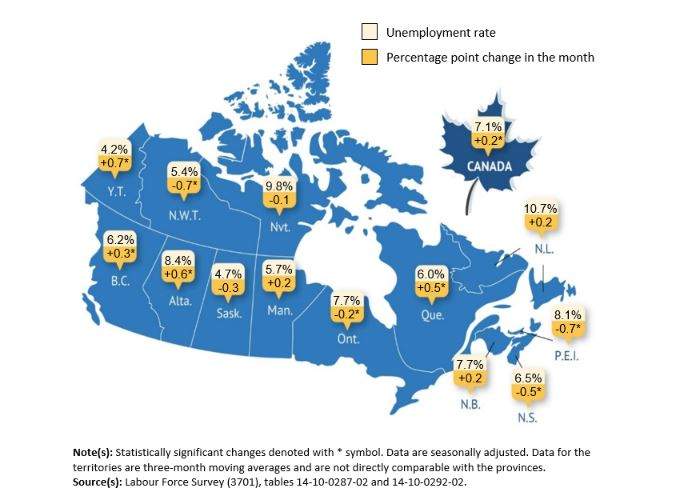
The unemployment rate in Alberta increased to 8.4 per cent in August — that’s up more than half of a percentage point from July’s rate of 7.8 per cent, according to the latest numbers from Statistics Canada.

That’s the second-highest unemployment rate among all the provinces.
Only Newfoundland and Labrador had a higher rate last month at 10.7 per cent.
Saskatchewan had the lowest jobless rate in the country at 4.7 per cent.
Nationally, the unemployment rate increased to 7.1 per cent — its highest level since May 2016, excluding the pandemic.
StatCan said most of the jobs lost across the country in August were part-time.
“We’re seeing the full brunt of the trade war now on the national market,” said Mark Parsons, chief economist with ATB Financial.
“What makes Alberta a bit unique is that we are getting an influx of migrants at a rate that other provinces aren’t, so you have a lot of people entering the labour market, looking for work right now in Alberta and that’s putting upward pressure on the unemployment rate and we are seeing it particularly with youth because migrants tend to be young,” added Parsons.
In Calgary, one of four cities in Alberta included in the latest numbers, the unemployment rate remained steady at 7.7 per cent, as the number of people in the labour force declined by about 5,300 people.

Get daily National news
In Edmonton, the jobless rate increased from 7.9 per cent in July to 8.5 per cent in August, as the number of jobs available failed to keep pace with an increase in the labour force that added 10,600 people in August.

The city of Red Deer saw the biggest jump, with the rate spiking from 5.4 per cent in July to 6.7 per cent in August.
In Lethbridge, the unemployment rate climbed a full percentage point from 5.7 in July to 6.7 per cent last month.
“I think what you’re seeing is really cautious businesses right now – they don’t’ want to add a lot to payrolls right now – it’s a very uncertain trade environment, business investment is weak, we’ve seen a reduction in oil prices. So all that’s translating for a pretty weak environment for job creation,” said Parsons.
However, he said there are a couple of factors that could eventually help turn the economy around.
“The good news is that we do eventually expect a trade deal between Canada and the U.S. and that will lead to more certainty and rehiring,” said Parsons.
“And also we are hopeful that the federal government is going to start fast tracking major projects – we desperately need business investment in Canada to improve – and that’s going to be the turning point that gets the Canadian economy going again.”




Comments
Want to discuss? Please read our Commenting Policy first.