


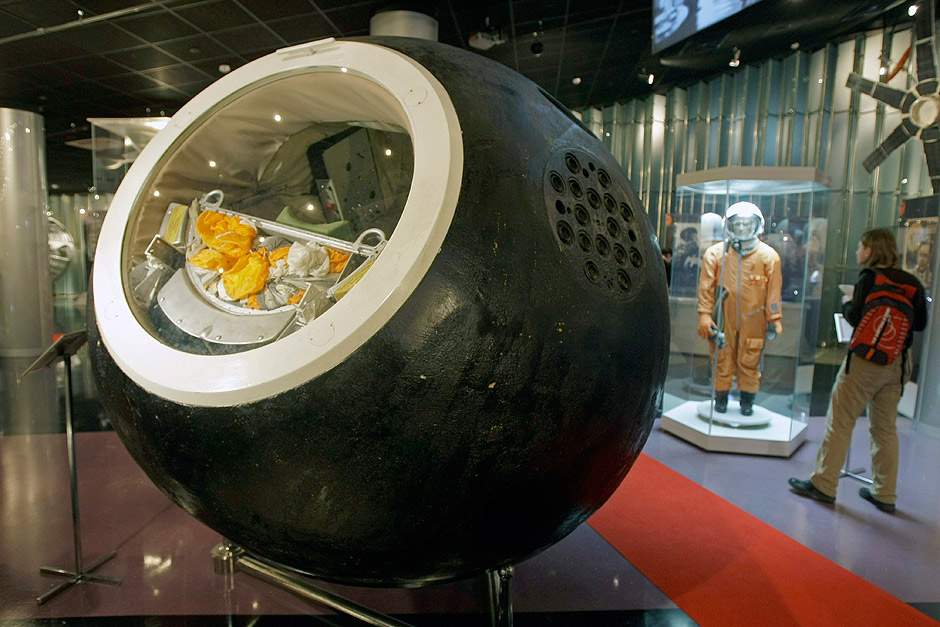
Tuesday marks the 50th anniversary of man’s first journey into space, by Russian Yuri Gagarin, an event that acted as catalyst for decades of competition and achievements between nations.
Gagarin’s 108-minute journey in space on April 12, 1961 shocked the United States, prompting it to declare the goal of putting a man on the moon before the end of the decade.
What followed was a race to space between the Russian and American space programs.
As celebrations worldwide mark the 50th anniversary of the first human in orbit, we take a closer look at other memorable moments in space.
October 3, 1942:
Nazi Germany successfully launches the V2 rocket, becoming the first rocket to reach the boundary of space, 100km from the Earth’s surface.
June 14, 1949:
The first monkey goes to space. Albert II, a Rhesus monkey, traveled to space in an adapted American V2 rocket, which flew 133km from the surface of the Earth.
October 4, 1957:
The Soviet Union launches the Sputnik I satellite in to space. It becomes the first satellite to orbit the Earth.
November 3, 1957:
Sputnik II, the world’s second man-made satellite, is launched into space by the USSR where it remains in orbit until April 13, 1958. Sputnik II was the first vehicle to carry an animal into orbit. “Laika”, a small stray dog picked up from the street, died during the mission.
September 15, 1958:
The Soviet spacecraft Zond 5 was launched and later became the first spacecraft to orbit the Moon and return to Earth.
September 13, 1959:
Russia’s space probe Luna II becomes the first man-made object to hit the moon when it crash lands.
August 19, 1960:
The first plants and animals return alive from Earth’s orbit in the USSR’s Sputnik 5. Two dogs, Strelka and Belka, spent a day in space before returning to Earth. Also on the mission was a rabbit, 42 mice, two rats, flies and a number of plants and fungi. All passengers returned from space alive.
April 12, 1961:
Yuri Gagarin becomes the first human in space. He orbited the Earth during his 108-minute mission in the spacecraft Vostok 1.
May 5, 1961:
Astronaut Alan Shepard becomes the second person, and first American, in space. Shepard piloted the spacecraft Freedom 7 on the mission named Mercury-Redstone 3, a suborbital flight.
February 20, 1962:
While aboard the Friendship 7 spacecraft, Astronaut John Glenn becomes the first American to orbit the Earth.
June 16, 1962:
Russia’s Valentina Tereshkova becomes the first woman in space. She was chosen out of more than 400 applicants to pilot the Soviet’s Vostok 6. Tereshkova orbited the Earth 48 times in her three days in space.
March 18, 1965:
While tethered to his spacecraft, Russian cosmonaut Alexey Leonov became the first person to walk in space, after leaving his Voskhod 2 spacecraft.
February 3, 1966:
In 1966, the Soviet spacecraft Luna 9 became the first unmanned spacecraft to land safely on the Moon.
July 20, 1969:
U.S. astronauts Neil Armstrong and "Buzz" Aldrin become the first men on the moon. The Apollo 11 spaceflight fulfilled President Kennedy’s goal of sending man to the moon before the Soviet Union, by the end of the 1960s. After Apollo 11, five other Apollo missions landed on the Moon between 1969 and 1972.
September 12, 1970:
The Soviet Union spacecraft Luna 16 is launched. It became the first automated spacecraft to return soil samples of the moon.
November 10, 1970:
The Russian Lunokhod 1 rover lands on the Moon, becoming the first roving remote-controlled robot to land on any celestial body.
December 15, 1970:
The Soviet Union launches Venera 7, which became the first probe to land on Venus.
April 19, 1971:
The Soviet Union launches Salyut 1, the first space station of any kind.
July 30, 1971:
A moon rover was driven on the moon for the first time.
November 13, 1971:
NASA’s Mariner 9 probe became the first craft to orbit another planet – Mars.
December 11, 1972:
U.S. astronauts Eugene Cernan and Harrison "Jack" Schmitt became the last men to walk on the moon.
May 14, 1973:
The U.S. launched its first space station, Skylab. Skylab was the second space station visited by a human crew, after the Soviet Salyut 1.
September 1976:
The U.S. probe Viking 2 discovered water frost on Mars’ surface. Viking 2 operated on the planet’s surface for 1,281 Mars days and shut off when its batteries died on 11 April 11, 1980.
August and September 1977:
Voyagers 1 and 2 were launched. Voyagers 1 and 2 are a pair of probes that were part of a series of unmanned space missions funded by NASA. Currently, Voyager 1 is the farthest human-made object from Earth.
March and August 1979:
Voyagers 1 and 2 begin transmitting images of Jupiter and her moons. In November 1980, Voyager 1 reaches Saturn and begins transmitting images. In August 1981, Voyager 2 does the same.
April 12, 1981:
Space Shuttle Columbia becomes the first shuttle in NASA’s orbital fleet to be launched. Aboard Columbia is the Canadarm – a mechanical arm used on a number of shuttles. The Canadarm was used in over 50 missions since 1981.
April 4, 1983:
Space Shuttle Challenger takes her maiden flight. Challenger would go on to complete nine missions, before disaster strikes on her tenth mission in 1986.
February 3, 1984:
U.S. Astronaut Bruce McCandless II becomes the first man to walk in space untethered.
August 30, 1984:
The Space Shuttle Discovery takes her maiden flight and remains operational until her final landing on March 9, 2011. Discovery was the first operational NASA Space Shuttle to survive its final mission launch, and first operational Shuttle that was retired.
October 1984:
Marc Garneau becomes the first Canadian in space. He was one of seven astronauts chosen for the sixth Space Shuttle Challenger mission, out of over 4,000 applicants.
January 28, 1986:
Space Shuttle Challenger takes off for its 10th mission, but is destroyed 73 seconds after its launch, killing all seven crew members. The Challenger disaster resulted in a two-and-a-half year grounding of the shuttle fleet.
1990:
The Space Shuttle Discovery carries the Hubble Space Telescope into orbit. Although Hubble wasn’t the first telescope in space, the NASA-built telescope is the largest and most versatile.
1995:
Chris Hadfield participates in a mission on the shuttle Atlantis, becoming the only Canadian to visit Mir, the Russian space station.
February 2, 1995:
U.S. astronaut Eileen Collins becomes the first female Shuttle pilot. She piloted Space Shuttle Discovery on the STS-63 mission, which carried out a rendezvous between Discovery and the Russian space station, Mir. In 1999, Collins becomes the first female Shuttle commander.
1995:
A remote sensing satellite developed by Canada and the U.S. is launched. Using advanced microwave technology, the satellite can penetrate fog, darkness and clouds. The satellite, called RADARSAT, provides high-resolution images to be used in monitoring the environment.
1998:
Canada, the U.S. Japan, Russia and 11 European nations collaborate to launch the first part of the International Space Station in November.
1999:
Julie Payette flies on Space Shuttle Discovery, becoming the first Canadian to participate in an international space station mission and the first to board the station.
2001:
The Mobile Servicing System – known by its main component, Canadarm2 – is launched. A robotic system on the International Space Station, it is involved in station assembly and maintenance. This development comes 20 years after the launch of the first Canadarm.
April 28, 2001:
American Dennis Tito becomes the first tourist in space after paying the Russian space program $20,000,000 to spend nearly eight days in orbit as a crew member of ISS EP-1.
February 1, 2003:
The Space Shuttle Columbia disintegrates on re-entry into the Earth’s atmosphere after a 16 day mission.
August 25, 2003:
NASA launches the largest-diameter infrared telescope ever in space, named the Spitzer Space Telescope.
September 21, 2003:
NASA ends its 14-year Galileo mission with the spacecraft crashing by design into Jupiter.
July 26, 2006:
Space Shuttle Discovery is launched with seven crew members aboard, marking America’s first manned space shot since the Columbia disaster in 2003.
August 4, 2007:
NASA launches its Phoenix Mars Lander. In May 2008 it would land safely on Mars and start sending images of the planet’s surface back to Earth.
March 6, 2009:
The NASA spacecraft Kepler is launched, with the mission to search for planets outside our solar system.
2010:
NASA announces that Canadian astronaut Chris Hadfield will command the International Space Station (ISS) during Expedition 35, which is the 35th long duration mission to the (ISS).
October 10, 2010:
Virgin Galactic, a private company owned by business mogul Richard Branson, announces the successful first manned glide flight of the VSS Enterprise. Branson hopes this will be the first of many flights in the new industry of space tourism.
December 8, 2010:
For the first time ever, a non-government organization launches a spacecraft into orbit, and returns it safely. The American private company, SpaceX, launched the unmanned Dragon capsule into orbit in order to test its maneuverability and re-entry capabilities.


-
![]() New Brunswick recognizes several women for their work towards gender equality
New Brunswick recognizes several women for their work towards gender equality -
![]() Supreme Court of Canada rules refugees should have access to subsidized daycare in Quebec
Supreme Court of Canada rules refugees should have access to subsidized daycare in Quebec -
![]() Pointe-Claire unveils monument to young boy who tragically lost his life at Terra-Cotta Nature Park
Pointe-Claire unveils monument to young boy who tragically lost his life at Terra-Cotta Nature Park -
![]() Nova Scotians gathered in solidarity with Black and Indigenous voices after a week of budget protests
Nova Scotians gathered in solidarity with Black and Indigenous voices after a week of budget protests


Comments
Want to discuss? Please read our Commenting Policy first.