


Japan has 48 hours to bring its rapidly escalating nuclear crisis under control before it faces a catastrophe "worse than Chernobyl", it was claimed on Wednesday night.
Nuclear safety officials in France said they were "pessimistic" about whether engineers could prevent a meltdown at the Fukushima power plant after a pool containing spent fuel rods overheated and boiled dry.
Radiation levels were "extremely high" in the stricken building, which was breached by an earlier explosion, meaning that radiation could now escape into the atmosphere. Tokyo Electric, the owners of the plant, said five workers had been killed at the site, two were missing and 21 had been injured.
As Japan resorted to increasingly desperate measures – including dumping water on the site from helicopters – there were accusations that the situation was now "out of control".
The Foreign Office responded to the latest developments by advising all British citizens to leave Tokyo – which is 150 miles south of the plant – and the whole of northern Japan.
The EU has even urged member states to check Japanese food imports for radioactivity. Yuhei Sato, the governor of the Fukushima region, criticized the government, saying that the "anxiety and anger" of residents had "reached a boiling point".
Emperor Akihito made a rare address to the nation, urging the Japanese to pull together, but hinted at his own fears for the nuclear crisis saying: "I hope things will not get worse."
In London, the FTSE-100 share index slumped as news of the latest emergency emerged, closing 1.7 per cent down.
The official death toll from last Friday’s earthquake and tsunami now stands at 4,314, with another 8,606 listed as missing.
Thousands of people still waiting for food aid in the remotest areas of the disaster zone endured fresh misery yesterday as heavy snow began to fall across northern Japan. But all eyes were on the Fukushima Daiichi nuclear plant as Japanese authorities admitted concerns over rising temperatures in three pools containing spent fuel rods.
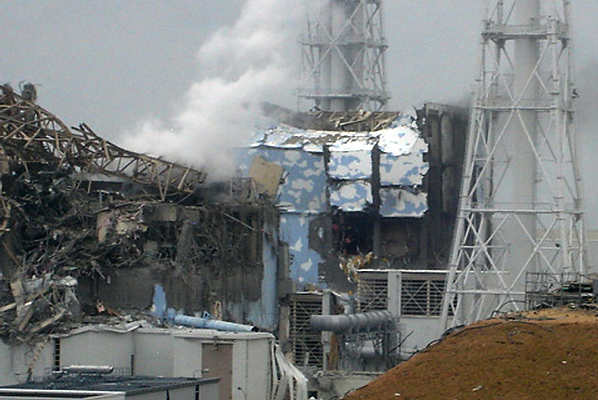
A failure of the cooling system that has crippled the entire plant led water in the No 4 pool to begin to boil. If the water evaporates and exposes the rods, a meltdown could occur, and last night the U.S. Nuclear Regulatory Commission [USNRC] said there was no water left in the pool, resulting in "extremely high" radiation levels.
An earlier fire and explosion in the No 4 reactor building is thought to have breached the protective walls around the pool. A statement from the USNRC said: "We believe that secondary containment has been destroyed and there is no water in the spent fuel pool and we believe that radiation levels are extremely high which could possibly impact the ability to take corrective measures."
Attempts to cool the site by dumping seawater from helicopters had to be aborted at one stage because of dangerous radiation levels in the air above the plant. A police water cannon was brought in to help blast water into the overheating reactors and pools, but there were warnings that it may be too late to prevent a disaster.
Thierry Charles, a safety official at France’s Institute for Radiological Protection and Nuclear Safety, [IRSN] said: "The next 48 hours will be decisive. I am pessimistic, because since Sunday I have seen that almost none of the solutions has worked." He described the situation as "a major risk", but added: "All is not lost, and I hope that the Japanese can find a way."
Asked about the maximum possible amount of radioactive release, he said "it would be in the same range as Chernobyl".
Francois Baroin, a French government spokesman, went further, saying: "In the worst of cases, it could have an impact worse than Chernobyl." He added: "Let’s not beat about the bush. They have visibly lost the essential of control. That is our analysis, in any case, it’s not what they are saying."
Malcolm Grimston, a British nuclear expert at the Chatham House think tank, played down suggestions of an impending disaster, saying Fukushima was not like Chernobyl.
"We’re nearly five days after the fission process was stopped, the levels of radioactive iodine will only be about two-thirds of where they were at the start, some of the other, very short-lived, very radioactive material will be gone altogether by now," he said.
Earlier, Nathalie Kosciusko-Morizet, France’s ecology minister, had said that "the worst scenario is possible and even probable". At one point, radiation levels at the plant rose to such dangerous levels that all workers were evacuated from the site. A 180-strong team was later allowed back to continue attempts to cool the fuel rods, but the government raised the maximum allowable radiation exposure for workers from 100 millsieverts per year to 250 mSvs, which it said was "unavoidable due to the circumstances".
The fuel rod pools contain spent uranium rods which remain extremely radioactive after being used in the reactor, and have to be constantly cooled until safe for disposal. In a statement, the IRSN said: "Without water replenishment, the fuel-rod assemblies will start to be exposed in a few days. If the pool runs dry, this would eventually lead to the meltdown of the fuel Ö The corresponding releases of radioactivity would be far higher than those that have occurred up till now."
The Pentagon ordered its armed forces, which had been sent to Japan to help with the relief effort, to retreat to 50 miles away from the plant, more than four times the 12-mile limit imposed by the Japanese government.
Yukiya Amano, the IAEA’s director general, said the situation was "very serious" and announced he would fly to Japan on Thursday for a first-hand briefing on the crisis.


Comments
Want to discuss? Please read our Commenting Policy first.