

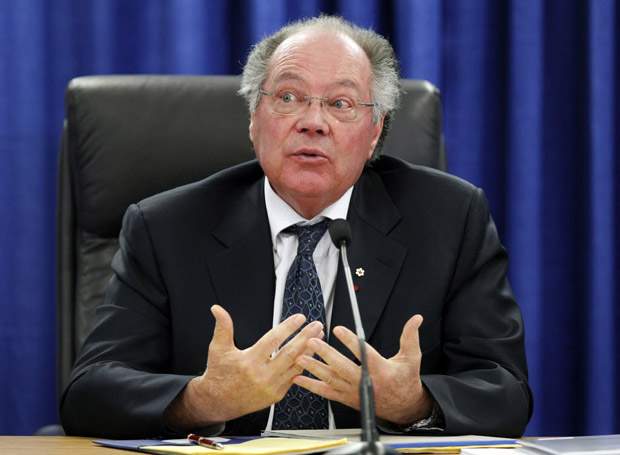
QUEBEC – The Bastarache commission dragged on for weeks and heard from dozens of witnesses and experts.
Now, it’s time for former Supreme Court justice Michel Bastarache to hand down his report on Quebec’s system for judicial nominations following allegations by former provincial justice minister Marc Bellemare, who said the system was being rigged by Liberal Party fundraisers. The rigging is alleged to have happened back in 2003, when Bellemare was a minister, but the story came to light only last spring and was retold and analyzed last fall when the commission held hearings in Quebec City.
Bastarache, who handed over 30 copies of his report Tuesday to the Quebec government, is to make it public Wednesday at 2:30 p.m.
Playing it safe because of the defamation lawsuits Bellemare and Premier Jean Charest have launched against each other, Bastarache has chosen to not take questions from the media on the 300-page document and will instead simply read a summary.
But Charest is expected to react immediately, even moving up the weekly meeting of the cabinet to 9 a.m. to clear his afternoon schedule.
There were rumours Tuesday night that Bellemare might react only on Thursday.
There is a lot to remember about the commission, which involved seven weeks of hearings and 40 witnesses, so here are the top 10 things you need to know about the Bastarache probe, including some data on the key players, ahead of the report’s release:
1. Bellemare has a beef
It really all starts with Marc Bellemare, Premier Jean Charest’s star recruit for his first cabinet after taking office in April 2003. A Quebec City lawyer who made a name for himself defending victims of automobile accidents before the province’s automobile insurance board, Bellemare arrived in politics with one major goal: to reform the province’s no-fault system to allow Quebecers to sue drivers involved in accidents. He hit a brick wall. To this day, he claims Charest indicated to him the reforms would happen when he was being recruited into politics. Bellemare’s bitterness about the issue was abundantly clear in side remarks he made on the day he testified before the commission.
2. Bellemare peddles his story to the media
In April 2010, almost seven years after leaving office in 2004 in a huff and following two failed attempts to become mayor of Quebec City, Bellemare decides, in the wake of rumours and media reports about alleged corruption in the construction industry, to call in the media with a story that would rock Quebec’s political class. Slowly and at first refusing to give names, he makes allegations of influence peddling by Liberal Party bagmen in the naming of judges. He tells the media he witnessed cash changing hands in a Quebec City restaurant, the now famous Michelangelo, between Liberal workers and owners of construction companies. He says he told the premier, but nothing happened.
3. Charest calls inquiry
By April, and with Bellemare still making the allegations, Charest announces there will be an inquiry, not into the construction industry as some politicians and many in the public want, but into Bellemare’s very specific allegations about judges. He says he had to act because the integrity of the legal system was being questioned. Quebec reaches out of the province and brings in Acadian-born Michel Bastarache to lead a commission, which was granted a budget of $6 million. By Aug. 24, the commission – which Bellemare initially tried to quash but later agreed to participate in – gets rolling in a second floor former insurance company building in Quebec City. On opening day, there are clowns on the sidewalk making fun of the exercise.
4. The names come out
Under the glare of television lights – the hearings were broadcast live across Quebec – Bellermare, the lawyer, arrives with two other lawyers. He starts by handing over a list of three judges he said he named or promoted under pressure from Liberal bagmen. The three are: Marc Bisson, the son of a West Quebec Liberal fundraiser, named to the bench in November 2003; Michel Simard, promoted assistant chief judge in November 2003; and Line Gosselin-Despres, a relative of former Liberal labour minister Michel Despres, named to the bench in November 2004. He names two behind-the-scenes Liberal fundraisers, too, both from the Quebec City area – Franco Fava and Charles Rondeau – as the men who put pressure on him. Fava, who annually raises about $300,000 a year for the party, co-owns a construction company that has benefited from numerous government contracts at James Bay, as well as the Laval metro extension.
5. Bellemare drops his first bomb
Bellemare’s testimony on Aug. 24 is explosive and damning for the Quebec Liberal Party and for Charest personally. Bellemare outlines in detail a face-to-face meeting between him and Charest on Sept. 2, 2003, in the premier’s Quebec City office during which he complained about Fava and Rondeau pressuring him, sometimes over friendly dinners in Quebec City restaurants, to name the "right" judges. He describes the meeting with the premier right down to how they were seated and the bottle of Perrier on the table before them. He said he personally found it morally wrong but was stunned to discover the premier had no problems with the situation. In his most famous quote at the commission, Bellemare quoted Charest as telling him: "Franco told you to name Bisson and Simard. Name them. Franco is a personal friend, he’s an influential fundraiser. We need guys like him." Under questioning, Bellemare describes the pressures on him as "colossal and undue."
6. Holes in the story
Bellemare’s story, a headline maker, is quickly attacked on all fronts, including by lawyers representing the government and the Quebec Liberal Party. The only proof Bellemare is able to produce is a cardboard back of a notepad on which he scrawled three lines of text the day he quit as minister and while he was sitting at home watching a hockey game. An ink expert is brought in, but he says his testing yielded nothing by way of a precise date. The commission is ridiculed on Quebec City radio stations as a waste of time and money. After maintaining for weeks he no longer has an agenda book that would confirm his meeting with Charest, at the very end of hearings Bellemare’s wife stumbles on an electronic disc in a box in the basement containing her husband’s professional agenda for May 5, 2003, to April 2004. It appears to include a meeting. Charest’s own agenda is brought in, showing no meeting. Later, members of Bellemare’s old Vanier riding association tell reporters Bellemare was with them that night and not with the premier. The mystery goes unsolved.
7. Fava and Rondeau deny everything
Sept. 22 was official denial day at the commission. Up first, Rondeau, a gruff-talking Quebec City accountant who portrays himself as a simple loyal soldier – faithful, as he puts it, to the Liberal family. But under questioning, Rondeau delivers damaging testimony to the Liberals when he reveals he lobbied Bellemare in the summer of 2003 to help an old school chum, Michel Simard, get a plum job on the bench. Simard did not get the job he wanted but was nevertheless promoted to another. It is also revealed that Rondeau had been to the premier’s office 20 times in 12 months to meet the woman responsible for nominations, Chantal Landry. Next up is Fava, who also visited the premier’s office. "My first reaction was that someone is hallucinating," Fava says when asked about Bellemare’s testimony. He adds he never dined with Bellemare to put "colossal and undue" pressure on him to name judges. Michelangelo’s restaurant gets another plug.
8. Charest comes out swinging
Finished with minor witnesses and floundering in public opinion – Bellemare would later call it a "pitiful circus" – the commission gets around to its main witness, Charest, on Sept. 23. True to form, when he finds himself on the ropes, Charest’s performance is impeccable, ripping apart his former minister’s story piece by piece and managing to plant the idea that Bellemare was an unstable character. He says that despite his efforts, Bellemare failed to grasp the ABCs of how government works and was such a lone wolf that nobody wanted to work with him. "I never said the words (Bellemare) attributed to me," Charest says at one point. "A meeting where he says he informed me of pressures from Franco Fava? I would remember. I would not have forgotten this."
9. A political filter
Bastarache’s report is expected to say Bellemare was unable to prove most of his case and that contrary to what he claims was probably not subject to overwhelming pressures. But the commission revealed some startling facts about the way judges are named in Quebec. For example, unlike the previous Parti Quebecois regime, the premier had access to the list of candidates, and ministers other than the minister of justice were able to intervene. Chantal Landry, the political aide in the premier’s office responsible for nominations, revealed she identified known Liberal candidates with a Post-it note on their file. The PQ seems to have kept a tighter lid on the process. Bastarache, who appeared keener to address the theory of nominations with university professors than watch Charest and Bellemare squabble, is expected to recommend the system be tightened up.
10. The sideshows are not over
While today’s report is not expected to blame either Charest or Bellemare personally, their dispute seems far from over. Charest is still suing Bellemare in a $700,000 defamation suit. And in December, the province’s chief electoral officer closed its own case on Bellemare’s allegations with one blunt statement: "In the absence of sufficiently convincing facts." And the battle for public opinion is far from over. Throughout the commission, polls consistently showed the public overwhelmingly believed Bellemare’s version of events and not Charest who, with all his other problems, will still have to fight for his political life.



Comments
Want to discuss? Please read our Commenting Policy first.