

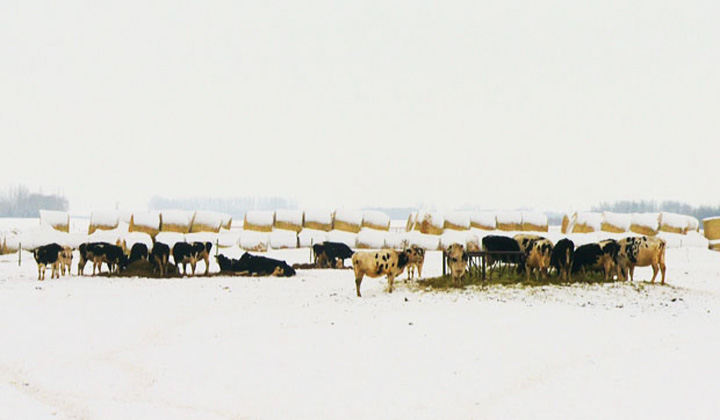
MOOSE JAW, Sask. – People might be heading to the gym to work off holiday treats, but cattle are still chowing down as a deep freeze settles over much of the Prairies.

Agriculture experts and ranchers know that when the temperature dips below -20 C, cattle need even more to eat so they can create extra energy to stay warm.
“Most years the average hay out there is good enough to maintain a cow in wintertime, as long as she doesn’t have extra demands on her body, so she’s not heavy into pregnancy and she’s not lactating, she’s not providing milk for a calf,” Murray Feist, a ruminant nutrition specialist with Saskatchewan Agriculture, said Monday.
“Once we get into these really cold, cold days, we have to add a different form of energy into the diet. And what we’ve done is we’ve used grain to do that for us and it’s got a considerable amount more energy per pound than what you would get from a feed like a hay.”
Feist says there are other factors to consider, such as shelter from the wind.

Get breaking National news
The general rule of thumb is to feed an extra pound of grain for every five degrees below -20 C.
Much of Saskatchewan and Manitoba were in a deep freeze Monday with temperatures near or below -30 C and wind chills colder than -40 C. At one point in Regina, it felt like -47 with the wind chill.
- Federal government raises concerns over OpenAI safety measures after B.C. tragedy
- Free room and board? 60% of Canadian parents to offer it during post-secondary
- Ipsos poll suggests Canada more united than in 2019, despite Alberta tensions
- Indigenous leaders outline priorities for spring sitting of Parliament


“When we get down to temperatures of the -30s, and you know -50 with the wind chill, those cattle feel the cold pretty quick, so you really have to be able to adjust and accommodate for those temperatures by feeding a certain amount of grain,” said Feist.
But getting cattle through the frigid weather is not as simple as just feeding more grain.
Ranchers also need to be careful to avoid “grain overload,” known as acute acidosis, said Feist.
“If they have to split it up into a morning and an afternoon (feeding), that can help them avoid getting into some digestive upsets by overfeeding too much grain. So yes, extra grain does help, but if you take it too far, you can cause a digestive upset,” he explained.
“So then you split the diet out so they don’t get one big belly ache.”
Comments
Want to discuss? Please read our Commenting Policy first.