

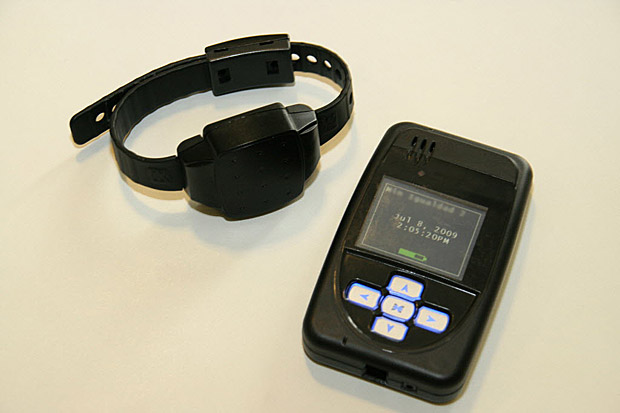
Without giving any details as to its reasoning, the Montreal police department has shelved a long-awaited project that would have seen GPS bracelets given to people suffering from Alzheimer’s disease or other conditions that put them at risk of going missing.
The pilot project was seen by many as a smart use of technology to shore up struggling caregivers and to improve security of Alzheimer’s sufferers, a large demographic group that is expected to explode as baby boomers age.
The police initiative was launched last year after two high-profile cases in which women with cognitive disease left their homes, became disoriented and whose bodies were discovered days later, frozen in snow.
"Now, it’s a no-go," Montreal police Sgt. Ian Lafrenière confirmed yesterday.
"We are not going further with this project with this company at the moment," Lafrenière said.
Since January, E-For Technologies, a Pointe Claire company, has been working on developing a geolocating system to meet the needs of the Montreal police force.
As recently as September, Montreal police officials were touting the GPS bracelet program as a way to save lives, time and considerable manpower when searching for people who go missing as a result of Alzheimer’s and other conditions.
But when pressed for details yesterday about the change, Lafrenière would only say that as the Montreal police department repositions itself under Marc Parent, it new chief, the idea is being re-evaluated.
Calls to E-For Technologies from The Gazette yesterday were not returned.
Reaction to the news was mixed from Montreal doctors, researchers and public health officials, including those working with Alzheimer’s patients.
Howard Bergman, the Dr. Joseph Kaufmann professor of Geriatric Medicine and head of the Division of Geriatric Medicine at McGill University, was the first to weigh in.
Bergman chaired a provincial task force that in 2009 produced a ministerial action plan on Alzheimer’s disease and related disorders.
Although he did not know the specifics of the Montreal police GPS program or the surveillance equipment being considered, he said he still supports the idea, generally.
Quebec needs to use all technological advancements available to bolster Alzheimer’s care and to reduce the impact of the disease and of related disorders, Bergman said.
Serge Gauthier said he supports the idea of GPS being made available to patients at high risk of wandering off or getting lost outside their home, especially given the Canadian winter.
In an email from France, Gauthier, director of the Alzheimer’s Disease Unit at the McGill Centre for Studies in Aging, said Montreal needs a pilot project, at the very least, to justify wider use.
Laura Guerschanik is an education coordinator with the Alzheimer Society of Montreal. She was shown the bracelet in September, when Montreal police were gaging support from public health stakeholders.
Statistics compiled by the Alzheimer Society indicate that a person with Alzheimer’s runs a 50-per-cent risk of death or injury if not found within the first 12 hours after disappearing.
But the Alzheimer Society has neither supported nor discouraged the idea of a broad-based GPS to monitor Alzheimer’s patients, favouring instead a case-by-case approach to keep wanderers safe, she said.
Privacy is a concern, as is the possibility that caregivers could be lulled into a false sense of security if their loved one is equipped with a GPS. Technology cannot replace human contact, Guerschanik added.
The lack of research on real-life applications of locating technology for Alzheimer’s patients prone to wandering makes it hard to judge the use of GPS as a tool for Alzheimer’s care, she went on.
A 2006 study by researchers at McMaster University’s School of Rehabilitating Science for the Ontario Ministry of Community and Social Services is one of the few to follow Alzheimer’s patients with GPS bracelets. The study suggested GPS offers some promise in finding wanderers faster, 50 per cent of the time within 60 minutes, but compliance was another issue.
Susan Vaitekunas, a Montreal geriatrician at the Jewish General Hospital’s Memory Clinic, agreed that ensuring an Alzheimer’s patient is wearing his or her bracelet is an issue. Many older patients with demential won’t even wear bracelets and necklaces that enable them to push a panic button if they fall or require emergency help.
"Our approach is generally a low-tech one," she said. "People who wander should not live alone, and need more supervision."


Comments