

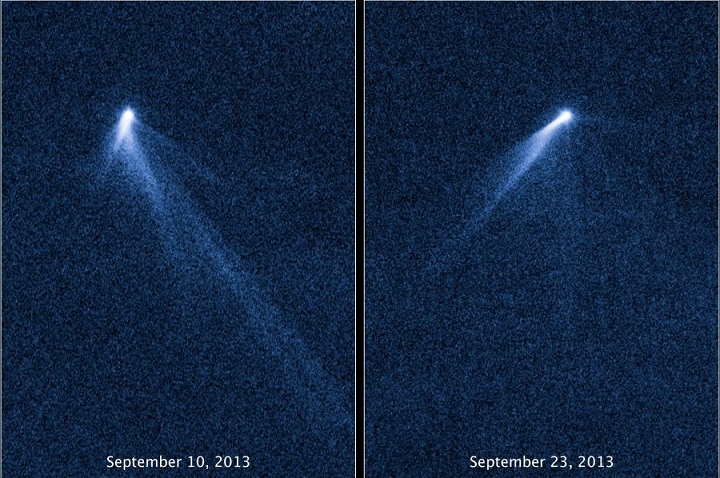
CAPE CANAVERAL, Fla. – The Hubble Space Telescope has discovered a six-tailed asteroid in the asteroid belt between the orbits of Mars and Jupiter. Scientists say they’ve never seen anything like it. Incredibly, the comet-like tails change shape as the asteroid sheds dust. The streams have occurred over several months.


Get breaking National news
A research team led by the University of California, Los Angeles, believes the asteroid, designated P/2013 P5, is rotating so much that its surface is flying apart. It’s believed to be a fragment of a larger asteroid damaged in a collision 200 million years ago.


Scientists using the Pan-STARRS telescope in Hawaii spotted the asteroid in August. Hubble picked out all the tails in September.
The discovery is described in this week’s issue of Astrophysical Journal Letters.


Comments
Want to discuss? Please read our Commenting Policy first.