

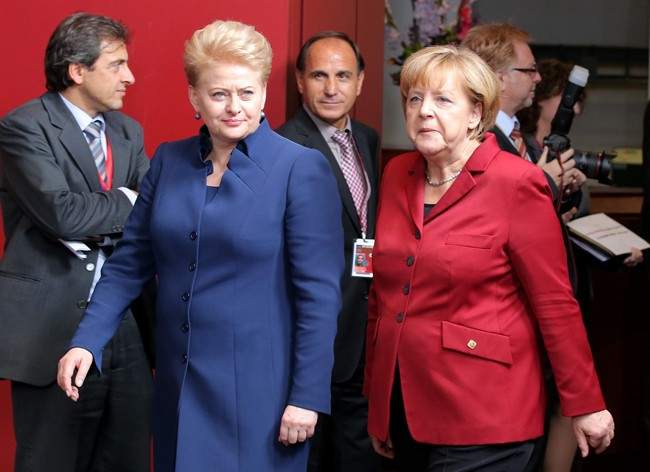
BRUSSELS, Belgium – German officials will travel to the U.S. “shortly” for talks about spying allegations, including whether Chancellor Angela Merkel’s cellphone was monitored by the National Security Agency, the government said Friday.

The heads of Germany’s foreign and domestic intelligence agencies will participate in the talks with the White House and NSA, government spokesman Georg Streiter said – though he later said the exact composition of the team had yet to be determined.
He did not give a specific date for the trip, saying it was being arranged on “relatively short notice.”
European Union leaders, meeting at a summit in Brussels, vowed to maintain a strong trans-Atlantic partnership despite their anger over allegations of widespread U.S. spying on allies. Still, France and Germany insist that new surveillance rules should be agreed upon with the U.S. this year.
“We are seeking a basis for co-operation between our (intelligence) services, which we all need and from which we have all received a great deal of information … that is transparent, that is clear and is in keeping with the character of being partners,” Merkel said.
French President Francois Hollande said “what is at stake is preserving our relations with the United States.” He insisted that “trust has to be restored and reinforced.”
Most EU leaders shared the view that good partnership trumped deep resentment over the alleged snooping by U.S. security services.

Get daily National news
“The main thing is that we look to the future. The trans-Atlantic partnership was and is important,” Lithuanian President Dalia Grybauskaite said. Her country holds the rotating presidency of the 28-nation EU.
Merkel complained to President Barack Obama on Wednesday after her government received information that her cellphone may have been monitored. Merkel and Hollande insisted that, beyond being fully briefed on what happened in the past, the European allies and Washington need to set up common rules for surveillance which does not impede the fundamental rights of its allies.
“The United States and Europe are partners, but this partnership must be built on trust and respect,” Merkel said early Friday. “That of course also includes the work of the respective intelligence services.”
The forthcoming visit to Washington by a German delegation is aimed primarily at clearing up what happened in the past. In Berlin, Streiter said details of negotiations on an agreement for the future between Germany, France and the U.S. were still being worked out.
“What exactly is going to be regulated, how and in what form it will be negotiated and by whom, I cannot tell you right now,” he told reporters. “But you will learn about it in the near future because we have put some pressure to do this speedily.”
- US strikes Iran over latest ship attack and Tehran responds by hitting Arab states
- Trump and Iran’s supreme leader trade threats as mediators try to save their crumbling deal
- Passenger’s head and shoulders sucked out of window on flight from Greece: reports
- Art museum covers gallery floor in peanut butter to honour late Dutch artist


White House spokesman Jay Carney said the Obama administration was discussing Germany’s concerns “through diplomatic channels at the highest level,” as it was with other U.S. allies worried about the alleged spying.
Unlike Germany, France and Belgium, Britain has not complained publicly about NSA actions, which could complicate European leaders’ attempt to present a united front in the unusually heated dispute with Washington.
Britain and the U.S. enjoy a strong, mutually beneficial intelligence sharing program, and Prime Minister David Cameron’s spokesman has refused to comment on the controversy.
The White House may soon face other irked heads of state and government. British newspaper The Guardian said it obtained a confidential memo suggesting the NSA was able to monitor 35 world leaders’ communications in 2006.
The memo said the NSA encouraged senior officials at the White House, Pentagon and other agencies to share their contacts so the spy agency could add foreign leaders’ phone numbers to its surveillance systems, the report said.
Obama’s adviser for homeland security and counterterrorism, Lisa Monaco, wrote in an editorial published on the USA Today website Thursday night that the U.S. government is not operating “unrestrained.”
The U.S. intelligence community has more restrictions and oversight than any other country, she wrote.
“We are not listening to every phone call or reading every email. Far from it.”
—
Robert Wielaard in Brussels, Frank Jordans in Berlin and Gregory Katz in London contributed to this report.


Comments
Want to discuss? Please read our Commenting Policy first.