


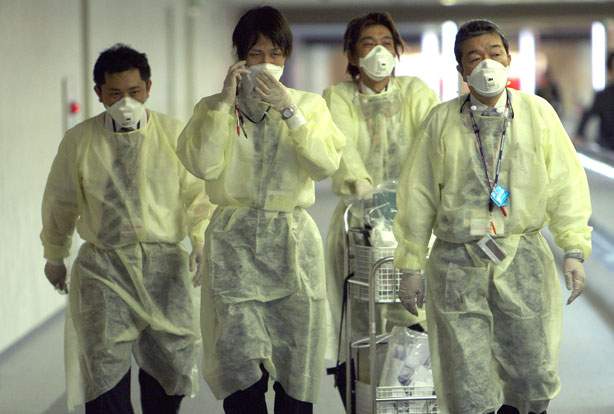
Eight more confirmed cases of swine flu were reported
in Canada on Thursday, bringing the national total to 27.
Four more cases were confirmed in Alberta – three men
and a woman from Calgary, all of whom recently returned from Mexico.
The four, all young adults, were recovering from what was described
as mild cases.
The other four new cases are in Windsor, N.S., bringing
the total there to eight. All of the cases are related to four sick
students at King’s-Edgehill School. The cases there are all mild and
health officials warned more people will likely contract the
illness.
Governments around the world are mobilizing their plans
for a widespread outbreak of swine flu, after the World Health
Organization raised its alert level a day earlier to phase five to
signal that a pandemic of swine flu is close to reality.
During a press briefing from Geneva, a WHO official
said the alert level will stay one below six, the pandemic phase,
until further notice.
"Today that assessment holds steady and we do not have
any evidence that we should move to phase six today or any such move
is imminent right now," said WHO acting assistant director general
Keiji Fukuda.
He reported a jump in the number of confirmed cases in
Mexico, where the outbreak of the new H1N1 strain is centred, to 97.
The number will likely continue to increase at a quicker pace now
that Mexico has its own testing capacity to verify cases. Health
experts from several countries, including Canada, have been in
Mexico to help authorities there get a laboratory up and running.
Samples from Mexico are also being tested at Canada’s National
Microbiology Laboratory in Mexico.
The United States updated its number of cases Thursday
to 109 and more cases in other countries were also confirmed by
laboratory testing.
The swine flu virus has now been confirmed in 13
countries and infected a total of 265 people, according to WHO’s
figures but it is also known to be in four more nations and is
suspected in at least a dozen others.
Canadian health officials say a pandemic plan was
kicked into motion days ago and that WHO’s change in alert level
doesn’t change their course of action.
American officials also said the new designation does
little to alter its plans but that the alert change "is a good
thing."
"It’s really a wakeup call to the rest of the global
community that if you haven’t been paying attention to what’s going
on here and in Mexico, it’s time to pull out your pandemic plans and
think about what you would do if this infection were occurring in
your own borders," Richard Besser, head of the U.S. Centers for
Disease Control and Prevention, said at a daily briefing.
But WHO’s increase in alert level to five from four did
prompt further actions from other governments Thursday, such as
increased screening at airports and other ports of entry. Countries
are also checking their stockpiles of antiviral medications and WHO
announced it has begun distributing some drugs from its stockpiles
to developing countries.
Pharmaceutical companies are also busy investigating
how to scale up their productions of medications including Tamiflu
and Relenza.
A number of governments have been pitching in to help
Mexico deal with the outbreak, which has forced the closure of
schools, businesses and other public places and hit its tourism
sector hard. On Thursday, a plane carrying masks, gloves,
thermometers and other supplies left Beijing as part of China’s
emergency aid package for Mexico.
In other developments Thursday, WHO announced from now
on that it would refer to the new virus strain as influenza A H1N1,
instead of swine flu.
Because of the association of the new virus with pigs,
pork farmers around the world are being hit hard, even though the
illness is being spread by humans, not animals. About a dozen
countries have banned pork and live pig imports from Canada, Mexico
and the United States, and Egypt ordered the cull of pigs in that
country.
The travel industry is also being affected and on
Thursday, the International Air Transport Association made a plea
for governments to follow WHO’s advice that travel restrictions are
ineffective in trying to stem the spread of the virus. The airline
industry, already struggling because of the global recession, said
passengers should be reassured that the air filtration systems in
planes are similar to those in hospitals and that the aircraft are
regularly disinfected.
The European Union’s health ministers met and decided
against recommending a travel ban to Mexico on Thursday. Several
countries around the world, including Canada, have issued their own
advisories warning to avoid traveling to the popular tourist
destination unless necessary and tour operators have cancelled trips
there.
Health officials continue to remind the public that the
seasonal flu is also responsible for making thousands of people sick
and for killing an average of 4,000 Canadians every year. Normally,
fewer than 0.1 per cent of people with influenza die, if they have
no underlying medical conditions.



Comments
Want to discuss? Please read our Commenting Policy first.