


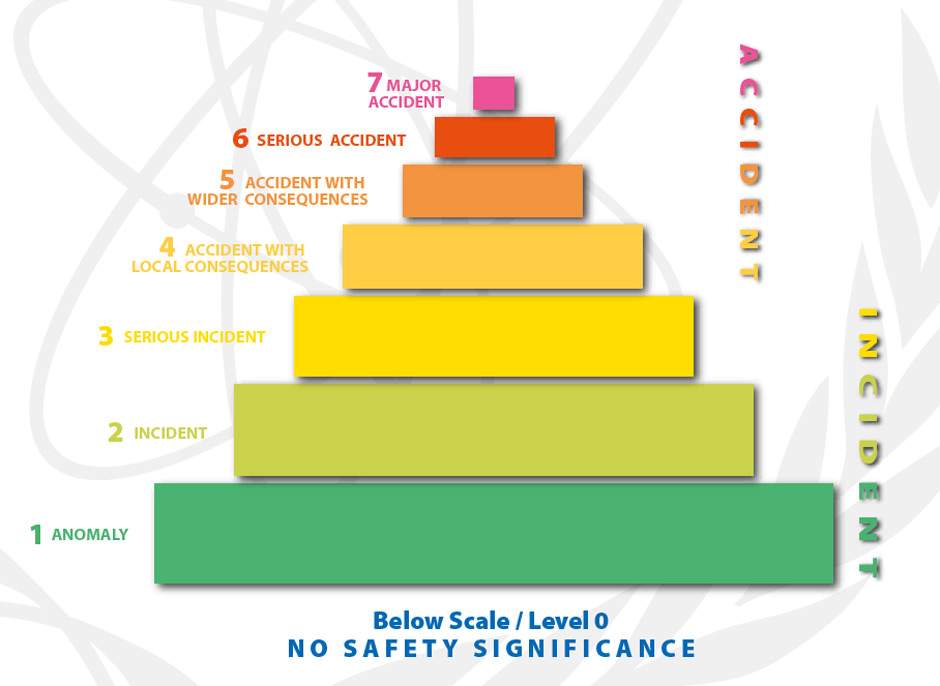
Japanese officials on Friday reclassified the rating of the accident at the plant from Level 4 to Level 5 on a seven-level international scale, putting it on a par with the 1979 Three Mile Island accident.
The International Nuclear Event Scale defines a Level 4 incident as having local consequences and a Level 5 as having wider consequences. Nuclear experts have been saying for days that Japan was underplaying the severity of the nuclear crisis.
What is the International Nuclear Event Scale?
The International Atomic Energy Agency introduced the International Nuclear and Radiological Event Scale in 1990 as a tool for communicating to the public in a consistent way the safety significance of nuclear and radiological events.
Just like information on earthquakes or temperature would be difficult to understand without the Richter or Celsius scales, the INES Scale explains the significance of events from a range of activities, including industrial and medical use of radiation sources, operations at nuclear facilities and transport of radioactive material.
Events are classified on the scale at seven levels: Levels 1–3 are called "incidents" and Levels 4–7 "accidents."
The scale is designed so that the severity of an event is about ten times greater for each increase in level on the scale.
Examples of events at different levels on the scale:
7 – Chernobyl, 1986 – Widespread health and environmental effects. External release of a significant fraction of reactor core inventory.
6 – Kyshtym, Russia, 1957 – Significant release of radioactive material to the environment from explosion of a high activity waste tank.
5 – Three Mile Island, USA, 1979 – Severe damage to the reactor core.
4 – Tokaimura, Japan, 1999 – Fatal overexposures of workers following a criticality event at a nuclear facility.
Source: International Atomic Energy Agency



Comments
Want to discuss? Please read our Commenting Policy first.