


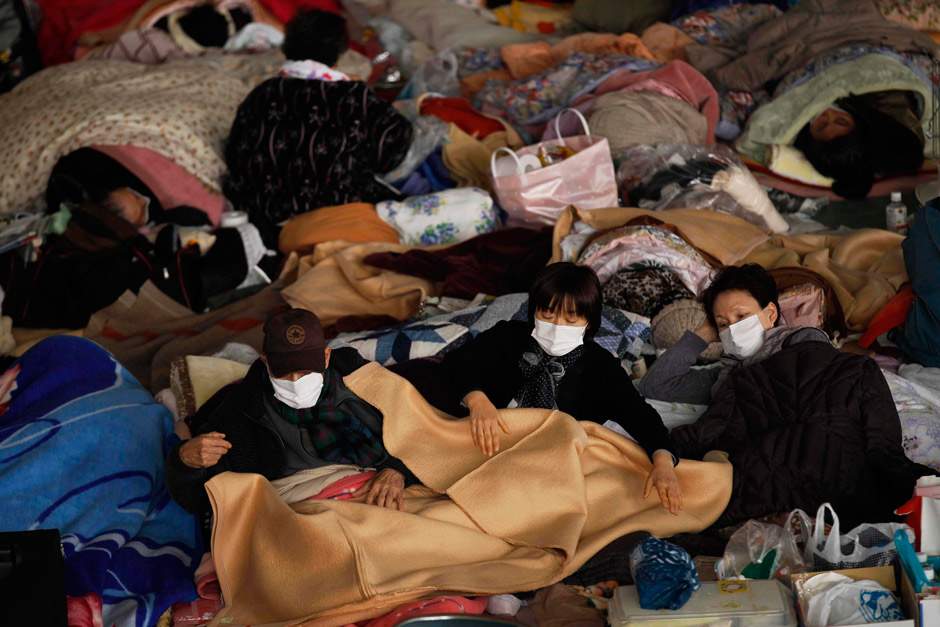
Canada has two Disaster Assistance Response Teams available to send to Japan, as well as rapid-deployment field medical facilities, and teams of engineering, humanitarian and search-and-rescue experts.
But none of these emergency crews have been dispatched to Japan because Ottawa hasn’t yet received an official request for their services.
So far, the only aid Canada has sent is 25,000 blankets that were sent on Wednesday.
Canada is not the only country prepared to help the beleaguered Asian country. Approximately a dozen nations have already sent help.
Australia, China and the United States have sent rescue teams that include specially-trained dogs.
Australia sent a 72-member search and rescue team and military airlift assistance. Britain sent 64 fire brigade search and rescue specialists, as well as heavy lifting equipment.
The U.S. sent two Seahawk helicopters with food. It has committed nine ships and a 144-member DART team to relief efforts.
"Japanese officials have only requested specific assistance from specific countries," Canada’s Minister of State for Foreign Affairs Diane Ablonczy said.
"The Japanese government has a very experienced emergency-response mechanism in place. So we want to collaborate and let them take the lead on what might be necessary and when."
Although Ottawa’s assistance teams has not been mobibilized, Canadian charities such as Red Cross, Oxfam Canada and Doctors Without Borders have been collecting donations and offering aid.
The Canadian Red Cross (CRC) said it had raised $3 million dollars by Tuesday, but will not send staff until the Japanese Red Cross requests support. The Japanese Red Cross has sent 85 medical teams to the area for search and rescue operations.
Foreign Affairs Minister Lawrence Cannon said that Canada has offered a range of assistance to Japan, including a 17-member victim-identification team, military assets and relief supplies.
After deciding it was no longer safe for Canadian medical workers to aid in Japan with a growing nuclear threat, the Canadian Medical Assistance Team flew home on Wednesday.
The team is trained in responding to natural disasters, but not nuclear disasters, and decided after being in Japan for a couple of days that it was not equipped to respond to the situation there.
CARE
The Tokyo-based wing of CARE will send three truckloads of relief goods – such as water, rice, face masks and toilet paper – to tsunami struck Iwate prefecture.
“The situation is changing daily,” says national director Katsuhiko Takeda. “Once in (the city of) Kamaishi we will assess the situation to determine how best CARE can scale up our response.
According to CAREJapan, the government will only allow a convoy of trucks to head to the area if they are carrying relief goods.
Canadian charity GlobalMedic has met with government officials in Japan and offered to deploy a field hospital and water purification capabilities. The group is still waiting for a response to their offer.
Plan International has a team standing by in Indonesia, where it has a warehouse containing 5,000 emergency kits available for distribution.
With files from Postmedia News



Comments
Want to discuss? Please read our Commenting Policy first.