

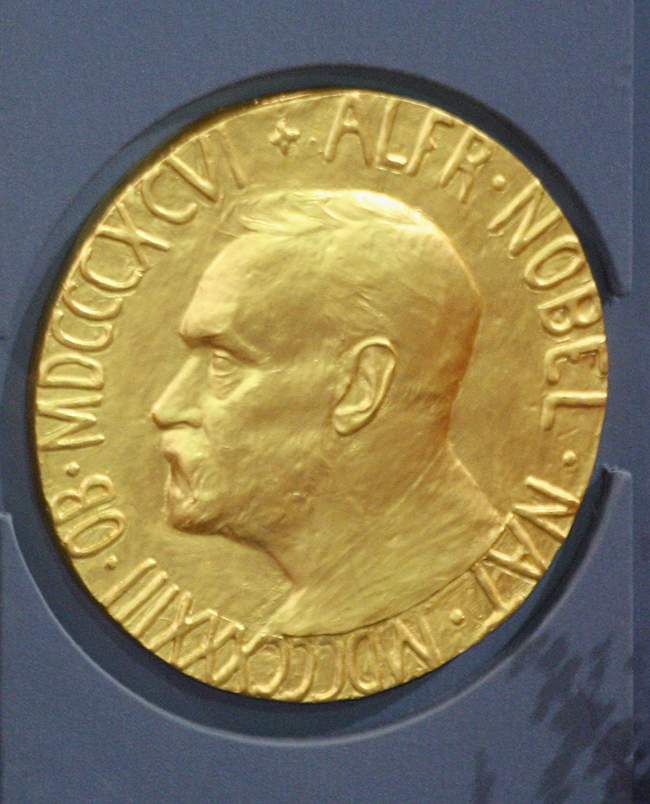
President Barack Obama’s controversial win of the Nobel Peace Prize today may have come as a shock to many, but he’s not the first head of state to win the coveted prize.
Many world leaders before him have won the prize for their work in promoting peace. Global News takes a look at some of them.
Theodore Roosevelt:
In 1901, with the assassination of President William McKinley, vice president Theodore Roosevelt, who was not quite 43, became the youngest president in the nation’s history.
In 1906 Roosevelt was awarded the Nobel Peace Prize for his work in negotiations that led to the Treaty of Portsmouth, ending the Russo-Japanese War in 1905. Roosevelt offered his skills as mediator between Russia and Japan, nudging the hostile countries to nominate a diplomatic agent to negotiate on the matters of peace. In August, 1905 the warring parties met in Portsmouth, New Hampshire, and after weeks of difficult discussions, concluded with the treaty.
Roosevelt was President of the United States until 1909.
Thomas Woodrow Wilson:
Wilson was President of the United States from 1913-1921. During World War I, he tried to stay neutral and protested against British and German aggression. However, in 1917, after Germany initiated unrestricted naval warfare and were found to be plotting against the United States, he asked Congress for a declaration of war, which Congress granted.
Wilson went to Paris in an effort to build an enduring peace, after the Germans had signed the Armistice on November 11, 1918. He presented the ensuing Versailles Treaty to the U.S. Senate, which contained the Covenant of the League of Nations, a predecessor of the United Nations. For this, he was awarded the Nobel Peace Prize in 1919.
Anwar al-Sadat:
Sadat was president of Egypt from 1970-1981. He was awarded the Nobel Prize jointly with Israeli leader Menachem Begin, for their efforts in negotiating peace between Egypt and Israel. The prize was awarded specifically for their involvement in the Camp David Peace Accords.
On September 1978, Sadat and Begin signed those accords, which led to a peace deal between the two main adversaries in several Middle Eastern wars. The leaders were awarded the prize shortly after the accords had been signed at the US presidential retreat of Camp David near Washington. Jimmy Carter, the president who brokered the deal, would go on to win the Nobel Peace Prize himself in 2002, after he left office.
Mikhail Gorbachev:
Gorbachev led the USSR in the latter part of the 1980s, and presided over its eventual demise as the arch-foe of the United States.
Gorbachev’s efforts to bring democracy to his country’s political system and liberalize its economy led to the downfall of communism and the breakup of the Soviet Union in 1991.
In October, 1990 he was awarded the Nobel Prize for his role in the peace process which, saw the dismantling of a superpower peacefully, and because he successfully ended the Soviet Union’s post-war domination of eastern Europe.
The reforms which were partly inspired by Gorbachev led to, among other things, the fall of the Berlin Wall and the reunification of Germany.
Frederik Willem de Klerk:
De Klerk was instrumental in ending the white-majority apartheid in his native South Africa.
In February 1989, de Klerk was elected leader of the National Party, and in September he went on to become State President. In his first speech after assuming the party leadership, he called for a non-racist South Africa. De Klerk lifted the ban on the African National Congress, and in 1990 released the man who would become president in 1994 — Nelson Mandela – from more than two decades of imprisonment.
While jailed, Mandela’s reputation grew steadily and became a symbol of resistance as the anti-apartheid movement gained strength. After his release from prison, Mandela went to work to end the oppressive system in his country. In 1993 the Nobel Prize was awarded to de Klerk and Mandela jointly for their efforts to end the country’s apartheid system, which paved the way – peacefully — for a new democratic South Africa.
Oscar Arias:
Arias won the Nobel Peace Prize in 1987, after having nominated himself for the presidency in Costa Rica and winning in 1986, an office he remained in for four years. He became president once more in 2006, a post he still holds.
In 1987 Arias forged a meeting with the presidents of Guatemala, El Salvador, Honduras and Nicaragua, and submitted his own ideas and visions for a peace plan to help bring an end to civil wars in Central America. The accord, which was approved by the five presidents on Aug.7, 1987, has been instrumental in reforming the turbulent politics of Central America.
In 1988, Arias used his Nobel money to found the Arias Foundation for Peace and Human Progress, which promoted peace and equality throughout the world.



Comments
Want to discuss? Please read our Commenting Policy first.