

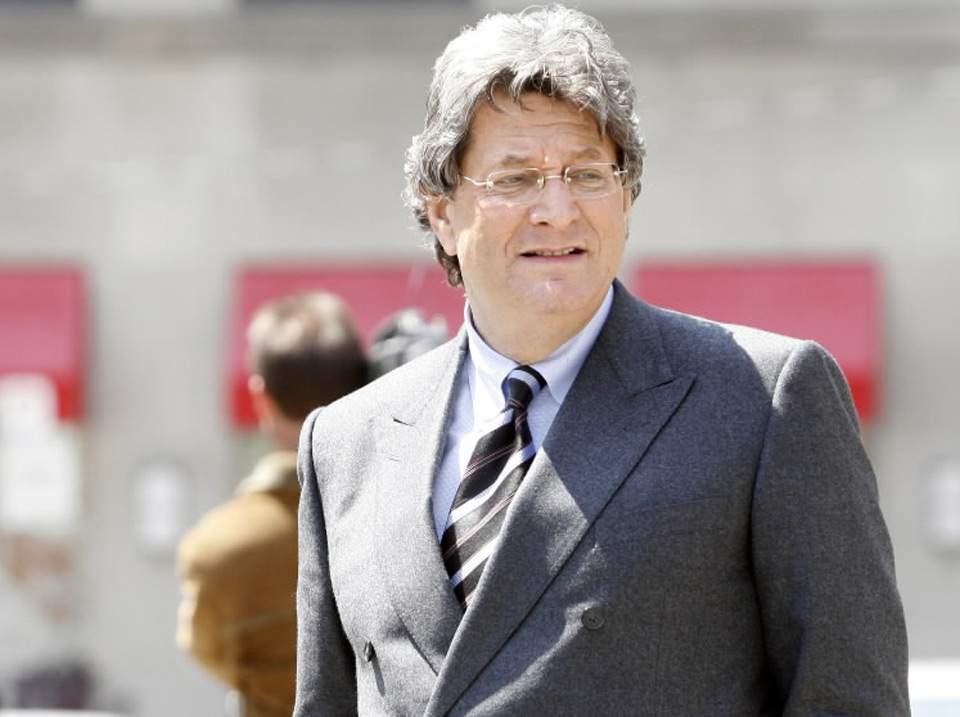
Garth Drabinsky’s life has had as much drama and intrigue as the many plays he has produced. He reached lofty heights by building one of the largest entertainment empires in the country. But he took a huge fall when it was revealed he had committed fraud.
Dranbinsky was born in Toronto in 1949 to an engineer father. He contracted polio at the age of three, and was forced to undergo a number of painful operations. The ordeal left him with a limp.
He fell in love with the theatre while still a high school student watching Moliere’s The Imaginary Invalid, but he pursued a law degree at the University of Toronto, graduating in 1973.
Drabinsky was called to the bar in 1975 but couldn’t stay away from the theatre. He became involved in film and theatre production, producing the 1977 Christopher Plummer film The Silent Partner.
In 1979, Drabinsky turned a parking garage under the Eaton Centre into an 18-screen movie theatre, the largest multi-screen complex in the world at the time. The complex also broke the mould with its marble floors and tuxedoed staff.
The entrepreneur would later introduce innovations such as computerized ticket sales for early purchase and airing previews before films.
Cineplex Odeon
Drabinsky would go on to buy Odeon Theatres in 1984 and turn it in to Cineplex Odeon, which would become the largest movie chain in North America.
He purchased the Toronto movie complex Imperial Six from Famous Players two years later, along with business partner Myron Gottlieb. Hidden inside the complex was the Pantages Theatre.
The pair restored the theatre to its 1930s grandeur and re-opened it in September 1989, showing Andrew Lloyd Webber’s The Phantom of the Opera.
Three months later, American entertainment company MCA ousted the pair from the board of Cineplex. MCA had purchased a 49.7 per cent stake in the company several years before.
MCA criticized the accounting of Cineplex after the removal of Drabinsky and Gottlieb, but there was no investigation into the matter.
Livent
The two took their remaining assets – The refurbished Pantages Theatre and the Canadian rights to Webber’s Phantom – and started Live Entertainment Corporation of Canada, or Livent.
The company began staging lavish productions, such as Showboat which cost the company $700,000 U.S.a week to put on. The trial for the two ex-producers later revealed the extent of the accounting fraud that was going on at the time. Millions of dollars in losses were readjusted to show millions in profits to boost the confidence of investors.
Over the next eight years, Livent produced such Canadian and Broadway hits as Kiss of the Spider Woman, Ragtime and Fosse. The shows generated a total of 19 Tony awards, including the 1994 award for Best Musical for Kiss of the Spider Woman, which Drabinsky accepted himself.
In 1998, a controlling stake of Livent was purchased by a group of American investors led by Hollywood agent Michael Ovitz. The group soon realized that Livent was in serious financial trouble, and Drabinsky and Gottlieb were fired on August 13, mere hours before the premiere of Fosse.
Four months later the company was bankrupt and the pair was charged with 16 counts of securities fraud and conspiracy. Drabinsky stayed in Canada and continued to work but, in 2002, the U.S. indictment was placed on hold as Drabinsky and Gottlieb were criminally charged in Canada.
The trial began in May 2008, with the defence arguing that lower-level Livent employees were responsible for the fraud. In March, the business partners were found guilty of fraud and forgery.



Comments
Want to discuss? Please read our Commenting Policy first.