

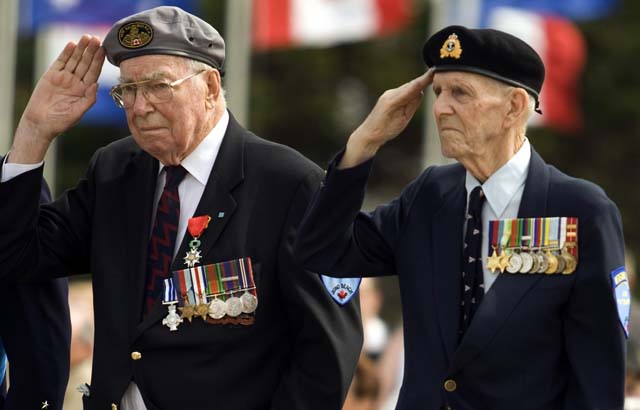
After four years of bloodshed, Allied commanders were eager to bring an end to the Second World War. Intending to break the backbone of the German Army in Europe, they planned the largest seaborne invasion in history.
On June 6, 1944, under the cover of pre-dawn darkness, British, American, Polish and Canadian forces navigated the choppy waters of the English Channel and stormed 80 km of flat, sandy beach on the coast of Normandy, a region in northern France.
Some 14,000 Canadian troops landed at the second-most heavily fortified of the five landing sites – an eight-kilometer wide strip of beach that included a small fishing port. It was code named Juno Beach.
The first wave of Canadians to hit the beach encountered fierce opposition from the Germans, who had fortified the coastline with guns, concrete barriers, pillboxes and fields of barbed wire and mines. But amid falling bombs, artillery and machine gun fire, the Canadians advanced and cleared the seawall within an hour.
One Canadian soldier later recalled that fateful morning in his book, Battle Diary. "The moment the ramp came down, heavy machine gun fire broke out from somewhere back of the seawall,” Charlie Martin wrote.
“Mortars were dropping all over the beach. The men rose, starboard line turning right, port turning left. I said to Jack, across from me, and to everyone: “˜Move! Fast! Don’t stop for anything. Go! Go! Go!’ We raced down the ramp, Jack and I side by side, the men closely following. We fanned out as fast as we could, heading for that sea wall…”
Moving farther inland the Canadians took the towns of Bernières, Courseulles and St. Aubin, sometimes engaging in hand-to-hand combat. By sunset, they had advanced 10 km into France, farther than any other Allied troops.
British historian John Keegan later recounted their contributions to Allied success on D-Day: “The opposition the Canadians faced was stronger than that of any other beach save Omaha. That was an accomplishment in which the whole nation could take considerable pride.”
That success came at a great cost. Some 340 Canadians were killed in the Normandy Invasion and 574 were wounded. Still, the Canadians pressed on, capturing Caen in July and Falaise in August.
The invasion was a success, leading to the defeat of Nazi Germany and the liberation of Europe.
Fifty years later, Canadian veteran Garth Webb and his companion spearheaded a movement to create a museum commemorating the Canadian contribution to the Normandy Invasion. With the financial backing of various businesses, institutions and government agencies, the Juno Beach Centre was established in 2003.
Located near Juno Beach, the museum presents the Canadian contribution, military and otherwise, to the war effort. It also showcases contemporary Canadian society.
"The location puts a lot of emphasis on D-Day, but really the story we tell is the whole story of Canada in World War II – how it became a nation, the Italian campaign, and Dieppe," Webb told The Toronto Star.

Comments
Want to discuss? Please read our Commenting Policy first.