


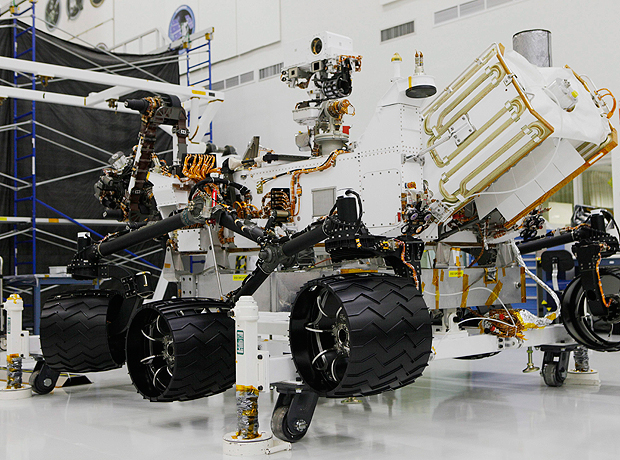

On November 26, NASA
will launch Curiosity-a rover that will use a Canadian-made sensor to look for
signs that Mars at some point had the conditions to support life. Global News takes a look
at some milestones in the 22-year history of the Canadian Space Agency.
1989:
Parliament creates the Canadian Space Agency. The CSA is responsible
for science and technology programs, including development of
satellites, space robotic technology, the astronaut program and space
sciences.
1992: Roberta Bondar participates in a mission on the shuttle Discovery.
1992: Steve MacLean participates in a mission on the shuttle Columbia.
1995: Chris
Hadfield participates in a mission on the shuttle Atlantis, becoming
the only Canadian to visit Mir, the Russian space station.
1995:
A remote sensing satellite developed by Canada and the U.S. is
launched. Using advanced microwave technology, the satellite can
penetrate fog, darkness and clouds. The satellite, called RADARSAT,
provides high-resolution images to be used in monitoring the
environment.
1996: Marc Garneau participates in a
mission on the shuttle Endeavour. It’s his second shuttle mission.
Twelve years earlier, he became the first Canadian in space.

Get daily National news
1996:
Robert Thirsk takes part in a mission on the shuttle Columbia. As a
payload specialist he helps perform 43 experiments, some of which are
devoted to the study of changes in plants, animals and humans under
space flight conditions.
1997: Bjarni Tryggvason participates in a mission on the shuttle Discovery. He serves as a payload specialist.
1998:
Dave Williams takes part in a mission on the shuttle Columbia. The
mission is dedicated to the advancement of neuroscience research, and
focuses its attention on the effects of weightlessness on the nervous
system.
1998: Canada, the U.S. Japan, Russia and 11
European nations collaborate to launch the first part of the
International Space Station in November.
1999:
Julie Payette flies on the shuttle, Discovery, becoming the first
Canadian to participate in an international space station mission and
the first to board the station.
2000: Marc Garneau
takes part a mission on the shuttle Endeavour, visiting the
International Space Station. He uses the shuttle’s Canadarm, a
mechanical arm used on a space shuttle to move around a payload, to
deliver and install solar panels and supplies to the station.
2001: Chris Hadfield takes part in a mission on the shuttle Endeavour, completing the first spacewalk by a Canadian.
2001:
The Mobile Servicing System – known by its main component, Canadarm2 –
is launched. A robotic system on the International Space Station, it is
involved in station assembly and maintenance. This development comes 20
years after the launch of the first Canadarm.
2006: Steve MacLean completes the second spacewalk by a Canadian, as part of a mission on the shuttle Atlantis.
2007: RADARSAT2 is launched for the Canadian Space Agency by Starsem, a European-Russian company.
2007: Dave Williams completes the third spacewalk by a Canadian as part of a mission on the shuttle Endeavour.
2009: Canada introduces its first new astronauts in 17 years: Dr. David Saint-Jacques and Capt. Jeremy Hansen.
2010:
The federal minister of state for science and technology announces that
astronaut Chris Hadfield will become the first Canadian to command the
International Space Station.
Hadfield, 51, a former fighter
jet pilot and native of Sarnia, Ont., will fly aboard a Russian Soyuz
rocket to the space station 350 kilometres above the Earth and live
there for six months starting in December 2012.
2011: As big as a car and as well-equipped as a laboratory, NASA’s newest Mars rover blows away its predecessors in size and skill. Nicknamed Curiosity and scheduled for launch on November 26, the rover has a two-metre arm tipped with a jackhammer and a laser to break through the Martian red rock. The minivansized rover will use a Canadian-made sensor to look for signs that Mars at some point had the conditions to support life.


Comments
Want to discuss? Please read our Commenting Policy first.