

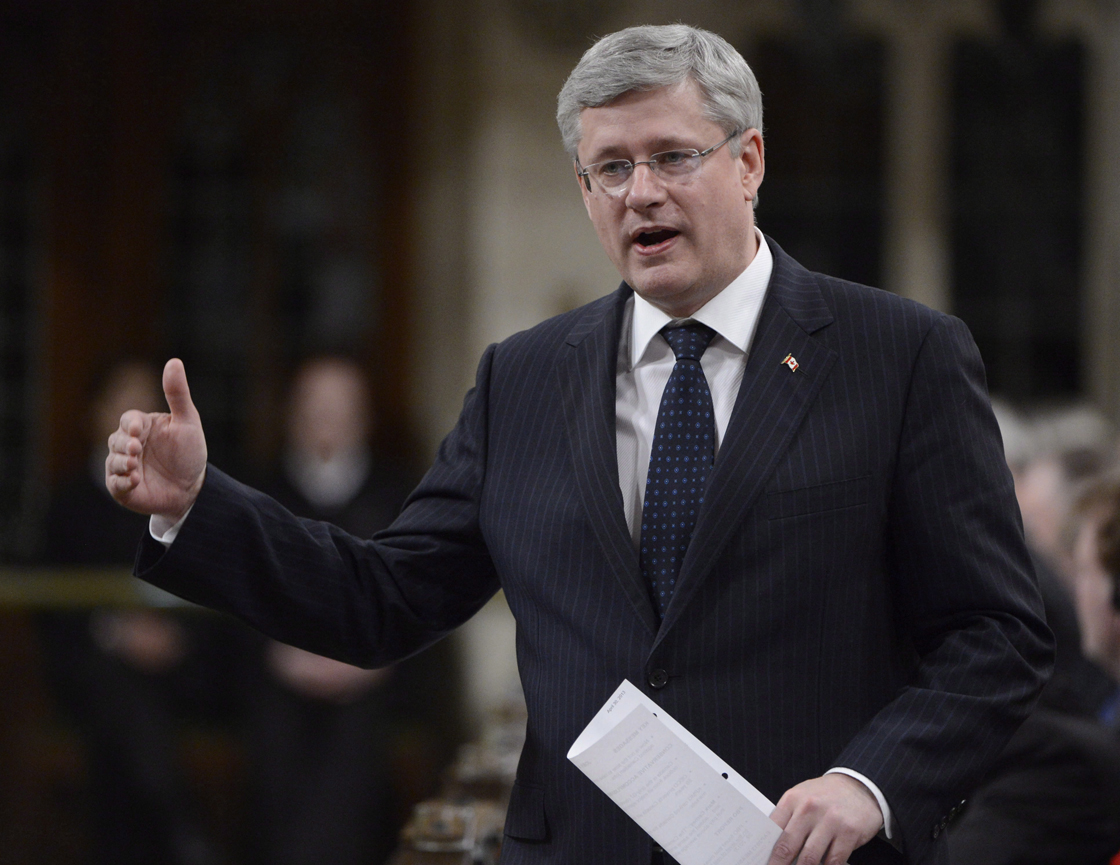
OTTAWA – When Stephen Harper takes the stage at a leading U.S. think-tank on Thursday to talk about Canada’s energy prospects, his pitch will more than likely mention that Canada is halfway towards meeting its greenhouse gas emissions target.

The question on many American minds is: what will Canada do to make up the other half?
As the Obama administration mulls whether to let TransCanada Corp. build the Keystone XL pipeline to connect the Alberta oilsands to the Gulf Coast, the federal Conservative government has ramped up the rhetoric around the measures it has taken to ensure pipeline safety, cut emissions and monitor oilsands pollution.
Environment Minister Peter Kent is making his pitch in Europe this week, hot on the heels of Natural Resources Minister Joe Oliver, while a number of federal and provincial politicians have worn a path to Washington to plead the Canadian case.
This week, in advance of the prime minister’s question-and-answer session with the Council on Foreign Relations in New York City, the government took out ads in U.S. publications and launched a new website to promote its sector-by-sector regulatory approach to reducing emissions.
“With these and other means, Canada is honouring its United Nations commitment under the Copenhagen Accord to a 17 per cent reduction in emissions from 2005 levels by 2020,” the website states.
“We estimate that as a result of our collective actions taken to date, Canada is already halfway toward closing the gap between what our emissions had originally been projected to be in 2020, and where we need to be to meet our Copenhagen target.”

Get weekly money news
The problem is, the “halfway” claim refers to all the measures both provincial and federal governments have taken, and the cumulative effect they will have on emissions by 2020. Numerous analyses have shown that closing the rest of the gap will take a near miracle, or some kind of national carbon pricing scheme.
The federal Conservatives have lashed out aggressively against any mention of carbon pricing, although many provinces have already headed in that direction — either of their own volition or in order to comply with federal regulations.
The Conservative message hasn’t convinced a skeptical public that Canada’s emissions are on the right track, said Peter Julian, the NDP’s natural resources critic.
“If Keystone is not approved, it’s because of the Conservatives’ environmental record,” Julian said.
The best hope is for Ottawa to drive a hard bargain in regulations for the oil and gas sector, said Clare Demerse, director of federal policy for the Pembina Institute.


“It is the single biggest thing (Harper) could do,” she said in an interview.
Oil and gas are the largest source of emissions growth. Federal, provincial and industry officials have been deep in negotiations for months to agree on a package that would curb emissions at a cost that does not disadvantage the industry.
But none of the scenarios on the table will take Canada anywhere near meeting its 2020 target, Demerse and other analysts have said.
Kent, meanwhile, is eyeing the handful of sectors that aren’t yet regulated. Commercial and residential buildings are key, he said in an interview from London, adding that he’s also hoping for international action in the aviation sector.
Canada, he also noted, is now getting credit for reforestation efforts.
But none of those areas will give Canada more than a few megatonnes of carbon reductions each by 2020. And Canada is short by more than 100 megatonnes.
Another option to make up the shortfall would be for Canada to buy international credits from developing countries that need the cash to clean up their emissions, said Dave Sawyer, an environmental economist with the International Institute for Sustainable Development.
“I think once Canada assesses what it can do, at what cost, it will be prudent to look outside Canada,” Sawyer said.
Kent was cool to that idea.
“We have no intention of sending Canadian money to buy credits from still-depressed eastern European economies,” he said.
The government has also rejected suggestions from Mark Jaccard, an environmental economist at Simon Fraser University, to freeze development in the oilsands and halt the building of pipelines in order to limit emissions.
This week, the International Energy Association said it expects oilsands production to increase by 1.3 million barrels a day by 2018, to a total of about 5 million a day. The rise in production is expected to put a strain on existing pipeline capacity.


Comments
Want to discuss? Please read our Commenting Policy first.