


Even a generation after she left Downing Street, there is little middle ground in Britain on the subject of Margaret Thatcher.

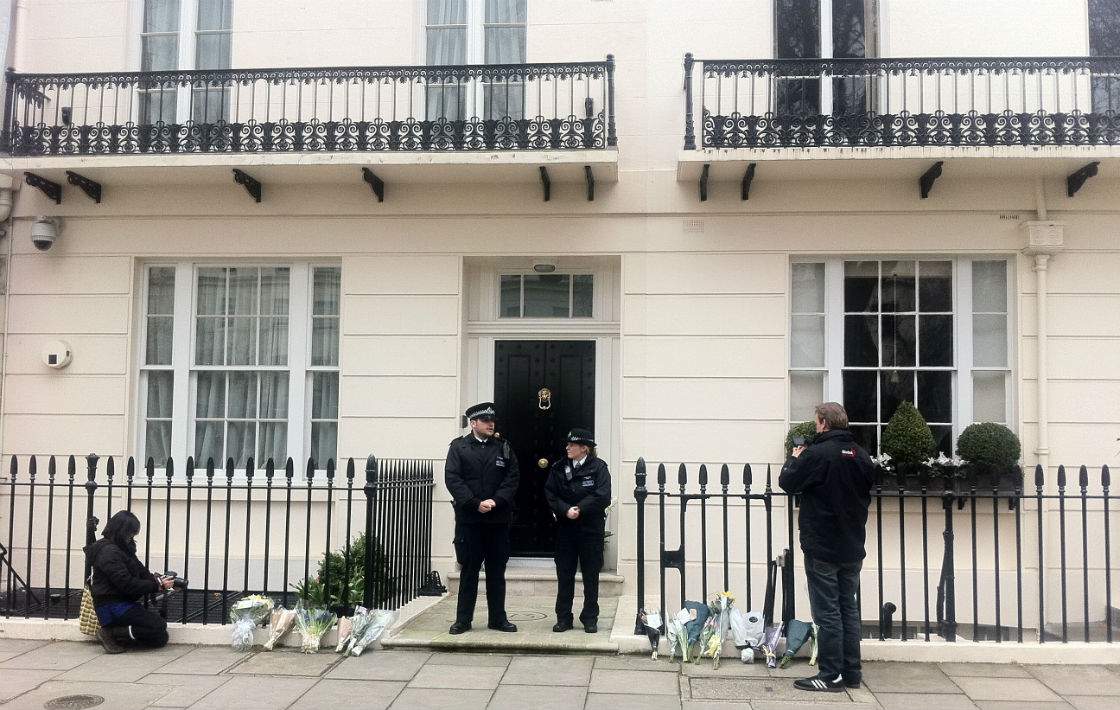
The day after her death, we made our way to the London neighbourhood of Belgravia in search of her home. She had not lived there in months. After an operation, a supporter set her up in the Ritz Hotel where she could live more comfortably with suitable care as her health declined. And that is where a stroke ended her life.
But her home is where admirers chose to deliver floral tributes. We knew only that it was somewhere on Chester Square. Finding it was relatively simple, the location given away by the satellite trucks parked out front with a small group of photographers standing behind a police barrier, looking bored.
The volume of flowers propped up against the fence was slight. We waited for a while to see if more would be delivered and were about to give up and leave when Jules and Ari Thoroddsson strolled up with a small bouquet and politely asked the police if they could add it.
Afterwards I asked them why they made the pilgrimage.
“I didn’t think I would be sad, but I really am,” said Jules.
“The thing to remember is that she was inspirational, particularly for women,” she added.
Thatcher would scarcely call herself a feminist, but she was undoubtedly an inspiration—for some.
As Rodney Barker from the London School of Economics told me: “she was the Joan of Arc of the right.” She slashed spending, sold off state-owned industries and broke the iron grip of British unions.
Thatcher paved the way for the rise of London as a world financial centre, as well as the banking crisis that followed.

Get breaking National news
She freed the economy, but the numbers of jobless more than doubled and remain higher now than when she took office.
All subsequent British Conservative leaders have suffered by comparison. The week after she was forced from office in 1990 the satirical magazine Private Eye had her on the cover, holding up an empty suit, with the word balloon: “I’d like to introduce you to my successor.”
True blue Tories regularly lambaste the current Prime Minister David Cameron, saying he is squishy, changeable and could take lessons in resolution from the unyielding Thatcher.
Cameron paid the highest of compliments: “she not only led our country, she saved our country.”
In death, even the most contentious of leaders generally draw praise. Margaret Thatcher is different. The Telegraph was unstinting, calling her the greatest of postwar prime ministers and chiding a BBC anchor for daring to appear on the air during the coverage of her death wearing a blue tie, not the black of mourning.
By contrast, the Labour Party found it necessary to send out an alert, pleading with members to be respectful. The Deputy First Minister of the Northern Ireland Assembly, Martin McGuinness, called on fellow Irish Nationalists to stop organizing celebrations of her death.
Even as her body was being taken away from the Ritz on the night of her passing, there was a spontaneous street party in the south London community of Brixton. In Glasgow, 300 smiling Scots popped open a bottle of champagne and cheered a song that ended with the line: “we’ve seen the last of dotty Maggie T.”
Thatcher’s government imposed the despised poll tax on Scotland a year earlier than the rest of Britain and memories are long. Her Tories elected exactly one Scottish MP in the last election.
It seems only appropriate that even her funeral would be the source of contention. Following her wishes, it was announced as a ceremonial service, with full military honours.
Only reigning monarchs and the occasional national hero (Winston Churchill, Lord Nelson) get state funerals. But the differences are slight. Both the Queen Mother and Diana, Princess of Wales got the ceremonial treatment. Thatcher’s casket will still be paraded through the closed streets of London, flanked by soldiers. The Queen will be at the service at St. Paul’s, the first prime ministerial funeral she has attended since Churchill.
Canadian admirers Stephen Harper and Brian Mulroney were also among the select list of invitees.
The left-leaning Mirror tabloid ran a glowering picture of Thatcher on the front page, calling her the woman who divided a nation and editorialized that the rumoured $13 million cost of her funeral (to be split between the government and her estate) would be better spent on other things.
On the other side of the divide, Tory supporters tweeted that in fact she merited the full state service.
For her part, Thatcher reportedly vetoed the idea of a Royal Air Force flyover, deriding it as a waste of money. Undoubtedly she would have been amused by the furor and not fazed by the celebrations of her death. Her former spokesman said she would have looked at those who would dance on her grave and briskly dismiss them as the same lot she repeatedly defeated at the polls.
The daughter of a grocer who rose to dominate Britain, who fundamentally changed the society and who moved the political spectrum to the right will get a grand sendoff, like it or not. Central London will come to a standstill, admirers will eulogize her and the world will be watching.
Outside the capital, particularly in the northern towns that suffered at her closure of inefficient mines, the moment will also be marked. With parties.
In one of those places, a village called Stainforth, former miner Mick Lanagan sipped a beer and spat out his bitterness, undimmed by the years.
“There’s a saying that you’re not supposed to speak ill of the dead,” he told a reporter.
“I’ll make an exception for her. She didn’t shed a tear when she killed my village.”
Not many leaders give their name to a movement. Margaret Thatcher may be gone. But Thatcherism lives on, as does the debate over whether it was a benefit or blight.


Comments
Want to discuss? Please read our Commenting Policy first.