

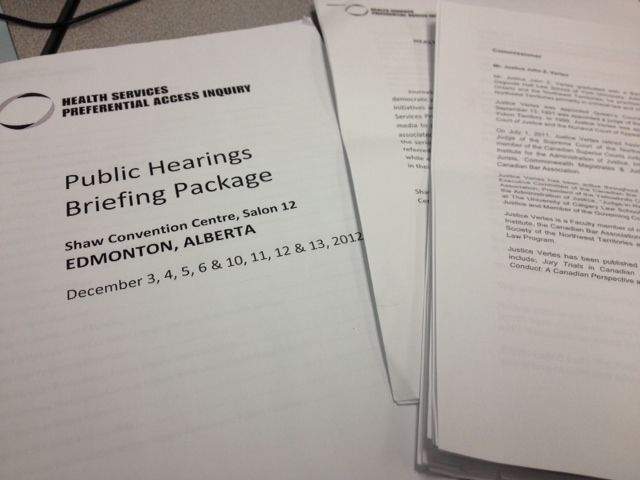
EDMONTON – The lawyer for a doctor at the centre of queue-jumping allegations is crying foul over the treatment of his client at Alberta’s health inquiry.

David Steele, in a written submission to the inquiry, says commission lawyers went outside their mandate by drawing what he called unsubstantiated and damning conclusions about the conduct of Dr. Ron Bridges.
“Not only is it not commission counsel’s role to comment on credibility and to draw such conclusions, but it could also call into question the impartiality of this inquiry,” Steele wrote in his submission.
He urged inquiry head retired justice John Vertes to ignore the conclusions of commission lawyers Michele Hollins and Jason Wilkins.
“It is unusual that here commission counsel are not following standard practices and elected to file submissions, which on their face draw conclusions, decide credibility and make representations on the outcome of the inquiry.”
The evidence, said Steele, does not support suggestions that Bridges moved favoured patients to the head of the waiting list at the publicly funded Colon Cancer Screening Centre in Calgary.
Testimony suggests just the opposite, Steele said.
“Dr. Bridges was trying to help people get through the system.”
Bridges is a gastroenterologist and an associate dean of medicine at the University of Calgary. He helped found the pubic screening centre in 2008.
The doctor became the focus of the inquiry in January when patient charts and testimony from clerks revealed a pattern of his patients, many from the private Helios Wellness Centre, being moved to the front of the line at the public clinic from 2008 to 2012.

Get weekly health news
Helios dispenses health and diet advice for clients who pay $10,000 a year. Helios donates $200,000 or more annually to the University of Calgary for medical scholarships.
Bridges is a key fundraiser for the university and both Helios and the Colon Cancer Screening Centre rent office space from the school.
The inquiry was told that Helios patients were seen and treated within months while everyone else waited years for a first appointment.
Darlene Pontifex of the screening clinic has testified that while Bridges didn’t have a formal role there, he exercised ongoing authority.
Hollins and Wilkins, in their final submissions presented Wednesday, wrote that the evidence was persuasive.
“The evidence shows Dr. Ron Bridges taking active steps to book (private clinic) Helios patients outside of the regular referral process,” they wrote.



“Dr. Bridges has been prepared to use those (public facilities) however he sees fit, often for the benefit of particular people.”
Steele labelled that an unsubstantiated leap of logic.
He noted that everyone involved at the screening clinic was having trouble in the early days getting the booking system to function. As a result, Bridges’s patients from Helios — and others as well —were slotted in so that exam rooms would not sit empty.
After 2010, Bridges told the inquiry, he sent patient referrals directly to senior managers at the clinic instead of to booking clerks, with notes to have the patients treated within months.
Bridges testified he bypassed the clerks because he didn’t know what the booking rules were. He also said that while he asked for his patients to be treated within months, he had no expectation they would be fast-tracked.
Helios staff testified they did end runs around the screening clinic’s booking rules by going through Bridges instead of the clerks. They said they turned to Bridges not to have their patients bumped up in line, but to get registered on what they perceived to be a dysfunctional clinic database.
Steele wrote that the inquiry is missing the bigger picture.
“The inquiry heard evidence that 60,000 patients have been screened at CCSC, with only a handful of patients raising any concerns about preferential access,” wrote Steele.
“The heart of the issue at this inquiry really is not preferential access, but wait times. If there were no queue, there would be no queue to jump.”
The inquiry has now concluded and Vertes has until Aug. 31 to file his findings and recommendations to Premier Alison Redford’s government. Redford ordered the independent review last year to address concerns about unfairness in health care.
The colon cancer clinic is not the only example of queue-jumping put before the inquiry.
Vertes has also heard evidence that certain VIPs were given special attention in hospitals and that doctors willingly treat colleagues and their loved ones more quickly under the guise of “professional courtesy.”
The evidentiary phase of the inquiry ran for four months, heard from 68 witnesses and compiled 172 exhibits.


Comments
Want to discuss? Please read our Commenting Policy first.