


Global News and Journalists for Human Rights have teamed up to send four Global News reporters to Africa as part of the Shaw Africa Project.

Barry Acton of Global National and Laurel Clark of Global Edmonton were recently in Liberia. Global News followed their journey and their work over the course of several weeks.
Most Canadian reporters cut their teeth in the boonies. They survive off macaroni and cheese, work with limited resources and cling to big city news directors’ promises: “Get experience and come back in a year.”
My starter town was Headingley, Man. I worked as a writer and photographer in between university semesters, circling the region in an old jalopy and interviewing farmers during the BSE crisis.
I don’t think I made very much money but I always knew if I put my heart into each story, I would eventually move up and eventually make a decent living.
The Liberian journalists I’ve met share these same goals, only they have to climb much higher to get ahead. An average camera operator or reporter makes about $100 US a month.

Get daily National news
Liberian journalists typically cover the costs of phones and cell plans – even if the calls are made to request an interview or speak with a source.
And there’s often little or no compensation for overtime.
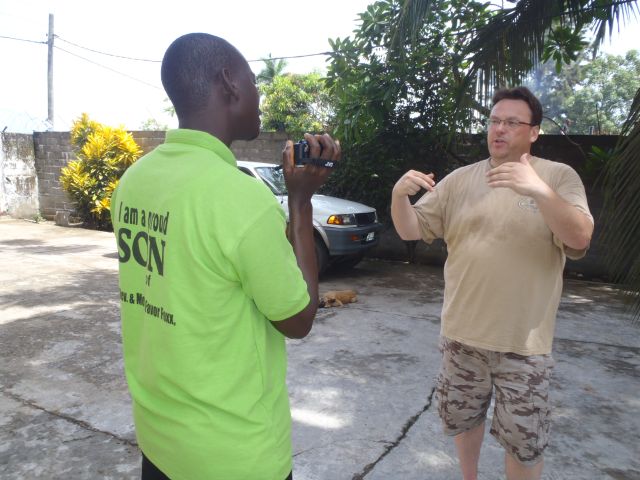
Knowing local journalists are up against some of these challenges has made training on behalf of Journalists for Human Rights even more rewarding. Our mentees, Henry Sumo and Issac Freeman, are so keen they have been coming to training sessions during breaks in their daily work schedule. Today, they came in on a day off!
Henry has been working as a reporter with Power TV in Monrovia for about five years. He’s eager to improve his storytelling and determined to do standups in fewer takes (Some Edmonton cameramen might suggest he ask someone else for help!) Issac has a production background and has been with Power TV for a few years. He recently won a national award for “Videographer of the Year.” His face lights up when he shows off the prize: a small compact HD camera.
The civil conflict may have ended nine years ago, but the country’s media is still decades behind international standards for professional broadcasting. For example, most camera operators use 20-year old home video cameras.
There are also few resources for in-depth coverage. Out-of-town trips cost money, as do investigative pieces. It means reporters have great difficulty getting the support they need to cover important issues that happen outside of Monrovia.
We are here for three-and-a-half weeks and cannot change these things. We can’t raise the wage for media employees across the country, revamp newsrooms with tens of millions of dollars in technology or design a technical college to train future journalists.
But we can mentor our two new friends. We can try to give them a few tools to help them tell a better story or in Henry’s case – nail that next standup. It won’t transform Liberian media, but I figure it’s a start.




Comments
Want to discuss? Please read our Commenting Policy first.