

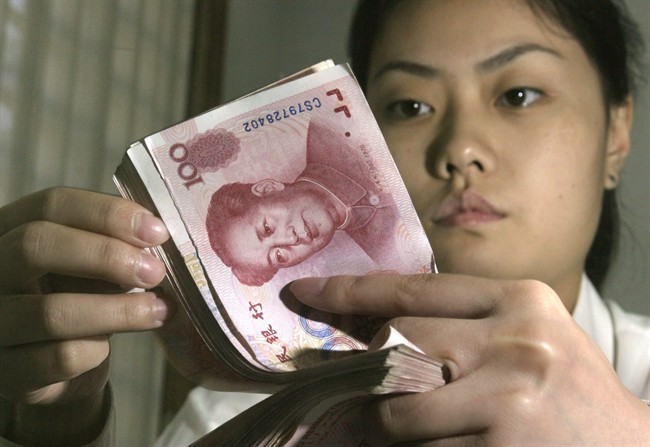
WASHINGTON – The slide continues. China’s currency has continued to slip this week, keeping global investors on edge.

The yuan slid 1.6 per cent on top of a 1.9 per cent drop engineered Tuesday by the Chinese government. The currency’s nosedive is giving investors plenty to worry about: The risk the Chinese economy, the world’s second-biggest, is weakening even faster than expected.
There’s also the threat a cheaper yuan poses to exports and economic growth in other countries. There’s the possibility that China’s move will trigger a currency war, or race between countries to lower their own currencies.
Finally, there’s the prospect it will force the U.S. Federal Reserve to rethink a widely expected interest rate hike this fall — a possibility that creates more uncertainties for financial markets.
HOW DID THIS START?
In a surprise move, China devalued the yuan on Tuesday. Beijing doesn’t let buying and selling in financial markets set its exchange rate the way the United States and other developed countries do. Instead, it links the yuan’s value to a basket of currencies. The composition of the basket is a secret, but it’s believed to be dominated by the U.S. dollar.
Each day, the People’s Bank of China sets a target for the yuan, then lets the currency trade 2 per cent above or below that level. On Tuesday, the central bank set the target 1.9 per cent below Monday’s — the biggest one-day change in a decade.

Get weekly money news
WATCH: Business analyst Michael Campbell explains why China has devalued the yuan
WHAT’S CHINA’S MOTIVATION?
China says the devaluation was part of an effort to give market forces a bigger say in the exchange rate — something the United States and the International Monetary Fund have long called for. Chinese people, worried about the economy and seeking investment opportunities abroad, have been pulling money out of the country. That exodus has held down the yuan’s value. But because the yuan was tied to a rising U.S. dollar, it remained at high levels. By devaluing the yuan, the Chinese government was catching up to the market, not trying to counteract it.
Or so Beijing says. Many economists also suspect a contributing factor: Beijing may be desperately trying to boost its economy. A cheaper yuan gives Chinese exporters a price advantage in foreign markets. And they need help: Exports dropped a steep 8.3 per cent in July year over year.


WHY ARE INVESTORS SO FREAKED OUT?
Plenty of reasons. The surprise devaluation suggests that something is spooking the Chinese government. Perhaps the Chinese economy is decelerating even faster than anyone realizes. Already, the IMF is forecasting 6.8 per cent economic growth in China this year, the slowest rate since 1990. Signs of trouble are accumulating. On Wednesday, for instance, China reported that auto sales sank 6.6 per cent in July.
MORE: The loonie and TSX dive as China’s monetary move rattles markets
Investors are also worried about how a weaker yuan will affect exporters in other countries. Shares in exporters such as Caterpillar and General Electric fell in the market rout this week, though many economists say the yuan’s drop so far isn’t significant enough to do much damage.
Then there’s the chance that other countries will adopt copycat devaluations to help their exporters compete with China, thereby igniting a currency war that disrupts international trade. On Wednesday, Vietnam allowed its currency to weaken in response to China’s move.
Finally, the Chinese devaluation complicates the Fed’s decision-making. The U.S. central bank, increasingly confident in the strength of the U.S. economy, is expected to raise the short-term rate it controls later this year. The Fed has kept the rate at zero since December 2008. But a cheaper yuan poses a threat to U.S. exports and economic growth. It also lowers inflation, already running below the Fed’s 2 per cent annual target. Still, most economists suspect the yuan’s drop won’t have much of a lasting impact. They continue to expect the Fed to raise rates at its September meeting.


Comments
Want to discuss? Please read our Commenting Policy first.