

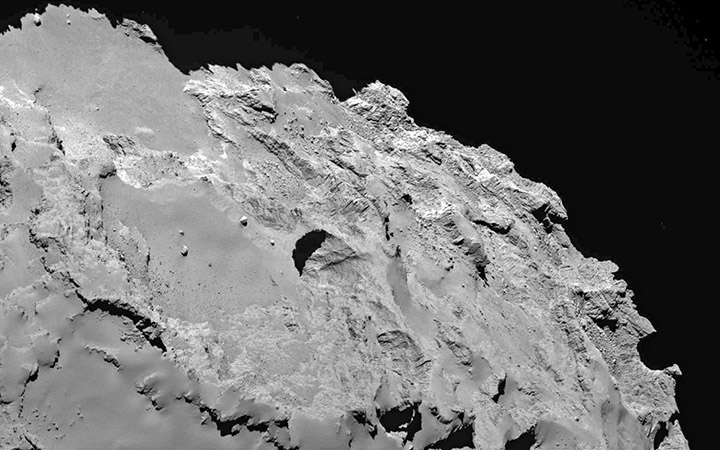
NEW YORK – Comets are basically dirty snowballs, but it turns out they can have a very Earth-like feature: sinkholes.

That’s what scientists think after analyzing data from a comet observed by the European Space Agency’s Rosetta spacecraft. The researchers suggest that 18 large holes on its surface are sinkholes, created by the collapse of its surface into a porous interior.

Get breaking National news
READ MORE: Chaotic dance of moons around Pluto; ‘Kind of like you’d see at a Grateful Dead concert’
Some pits are hundreds of yards deep, which gives glimpses of the comet’s interior. In some cases, the pits were seen spewing jets of gas and dust, as the sun’s warmth turned the ice inside them into a gaseous form.


Other comets have pits too, but they don’t look like the apparent sinkholes on comet 67P/Churyumov-Gerasimenko.
The new observations and analysis were released Wednesday by the journal Nature.


Comments
Want to discuss? Please read our Commenting Policy first.