


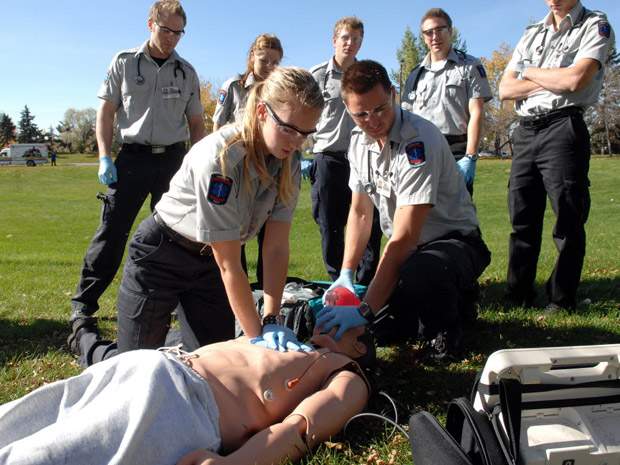
TORONTO – Emergency medicine doctors are calling for a national strategy to help boost the survival rate of Canadians who suffer a cardiac arrest outside hospital, including mandatory CPR training for all high school students.

In a position statement Thursday, the Canadian Association of Emergency Physicians said people whose hearts stop due to cardiac arrest in the home or a public place are three to four times more likely to survive if given immediate “bystander” CPR.
But CPR, or cardiopulmonary resuscitation, is performed in only about one-quarter of such cases. Even doubling that response rate would save an estimated 2,000 lives each year, said the CAEP, calling it unacceptable that vast numbers of witnessed cardiac arrest victims do not receive bystander CPR.
More than 20,000 Canadians have out-of-hospital cardiac arrests each year, with 85 per cent of cases occurring in residential dwellings. Less than 10 per cent survive.
“Emergency department doctors too often see the missed opportunities to save someone’s life had CPR been administered promptly,” said Dr. Christian Vaillancourt, a senior scientist at the Ottawa Hospital Research Institute and a co-author of the paper.

Get breaking National news
“Many more lives can be saved, but we need stronger inducements and a systematic approach to ensure more people in the community are prepared and ready to perform CPR,” Vaillancourt said in a statement.
The CAEP says every Canadian should be trained in CPR, and all Canadians have a moral obligation to provide chest compressions, with or without mouth-to-mouth ventilation, whether they are CPR-trained or not.
To increase the pool of Canadians trained in the technique, compulsory CPR education should be implemented in high schools across the country and certification “should be a pre-requisite for a graduating student to earn a high-school diploma,” the position statement says.
Currently, CPR education in schools is optional and its availability depends on individual school boards. In Ontario, British Columbia and Alberta, CPR education is introduced in Grade 9 or 10.
The CAEP also recommends increasing the number of CPR-trained Canadians by:
• Giving tax exemptions to companies that provide certified CPR courses to employees and to individuals who take CPR education.
• Targeting senior citizens, since they represent the population most at risk to witness a cardiac arrest.
• Considering implementing dispatch-assisted CPR instructions from emergency services for bystanders.
• Creating a coalition of stakeholder organizations to lead a national public awareness campaign.
Manuel Arango, director of health policy for the Heart and Stroke Foundation, said implementing the recommendations would strengthen what’s called the “chain of survival” in communities across the country.
“Early access to the EMS system through 911 or local emergency numbers, early CPR, early defibrillation and early advanced care are essential links in this chain,” Arango said.
The position paper is published in the Canadian Journal of Emergency Medicine and available on the CAEP website.


Comments
Want to discuss? Please read our Commenting Policy first.