

An oil tanker run aground in New Zealand is sparking fears of an environmental disaster. The ship is leaking fuel, and marine crews are preparing to extract oil from the ship before it breaks up even further.

While the BP oil spill or the Exxon Valdez might be the most well-known spills, they were not the most disastrous. Global News takes a look at the worst oil spills in history.
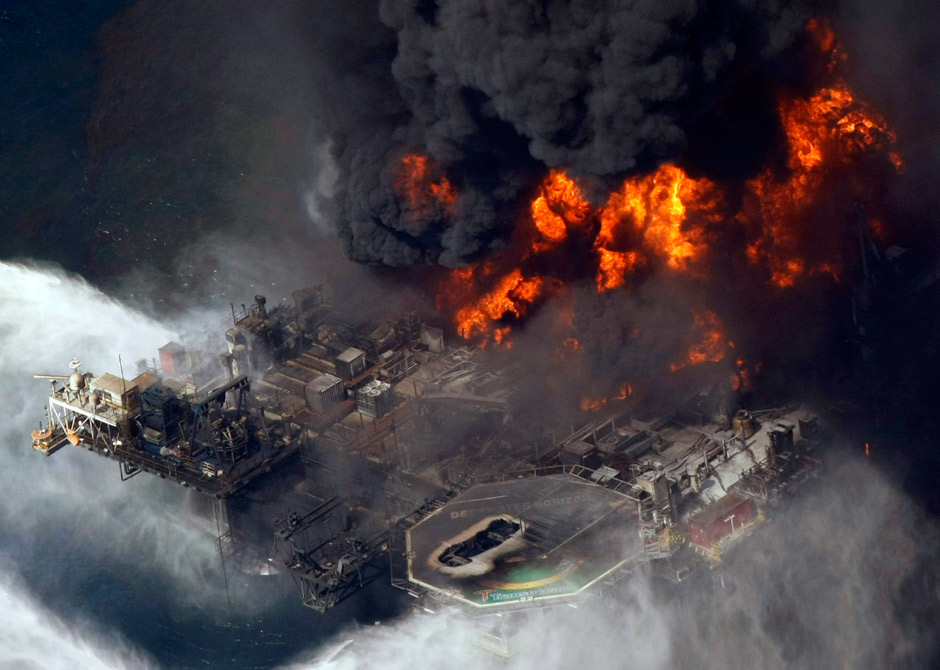
2010: BP oil spill
The BP oil spill in the Gulf of Mexico was the largest accidental one in history. It resulted from an explosion at the Deepwater Horizon oil rig on April 20, 2010, that killed 11 platform workers and injured 17 others.
Oil gushed in to the Gulf for three months until the leak was finally contained on July 15, 2010.
The accident caused extensive damage to the fishing industry in the Gulf, and to the area’s ecosystem.
1991: Kuwait
The worst oil spill in history was an intentional one, caused by the Iraqi army on January 19, 1991, as it tried to stop the advance of allied forces on Kuwait.
Under Saddam Hussein’s orders, the army opened valves and destroyed oil facilities along the shores of the Persian Gulf, releasing almost two billion litres of oil.
The resulting slick covered 10,360 square kilometres of the recently invaded country. Retreating Iraqi soldiers lit wellheads, causing giant plumes of smoke that lingered in the sky for months.
U.S. forces attempted to control the spill: troops bombed pipelines to prevent further spillage, and recovered about one million barrels of oil.
But the spill could not be fully contained – three million barrels of oil washed up on the shore of Saudi Arabia.
1989: Exxon Valdez
The Exxon Valdez ran aground on a reef in Alaska’s Prince William Sound on March 24, 1989, causing what was the largest oil spill in U.S. history.
More than 40 million litres of oil soiled 2,000 kilometres of shoreline and devastated wildlife. An estimated 250,000 seabirds and 2,800 otters were killed. The company paid $4.2 billion in cleanup, compensation and settlement costs.
A 2010 study at Simon Fraser University in B.C. determined that lingering oil from the spill is still being ingested by Alaskan wildlife.

Get daily National news
1983: The Castillo de Bellver
The oil tanker Castillo de Bellver caught fire 40 km off the coast of Cape Town, South Africa on August 6, 1983. An explosion ripped the tanker into two pieces, and sent oil spilling into the sea.
The ship sank and 300 million litres of oil were released into the water, the largest spill in South African history.
Fortunately, wind pushed the slick away from the shore, and the oil dissipated, causing little environmental damage.
1983: Nowruz Oil Field
An oil tanker struck the Nowruz Oil Field in the Persian Gulf on February 10, 1983, in the midst of a war between Iran and Iraq. The drilling platform, located in the middle of the war zone, collapsed into the sea.
The conflict hampered efforts to control the spill, causing 1,500 barrels of oil to spew into the water each day.
A month after the accident, Iraqi planes bombed the platform and ignited the oil, burning some of it off. Iran launched an effort to cap the well, which was finally successful in September after 11 Iranian workers were killed.
In total, 303 million litres of oil had spilled into the sea.
Norwegian experts called in to lead the clean-up effort used skimmers and pumps, but oil continued to wash ashore months after the cleanup crews were gone.
1979: Atlantic Empress/Aegean Captain
Two oil tankers collided during a tropical storm off the coast of Trinidad and Tobago on July 19, 1979. The Atlantic Empress and the Aegean Captain both caught fire after slamming into one another.
Crews battled the blazes and were able to extinguish the fire on the Aegean Captain and tow it to shore. But they could not control the fire on the Atlantic Empress, which continued to burn for two weeks as oil spewed into the sea.
An explosion sunk the ship, and crews worked to control the huge oil spill. But the disaster was still the largest ship-source oil spill in history, having released 340 million litres of crude oil into the Caribbean.
Fortunately, the tide drove the oil away from shore, sparing most wildlife and requiring minimal clean-up efforts.
1979: Ixtoc I
A Mexican state-owned oil company was drilling the Ixtoc I exploratory well in the Bay of Campeche off Ciudad del Carmen, Mexico on June 3, 1979, when the drill hit an area of high pressure and exploded. The oil ignited and the rig collapsed into the sea.
Emergency crews battled poor visibility and navigated surrounding debris to bring the disaster under control. Mud was dropped into the well to stem the flow of oil, and two relief wells were drilled in order to reduce the pressure on the main well.
Oil continued to spew into the sea for almost a year at a rate of 10,000-30,000 barrels a day before crews could finally cap the well on March 23, 1980.
In total, 530 million litres of oil were released into the bay, making the Ixtoc disaster the second-worst oil spill in history.
According to oil company Pemex, half the spilled oil burned when it reached the surface, and another third evaporated. Experts controlled the spill using skimming equipment and booms.
Oil from the Ixtoc disaster soon appeared on the shores of Texas, 600 miles north of the spill site. Birds and crustaceans were seen covered in oil, but heavy rains added to the work of clean-up crews and the beaches recovered within months.
1978: The Amoco Cadiz
The crude carrier Amoco Cadiz was en route from the Arabian Gulf to Le Havre, France, when it encountered stormy weather and ran aground on the Portsall Rocks off the coast of Brittany, France on March 16, 1978.
Huge waves prevented emergency crews from pumping oil out of the wreck, and the ship’s entire cargo of 260 million litres of oil poured into the sea, coating 322 km of French coastline.
The Amoco Cadiz resulted in what was at the time the greatest loss of marine life from an oil spill – 37,000 birds and 6,400 tons of oysters were destroyed.
1967: The Torrey Canyon
The Torrey Canyon was one of the world’s first oil supertankers, and cause of the world’s first major oil spill.
On March 18, 1967, Captain Pastrengo Rugiati tried to take a short cut to save time in arriving at the British port of Milford Haven, but struck the Seven Stones reef and spilled 117 million litres of crude oil in the sea between England and France.
It covered almost 300 kilometres of coastline, about 80 km in France and 200 km in England. Emergency crews had never faced this kind of disaster, and decided to bomb the boat to blow up the oil tanks to burn off the oil slick.
The bombs were unable to burn off the oil and the disaster killed 15,000 birds, but the detergent used to clean up the slick killed more wildlife than the oil.
The disaster led to changes in maritime laws, such as liability being placed on ship owners.


Comments
Want to discuss? Please read our Commenting Policy first.