

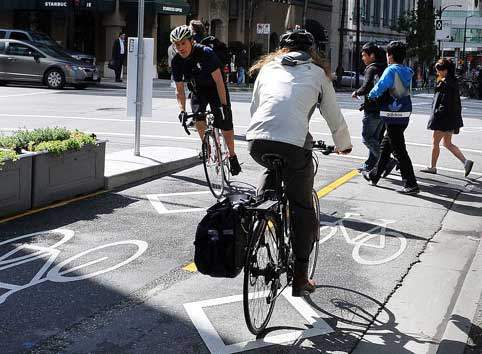
Vancouver’s controversial bike lanes are not supported by most residents, according to new Ipsos Reid-Global News survey.

The Burrard Bridge bike lane was the first separated bike lane opened by Mayor Gregor Robertson in 2010 and was immediately blamed by many commuters for increased congestion on the bridge, as it eliminated one lane of traffic. Later that year, separated bike lanes on Dunsmuir and Hornby streets opened downtown.
The Dunsmuir and Hornby bike lanes proved to be more disruptive to traffic flow in the downtown core. Right turns were restricted at many intersections and some large vehicles are unable to negotiate sharp corners around the separated lanes. The bike lanes also eliminated one lane of parking.
Businesses along the route also denounced the bike lanes, and an independent study commissioned by City of Vancouver, the Vancouver Board of Trade and the Downtown Vancouver Business Improvement Association found that the bike lanes had a “moderate economic impact.” The study estimated businesses on the bike lane lost $480,000 in profits over one year because of the lanes.
The Ipsos Reid-Global News survey revealed 16 per cent of people surveyed either strongly agree (5%) or somewhat agree (11%) with the statement “I personally use the bike lanes in Vancouver.” 84 per cent of people surveyed said they somewhat disagreed (15%) or strongly disagreed (69%) with the statement.

Get breaking National news
The City of Vancouver is planning more separated bike lanes in downtown Vancouver for 2012, including a new east-west route on Comox Street from Stanley Park to Yaletown. Cycling is one of the city’s top transportation priorities and the City says that cycling trips have increased 180% over the past 10 years.
It appears support for further expansion of bike lanes in Vancouver is split almost down the middle. 45% of respondents strongly agreed (14%) or somewhat agreed (31%) with the statement “I support the expansion of bike lanes in Vancouver.” 54 per cent of respondents somewhat disagreed (24%) or strongly disagreed (30%) with the statement.
During wet weather and in the winter months, the number of people using the separated bike lanes drops significantly. Respondents were asked if they agreed or disagreed with the statement “Bike lanes should be removed during the rainy season.” The majority of respondents agreed (22% strongly agree; 31% somewhat agree). 27 per cent of people somewhat disagreed and 20 per cent strongly disagreed.
The separated bike lanes are a system of road markings, concrete medians, planters and specialized traffic signals, which are not realistic to remove in the winter months. Despite the permanent nature of the lanes, the City insists the separated bike lanes are a trial.
People were also asked what they thought about Metro Vancouver and cyclists. 31 per cent of people thought “Metro Vancouver is too friendly to cyclists;” 47 per cent thought “Metro Vancouver is about as friendly as it should be to cyclists,” and 22 per cent thought “Metro Vancouver is not friendly enough to cyclists.”
Comparing those results to a similar survey in 2010 asking the same questions, it appears most people think Metro Vancouver is becoming more cyclist-friendly. One year ago, 24 per cent thought “Metro Vancouver is about as friendly as it should be to cyclists (47% in 2011), and 36 per cent thought “Metro Vancouver is not friendly enough to cyclists” (22% in 2011).
Vancouver Mayor Gregor Robertson is one of the city’s best known cycling advocate and rides his bike to City Hall most days.
A civic election is scheduled for November 19 in Vancouver and cycling infrastructure is expected to be a large part of the mayor’s transportation platform.
Follow me on twitter @PMeisznerGlobal
E-mail: peter.meiszner@globalnews.ca


Comments
Want to discuss? Please read our Commenting Policy first.