

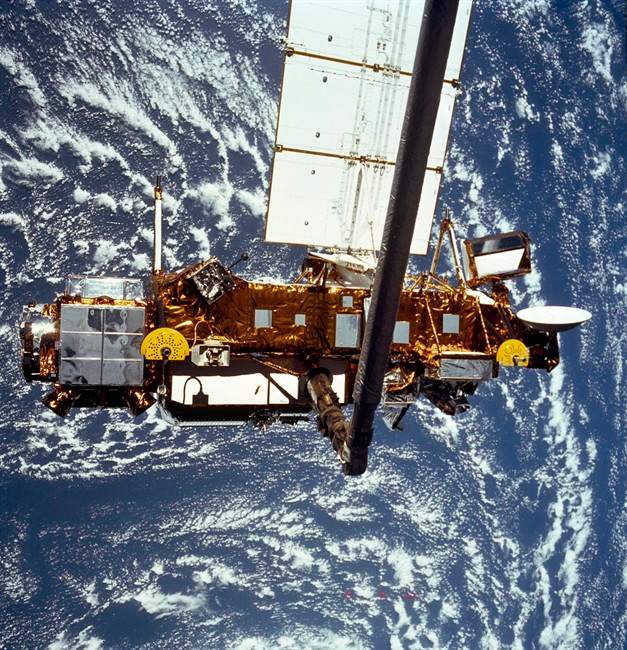
WASHINGTON – NASA’s dead six-tonne satellite plunged to Earth early Saturday, but more than 10 hours later, U.S. space officials didn’t know just where it hit. They thought the fiery fall was largely over water and the debris probably hurt no one.

The agency did not give a more specific location in a midday update on its website, which also said officials were not aware of any reports of injuries or property damage. Most of the spacecraft was believed to have burned up.
The bus-sized satellite first penetrated Earth’s atmosphere somewhere over the Pacific Ocean, according to NASA and the U.S. Air Force’s Joint Space Operations Center. But that doesn’t necessarily mean it all fell into the sea.
NASA’s earlier calculations had predicted that the 20-year-old former climate research satellite would fall over an 800-kilometre area and could include land.
Because the plummet began over the ocean and given the lack of any reports of people being hit, that “gives us a good feeling that no one was hurt,” but officials didn’t know for certain, NASA spokesman Steve Cole told The Associated Press.
The two government agencies said the satellite fell sometime between 11:23 p.m. ET Friday and 1:09 a.m. ET Saturday, but with no precise time or location.

Get breaking National news
There was rampant speculation on the Internet, much of it focusing on unconfirmed reports and even video of debris from the Upper Atmosphere Research Satellite over Alberta.
Jonathan McDowell of the Harvard-Smithsonian Center for Astrophysics said the spacecraft entered the atmosphere around 12:15 a.m. ET over the coast of Washington state. He said much of the debris likely fell over the Pacific Ocean, with some making it to Canada over northern Alberta and perhaps as far as the Hudson Bay.
“Pieces are falling off of this flaming fire ball, and some of it has enough momentum to go hundreds of miles,” he said.
But McDowell said he’d be surprised if anyone was hurt by the debris because it appears to have fallen in such remote areas.
“I do think people saw lights in the sky and fireballs and may well be bits of UARS falling down,” he said.
Cole said that was possible because the last track for the satellite included Canada, starting north of Seattle and then in a large arc north then south. From there, the track continued through the Atlantic south toward Africa, but it was unlikely the satellite got that far if it started falling over the Pacific.
Cole said NASA was hoping for more details from the air force, which was responsible for tracking debris.
But given where the satellite may have fallen, officials may never quite know precisely.
“Most space debris is in the ocean. It’ll be hard to confirm,” Cole said.
Some 26 pieces of the satellite _ representing 550 kilograms of heavy metal _ were expected to rain down somewhere. The biggest surviving chunk should be no more than 135 kilograms.
The Upper Atmosphere Research Satellite is the biggest NASA spacecraft to crash back to Earth, uncontrolled, since the 75-tonne Skylab space station and the 10-tonne Pegasus 2 satellite, both in 1979.
Russia’s 135-tonne Mir space station slammed through the atmosphere in 2001, but it was a controlled dive into the Pacific.
Before the UARS fell, no one had ever been hit by falling space junk and NASA expected that not to change.
NASA put the chances that somebody somewhere on Earth would get hurt at 1-in-3,200. But any one person’s odds of being struck were estimated at 1-in-22 trillion, given there are seven billion people on the planet.
The satellite ran out of fuel and died in 2005. It was built and launched before NASA and other countries started new programs that prevent this type of uncontrolled crashes of satellite.
___
Online:


Comments
Want to discuss? Please read our Commenting Policy first.