

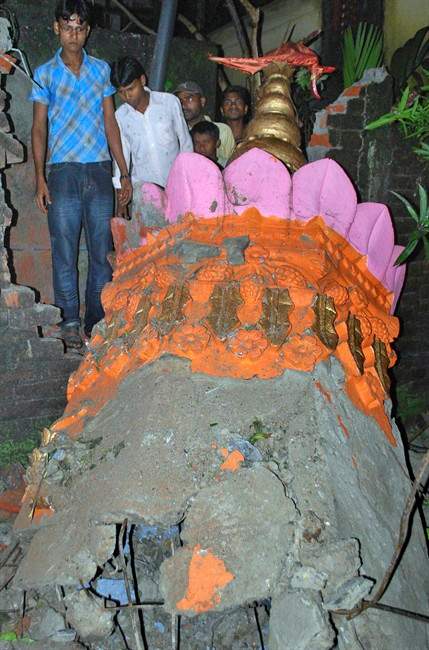
GAUHATI, India – Rescue workers raced Monday to clear roads blocked by mudslides as they scrambled to reach remote villages cut off after a powerful earthquake killed at least 50 people in northeast India, Nepal and Tibet.

Hundreds of paramilitary soldiers and local police working through the night cleared away concrete slabs, bricks and mud to rescue scores of people trapped under the debris of houses that collapsed after a 6.9-magnitude quake struck the mountainous Himalayan region Sunday evening.
At least 25 people died in the northeastern Indian state of Sikkim, where the quake was centred near India’s border with Nepal, police said.
Paramilitary soldiers had pulled out 18 bodies and had located seven others buried under mounds of concrete in Gangtok, Sikkim’s capital, said police Chief Jasbir Singh. At least 50 people, some of them with serious injuries, were hospitalized, he said.
Another 11 people were killed the neighbouring Indian states of Bihar and West Bengal. Seven people died in Nepal and China’s official Xinhua news agency reported seven deaths from Tibet.
Most of the deaths occurred when houses, already weakened from recent monsoon rains, collapsed due to the force of the quake.

Get breaking National news
Heavy rains and landslides hampered rescue workers as they worked through the night to pull people from under the rubble, Singh said.
At least 400 paramilitary soldiers carrying rescue equipment and food supplies were stranded in the closest airport in Bagdogra, as the main highway linking Sikkim was blocked at two places due to landslides, Singh said. Efforts were now on to airlift them to Gangtok, he said.
In Gangtok, police evacuated and cordoned off the office of the top elected officer after the building developed cracks and was severely damaged in the quake, Singh said.
Much of the damage was not immediately known because the region is remote and sparsely populated with many people living in remote areas now cut off by mudslides triggered by the quake.
Nepal’s government said seven people died there, including two men and a child who were killed when a brick wall toppled outside the British Embassy in the capital, Kathmandu. Nearly 70 people were injured, some of them seriously, and were in hospitals across Nepal.
In Kathmandu, members of Parliament who were debating the national budget ran out of the assembly hall into a parking area. They returned 15 minutes later and resumed their session.
TV broadcasters showed footage of buildings buckled, sidewalks cracked and two major roads collapsed in Gangtok, 42 miles (68 kilometres) southeast of the quake’s epicenter near the border with Nepal. The Indo-Tibetan Border Police said two of its buildings had collapsed in Gangtok.
In India’s West Bengal state, utility workers toiled through the night to restore power to a large swathe of the state which plunged into darkness after power lines snapped during the quake.
Prime Minister Manmohan Singh summoned the National Disaster Management Authority for an emergency meeting and ordered that its rescue teams be airlifted to the worst hit areas of Sikkim.
The quake was also felt as far as the Indian capital, with New Delhi residents also rushing out of shaking buildings Sunday. The quake caused some houses in China’s Himalayan region of Tibet to collapse and disrupted a border county’s telecommunications services, Xinhua said.
There were at least two aftershocks of magnitude 6.1 and 5.3, Indian seismology official R.S. Dattatreyan said. He warned more aftershocks were possible.
The region has been hit by major earthquakes in the past, including in 1950 and 1897.
___
Associated Press writers Binaj Gurubacharya in Kathmandu, Nepal; Julhas Alam in Dhaka, Bangladesh; and Gillian Wong in Beijing contributed to this report.


Comments
Want to discuss? Please read our Commenting Policy first.