

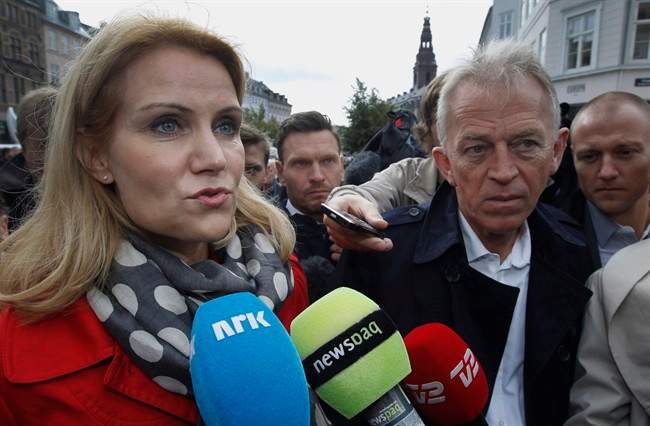
COPENHAGEN – Denmark has elected its first female prime minister, ousting the right-wing government from power after 10 years of pro-market reforms and ever-stricter controls on immigration.

Near complete official results showed Thursday that a left-leaning bloc led by Social Democrat Helle Thorning-Schmidt would gain a narrow majority in the 179-seat Parliament.
“We did it. Make no mistake: We have written history,” the 44-year-old opposition leader told jubilant supporters in Copenhagen. “Today there’s a change of guards in Denmark.”
Prime Minister Lars Loekke Rasmussen conceded defeat, saying he would present his Cabinet’s resignation Friday to Queen Margrethe, Denmark’s figurehead monarch.
“So tonight I hand over the keys to the prime minister’s office to Helle Thorning-Schmidt. And dear Helle, take good care of them. You’re only borrowing them,” Loekke Rasmussen said.
The result means the country of 5.5 million residents will get a new government that could roll back some of the austerity measures introduced by Loekke Rasmussen amid Europe’s debt crisis.
A majority for the “red bloc” also deprives the anti-immigration Danish People’s Party of the kingmaker role it has used to tighten Denmark’s borders and stem the flow of asylum-seekers.
The opposition won 89 of the mainland seats compared to 86 for the governing coalition, according to preliminary results with 100 per cent of votes counted. The “red bloc” was expected to win at least two of the four seats allocated to the semiautonomous territories of Greenland and the Faeroe Islands.

Get breaking National news
A power shift isn’t likely to yield major changes in consensus-oriented Denmark, where there is broad agreement on the need for a robust welfare system financed by high taxes.
But the two sides differ on the depth of austerity measures needed to keep Denmark’s finances intact amid the uncertainty of the global economy.
Thorning-Schmidt wants to protect the welfare system by raising taxes on the rich and extending the average working day by 12 minutes.
Loekke Rasmussen, 47, says tax hikes would harm the competitiveness of a nation that already has the highest tax pressure in the world.
“We need sound public finances without raising taxes,” he told reporters after casting his ballot in Graested, north of Copenhagen.
His centre-right Liberal Party gained one seat and remains the biggest party in Parliament with 47 seats, but its conservative partner lost 10 seats, the official results showed. The Danish People’s Party, which backed the minority government in Parliament in return for a say on its policies, dropped three seats to 22.


The Social Democrats dropped one seat to 44, while other parties in the “red bloc” advanced, including the centrist Social Liberals, which gained eight to 17.
Thorning-Schmidt said she would start government formation talks Friday with the Social Liberals and the left-wing Socialist People’s Party. That coalition can also count on the support of a far-left party, the Red-Green Alliance, which tripled their seats to 12.
Turnout was 87.7 per cent, up from 86.5 four years ago.
Loekke Rasmussen took credit for steering Denmark through the financial crisis in better shape than many other European countries. However, the rebound has been slower than in neighbouring Nordic nations and the government projects budget deficits of 3.8 per cent of gross domestic product in 2011 and 4.6 per cent in 2012.
Although Denmark isn’t part of the debt-ridden eurozone, its currency is pegged to the euro and the country’s export-driven economy is affected by shocks from Europe and beyond.
The government’s reforms include gradually raising the retirement age by two years to 67 by 2020 and trimming benefit periods for early retirement and unemployment.
The economy emerged as the top election theme, to the chagrin of the Danish People’s Party, which has used its kingmaker role in previous elections to push through immigration laws that are among Europe’s toughest.
Thorning-Schmidt isn’t likely to make any major changes to those laws, but she’s promised to overhaul a system of beefed-up customs controls at borders with Germany and Sweden, which critics say violates the spirit of EU agreements on the free movement of people and goods.


Comments
Want to discuss? Please read our Commenting Policy first.