


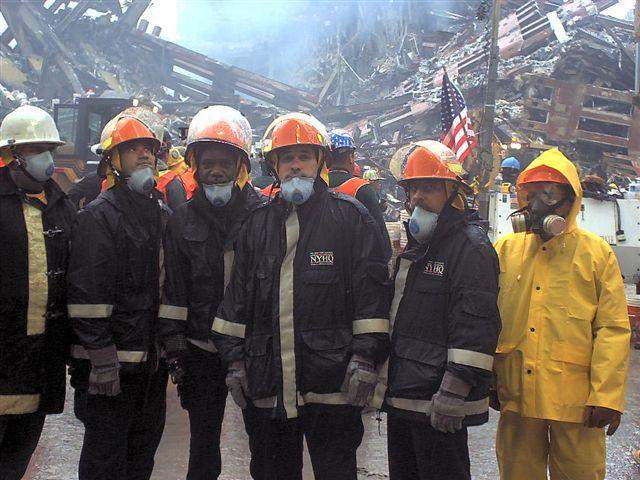
As thousands of people fled the burning World Trade Center, they were the ones who rushed towards it.

Firemen, paramedics and police officers barreled into harm’s way, as they do every day, eager to save the lives of others.
In the panic of the terrorist attacks, there was no time to think about the lethal mix of chemicals that was attacking their lungs.
New York paramedic Marvin Bethea was one of the first people on the scene and he was quick to give his protective mask to the victims on the streets of New York City’s financial district.
“We were totally blind, and it was like somebody was throwing a bucket of dust down your throat,” he recalls. “We didn’t realize the dirt was toxic.”
Mixed in with the rubble and dust from the falling towers were tonnes of asbestos, millions of kilograms of mercury and lead.
Since he answered the Twin Towers emergency call, Bethea’s life has never been the same. He developed severe asthma and suffers from depression. The once healthy paramedic takes between 10 and 15 drugs to keep the lasting side effects of 9/11 in check.

Get breaking National news
Bethea’s health problems are compounded by cruel financial realities.
He can no longer work and can’t get medical insurance. It took him two years to qualify for workers compensation.
“The government can’t throw you into a fire, and if you’re burned, say ‘you’re on your own.’ That’s unacceptable,” Bethea says.
Still, Bethea is one of the lucky ones. More than 1000 first responders and clean-up crew members have died in the decade since they first breathed in a fatal cloud of asbestos, lead, concrete and other toxins.
It’s a reality John Feal has seen firsthand.
“I’ve been to 53 funerals,” says the demolitions expert who volunteered at Ground Zero during the cleanup. “Fifty-one of them the guy died of cancer.”
Feal volunteered at the site, clearing debris until a catastrophic accident stopped him.
“Eight thousand pounds of steel fell on my foot…blood was gushing into the air,” Feal said.
Gangrene set in and half of his foot had to be amputated.
Despite being unable to work, Feal was denied compensation. He has since worked tirelessly to help other first responders, starting up the FealGood Foundation. (please link to it here)
The non-profit works to educate the public about the aftermath of 9/11 for the first responders and relieve some of the financial pressures of the struggling heroes.
“Two-thousand-nine-hundred people died when the towers fell,” Feal says. “We’ve lost 1000 people to illness since then, and we’re going to match the original death toll…we’re almost halfway there.”
Bethea too has not taken the challenge lying down. He founded Unsung Heroes Helping Heroes and took the story of the first responders to the media and to Congress.
After ten years of hard work the tide is starting to turn, as people slowly begin to see the lasting impact for first responders. The U.S. Government recently established a $4 billion fund to help people suffering from 9/11 related illnesses, with one giant omission.
Government officials maintain there is no proven link between the toxins in the air following 9/11 and cancer.
“They were exposed to carcinogens, and it makes sense, people exposed to lots of carcinogens are more likely to develop cancer” says Feal.
On 9/11 Bethea and the other first responders were treated like heroes, but he says that gratitude did not last long.
“We were heroes, and we’re now treated like zeroes.”


Comments
Want to discuss? Please read our Commenting Policy first.