

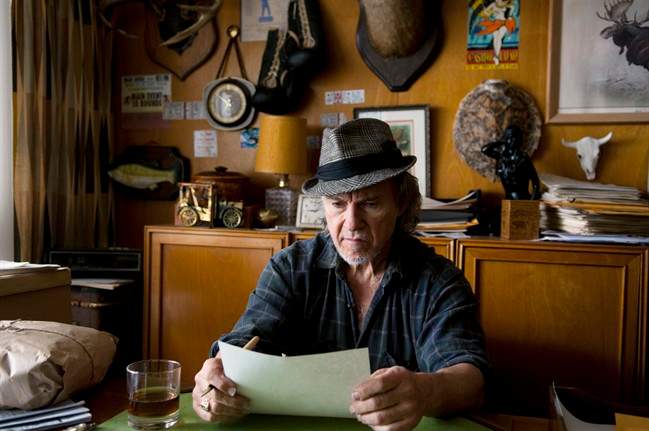
TORONTO – At this time last year, Canadian rookie director Jonathan Sobol was riding high as he prepared for a glitzy gala presentation of his debut film, “A Beginner’s Guide to Endings,” at the Toronto International Film Festival.

He would later take the stage at Roy Thomson Hall to rapturous applause alongside his cast, including Hollywood legend Harvey Keitel and Canadians Tricia Helfer, Jason Jones and Paulo Costanzo.
Fast forward 12 months and few have seen “A Beginner’s Guide to Endings” except insiders, press and audiences on the film festival circuit.
Just being selected for the Toronto International Film Festival, which runs this year from Sept. 8 to 18, is obviously a very big deal for the directors who beat overwhelming odds when their projects are chosen for the annual movie marathon. This year, only 268 feature films were picked from more than 3,000 applications.
But most will tell you it’s just the beginning of their quest to get their movie seen by a wider audience.
“Getting into a festival like TIFF is great but it is just one of many steps toward the release of a film,” Sobol says.
“Just because a film gets made doesn’t necessarily mean it gets seen.”
But Sobol is one of the fortunate ones.
Although it did take a while, his film will finally be released in theatres on Oct. 28 in Canada and the United States. For other filmmakers, who watch the festival fly by without any expressions of commercial interest, the post-TIFF hangover can be painful.
“We show over 250 feature films every year from all over the world, from about 60 different countries, and a lot of them are never going to find theatrical release in North America – that’s the sad fact of the matter,” said Cameron Bailey, co-director of the festival.
“There are a few you think will (get released) but for whatever reason they don’t make it. Either there are just other films that get in the way … or some don’t find the right distribution for them – there are many different factors at play.”
For the buzziest of movies, distribution deals are often signed before the festival even wraps and it’s not uncommon for audiences to be studied as they watch a film, Bailey says.
“We’re a major public festival so the audience is really the key element that sets us apart from, say, the Cannes Film Festival, which is more of an industry event,” he says.
“The distributors are watching the audience, they’re often sitting in the theatre (or) at the back of the room pacing back and forth watching how the Toronto audience responds to a film.
“And if it seems to play really well then they want to buy the film, because they can see if it plays well here in Toronto, it’s likely going to play well in North American release.”
Canadian director Vincenzo Natali was anxiously looking forward to TIFF as he put the final touches on “Splice” in 2009. He had a big budget at his disposal for the sci-fi horror film – by Canadian standards, at least – and great talent in Sarah Polley and Adrien Brody. But even he was still worried about his chances when it came time to find a distributor. He admits he truly feared that his movie could end up with one of the worst fates imaginable: going straight to DVD.

Get breaking National news
“I had no grey hair before I made this film, in fact I didn’t have any grey hair after I made the film. I only got my grey hair when I was trying to sell this movie,” Natali says with a laugh.
Natali ended up showcasing “Splice” at the Sundance Film Festival, where it did find a buyer in Warner Bros.
“We were very lucky (because) had that not happened, probably the only place you’d be able to see ‘Splice’ would be on DVD or through some kind of streaming – and that would be very disappointing to me as a filmmaker,” says Natali, who had two of his earlier films relegated to the video shelves.
But he adds that a movie going straight-to-DVD is no longer an indictment of its cinematic quality and has more to do with the state of the film industry.
“It used to be the worst movies made went straight-to-DVD and the best films were released theatrically, now it’s really starting to change so that some of the worst films that are made are the big stupid blockbuster movies that get 3,000 screens and some of the most interesting, innovative cool entertaining films go straight-to-DVD,” he says.
Every year at TIFF there are fantastic movies that just don’t fit the formula the industry usually follows and are deemed too risky to be picked up, says Tim Brown, founder of Joker Films, which sells film rights to distributors and studios.
Or sometimes, he adds, good films just suffer from bad luck and don’t get seen by the right people.
Brown recalls “Cooper’s Camera,” a Canadian film starring “Daily Show” vets Samantha Bee and Jason Jones and Dave Foley, as an example of a hilarious movie that just went nowhere after screening at TIFF in 2008.
“If there’s 200-plus films that come into the market, (buyers) are obviously not going to be able to look at all those movies, they’re going to be focused on maybe 10 per cent, maybe 20,” Brown says.
“I went in the screening and it went off just like gangbusters, it played fantastically well, and I thought, ‘This was the chance this film had, if a buyer was in the room, or more than one buyer was in the room, and saw the audience reaction we could’ve generated interest in the movie.’ But, no one went to that screening.
“If there’s no buyers in the room, it’s irrelevant.”
Buyers are obviously looking for hits and sometimes even getting a distribution deal doesn’t mean a film will get a chance in front of a theatrical audience.
“There are so many factors that come into play that have nothing to do with the movie or how good it is – quality has zero to do with it,” Brown says.
“They’re like, ‘OK guys, this is a good movie, but is it worth it? Should we put an extra $2 million into this (for advertising and promotion)?’ And they make a decision and therein lies the outcome of your movie, period. They sit back and they go, ‘It’s not worth it? OK guys, straight to video.’
“They’re going to do whatever they think makes them the most amount of revenue with the least amount of risk, because that’s their objective.”
Both “A Beginner’s Guide to Endings” and “Splice” had funding from Telefilm Canada, an arms-length government-funded organization that supports the audiovisual industry.
The organization’s feature film program has a mandate of supporting “the making and marketing of Canadian feature films that have high box office potential.” Telefilm is flooded with applications from filmmakers every year and has to try to figure out which have the best chance of becoming hits.
“The criteria is really subjective when you’re deciding whether or not to invest in something, so like any business, we’re investing with the hope of recouping, we’re trying to make our best judgement call,” says Karynn Austin, Telefilm’s interim national feature film executive for the English-language market.
“You cross your fingers, you hope it’s going to end up winning awards and be a box office smash.”
Of course, not all of them are. In 2010, “Barney’s Version,” “Fubar 2” “Good Neighbours” and “Incendies” were among the most prominent of the more than 50 feature films that received Telefilm funding, but most of the others would be considered unknown to all but the most devoted followers of Canadian film.
Sobol admits he’s anxious to see what kind of promotional effort his film will get, what kind of competition it’ll face at the box office on opening weekend, and whether it will make a splash.
“Every filmmaker worries about (that stuff), you’d have to be crazy not to be, simply because it so closely determines the success of your film,” he says.
“Often times it will get buried or lost in the shuffle,” he says, “you don’t know if you’re going to get … a lot of screens or a few screens – you just never know.”
“The Joneses,” which premiered at TIFF in 2009, seemed to have all the ingredients for box office success. First-time director Derrick Borte secured David Duchovny and Demi Moore as leads and the strong supporting cast included Lauren Hutton, Gary Cole and Amber Heard.
The comedy was well-reviewed at TIFF but the hype still wasn’t enough to get the film a proper big-screen release in Canada. It did get released in the U.S. but fizzled out after a disappointing opening weekend. For one thing, it had the misfortune of opening against the talked-about premiere of “Kick-Ass,” which won over comic-book geeks, and the second weekend of “Date Night,” starring Steve Carell and Tina Fey. And while “Kick-Ass” and “Date Night” opened in more than 3,000 theatres, “The Joneses” was screened in less than 200.
“It opened against some tough competition with ‘Date Night,’ which obviously had huge promotion, and in the States it just really wasn’t promoted very well,” Borte says.
“I’ve had so many people tell me – ‘in the know’ people – that had my film been promoted the right way it would’ve done really well. It’s just one of those things where you can only control so many pieces of this puzzle.”
But if there’s a silver lining for Borte it’s that the film has found a second life after being released on DVD and hitting Netflix in the U.S. A TV show based on the movie is also now in development for ABC.
“The movie’s still finding its audience, it wasn’t given a chance to find its audience theatrically because it didn’t have the promotional dollars to do so. But it’s finding its audience now.”


Comments
Want to discuss? Please read our Commenting Policy first.