


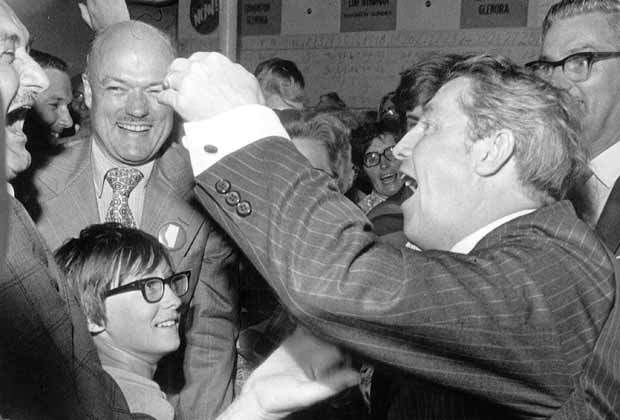
Albertans voted for transformation in 1971.

After 36 years of traditional conservative rule, in came the Progressive Conservatives under Peter Lougheed.
He was a young, well-dressed lawyer, not nearly as flowery as Ottawa’s pirouetting Pierre Trudeau, but far more hip than the older, preacher-like Social Credit Premier Harry Strom.
There were long hair and bad sideburns on men, and bell-bottoms and tie-dyed dresses for women.
After more than three consecutive decades under Social Credit, political change was in the air.
“It was a very exciting time because finally, we were going to be rid of the Social Credit and everything they stood for,” said Winston Gereluk, who was a 27-year-old graduate student studying philosophy at the University of Alberta in 1971. He was clean-shaven and had short hair – “I was thought to be a little strange,” he says now – but was working on the campaign of NDP candidate Timothy Christian, the scruffy looking Students’ Union president at the U of A running in Edmonton’s Strathcona riding. Christian is now a lawyer.
“Change was in the air everywhere,” said Gereluk, now 67. Vietnam protests and the fight for civil rights were still going on in the United States. All in the Family was debuting on TV and Led Zeppelin’s epic metal ballad Stairway to Heaven was burning up the airways late that year. “People were taking on the system and Lougheed promised that kind of change.”
The PC party was fiscally conservative, allowing businesses to flourish, but socially progressive, allowing people to choose what they wanted, Gereluk said. No more centralist ideology where government controlled things for the good of community. No more successors to Ernest Manning, former premier and preacher-politician, bringing Back to the Bible Hour over a Calgary radio station to all Albertans.
“Back then, there was no doubt it was going to be the Conservatives who were going to whip the Social Credit,” Gereluk said. “They were promising a more progressive way of looking at things. They were going to be more neo-liberal, free society up both economically and socially. To vote against the Social Credit was to vote against the church and God and all that.”

Get daily National news
Even Gereluk’s parents told him God wanted them to vote for the Socreds, a strong theocracy at the time.
But Gereluk was anti-establishment.
“Everywhere you went you would see black light and mandalas glowing on the walls,” he said. “Much of the same spirit surrounding (recently deceased NDP Leader) Jack Layton kind of surrounded Peter Lougheed and his group of hopeful. … Everyone was really quite excited because they were seen as representing change.”
Even so, John Barr was personally devastated by the defeat of the Social Credit party.
“I viewed it as a victory of style over substance, but then I was on the losing side,” said Barr, who was one of the “Young Turks who came together to modernize the Social Credit party and government at the time. “Lougheed was from an old Alberta family, was attractive, moderate, optimistic and didn’t threaten any radical change in anything, just a more modern version of Social Credit’s middle-of-the-road efficient government.”
But Lougheed did promise to defend Alberta’s interests, and he kept that promise, Barr said in an email interview.
Barr himself was in his early 30s at the time, had a family and mortgage and as a self-described old soul, didn’t care a lot about the July 3, 1971 death of Jim Morrison, lead singer for The Doors. “The whole youth revolution thing started to lose its momentum sometime in the late ‘60s,” said Barr, a retired communication consultant now living in Boundary Bay, B.C. “What I mainly remember about Archie Bunker (the bigot star of the hit TV show All in the Family) was that quite a few people were shocked by the blunt language and the open use of racial and other put-downs. Traditional Canadian society in those days was a more genteel place. Not quite ‘Sir’ and ‘Ma’am,’ but a lot more than today. The feeling was that you just didn’t talk to people the way Archie did.”
Yet 1971 brought change, said Robert Thompson, a pop-culture professor at Syracuse University in New York state. Although Thompson doesn’t know Alberta’s political history, he said the move from Social Credit to Progressive Conservatives matches what was happening elsewhere, even in popular culture.
“Songs like Stairway to Heaven were starting to make Elvis look positively traditional,” he said.
“If you were of a certain age, these were very exciting times because they really were revolutionary on a cultural level. You could argue in ‘71, all the shaking, rattling and rolling finally knocks the house down. Then we move into the new cultural, political and social foundations which has to re-establish it on the rubble of the old.”
Before then, the shows on television, such as Gilligan’s Island, Mister Ed, The Munsters and The Flying Nun, were escapist with castaways, talking horses, monsters and, well, flying nuns. All in the Family, perhaps the most influential entertainment show in U.S. television history that launched January 1971, finally addressed issues raised daily on the news such as racism, rape and antiwar sentiment.
“All in the Family is kind of the representation how by 1971, it became clear that all those things we call the counterculture through the 1960s had now definitely without question become the mainstream culture,” Thompson said. The world was chaotic, with the Helter-Skelter inspired murderer Charles Manson sentenced to death that year (the sentence was later commuted to life imprisonment), abortion being done in a Netherlands clinic and Mount Etna erupting in Sicily.
But that year also marked the opening of Walt Disney World in Orlando, Fla., the debut of the new stock market index called the Nasdaq, and the completion of the south tower of the World Trade Center, then the second tallest building in the world.
And whatever was new in 1971 soon became the norm, Thompson said. The Progressive Conservatives have stayed for 40 years.
“Once that gets established, it becomes, like so often, the new orthodox,” he said. “It’s not counter-culture anymore.”


Comments
Want to discuss? Please read our Commenting Policy first.