


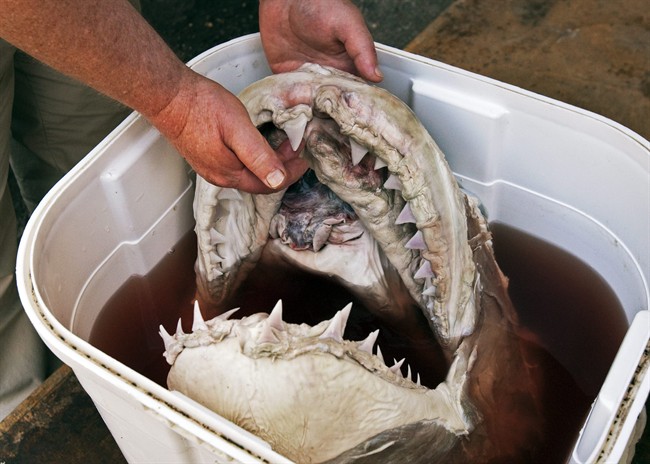
HALIFAX – The jaw of a 272-kilogram great white shark caught in the Bay of Fundy will be put on display at a Halifax museum next month.

It is all that’s left of the massive ocean predator, which became accidentally trapped in a fishing weir near Economy, N.S., earlier this month.
John Gilhen, the curator emeritus for the Nova Scotia Museum of Natural History, said the catch is significant because aside from the rare sighting, there’s been little physical evidence of great whites near the province.
“It’s a big deal because every year we hear stories about sharks and quite often about white sharks, but we don’t have any real evidence,” Gilhen said.

Get breaking National news
“But now with these jaws, this is solid evidence that white sharks visit the coast of Nova Scotia.”
Gilhen said the three-metre shark is believed to be a juvenile female and was only about half grown when it was caught Aug. 7.
He said the shark was caught alive, but eventually died.
The fisherman who found the animal thought it was a mako shark, but Gilhen said he suspected otherwise when he looked at photographs of the animal that were sent to him two days later.


“I could see from the triangular teeth that it was a white shark,” he said. “So we managed to get the head.”
That head obtained by the museum weighs around 45 kilograms.
Gilhen said he will gradually strip away fleshy cartilage from the jaw, which emits a pungent odour, with a knife.
He will eventually switch to a scalpel to expose the remaining bone and rows of razor-sharp teeth that will be framed to prevent it from buckling.
The jaws will then go on public display in the museum’s marine gallery some time in mid-September.
“And of course it’s always available to scientists who want to examine it,” said Gilhen.


Comments