

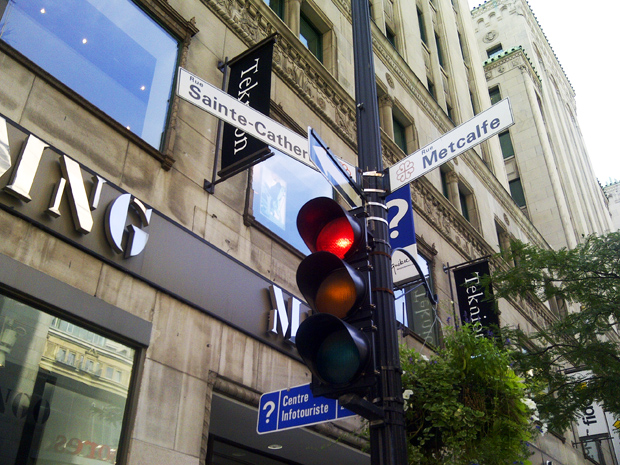
Not only do Montreal drivers have to watch for falling concrete, they also need to keep an eye out for local Grand Prix hopefuls flying through red lights. According to a Global News investigation, Montreal drivers receive proportionally more citations for running a red light than anyone else in the province of Quebec.

View our interactive map below
Montrealers have a reputation across Canada for being aggressive, dangerous drivers. Their fame has even spread internationally – in 2004, the US state department issued a travel advisory warning tourists about Montrealers’ habits of tailgating and changing lanes without a signal. It also expressed concern about Canadian drivers frequently running red lights.
But despite this reputation, the reasons why there are so many red-light infractions in Montreal are a little more complex, and might not be just about bad driving.
Global News analyzed statistics from the Societé de l’assurance automobile de Quebec (SAAQ), Quebec’s public auto insurer. These statistics showed information on a variety of traffic-related offences for residents of each Quebec municipalité régionale de comté (MRC – or in English, regional county municipality) in 2009. By comparing the number of offences to the number of licensed drivers in each MRC, a picture of driving patterns across the province begins to emerge.
Montreal has a rate of 14.4 citations per 1000 drivers for failing to obey a red light, significantly higher than the runner-up, Laval, with 9.8 citations per 1000 drivers. It far outstrips Quebec’s next most populous city – Quebec City, which has a rate of only 5.4 per 1000.

Get breaking National news
According to Lieutenant Louise Bonneau of the road safety and traffic division of the Service de police de la Ville de Montréal, the high rate of red light infractions in the city can be explained by two factors: the number of red lights in the area and police enforcement.


“Half of the province’s traffic lights are in the City of Montreal,” said Bonneau. “Even just in the old City of Montreal, there are 2,500 traffic lights and on the entire island, we’re talking about close to 3,200 traffic lights. So, it’s normal that the rate of infractions would be higher.”
Montreal police have also made policing intersections a priority.
“Most of the time, accidents happen at intersections. So, it’s part of officers’ targets for intervention, to watch that people respect red lights,” she said.
Outside Montreal, other regional municipalities stand out for different traffic offences. The MRC of Saguenay, which includes the towns of Chicoutimi and Jonquière, has the highest rate of citations for failing to wear a seatbelt in the province (20.7 per 1000 drivers).
The northern Quebec territories of Eeyou Istchee have the highest rates of citations for excessive speed, immediate suspensions for alcohol while driving, and unpaid fines in the province.
While they do not have the detailed information to explain with certainty why one region has more traffic citations than another, there are a number of things that could account for regional differences, said Gino Desrosiers, media spokesperson for the SAAQ.


“It’s certain that part of the statistic is behaviour, but we can’t say precisely whether culturally in one region, there is any tendency to exhibit delinquent behaviour compared to other regions,” said Desrosiers.
The level of police surveillance, the number of officers compared to the population and local police priorities contribute to the number of recorded offences, he said.
Certain demographic factors, such as the population of an area and the number of kilometers travelled per person can also affect the statistics, he said. Environmental factors can also be to blame, such as traffic lights being more common in cities than in the country.
“You can also imagine that proportionally, there will be more drivers arrested for drinking and driving in the country than in a city simply because alternative modes of transportation such as public transit, taxis, and designated driver programs are less common in rural areas and are sometimes non-existent,” said Desrosiers.
And how do Montreal drivers compare to other Canadian cities? Precise figures are difficult to find for many cities, but when it comes to red lights, Montrealers had a rate of 14.4 infractions per 1000 drivers in 2009. This is nearly double the City of Vancouver’s 2009 rate of 7.8 per 1000, according to ICBC figures. Whether that is due to the number of traffic lights, the amount of police enforcement or other factors is harder to say.
Comments