


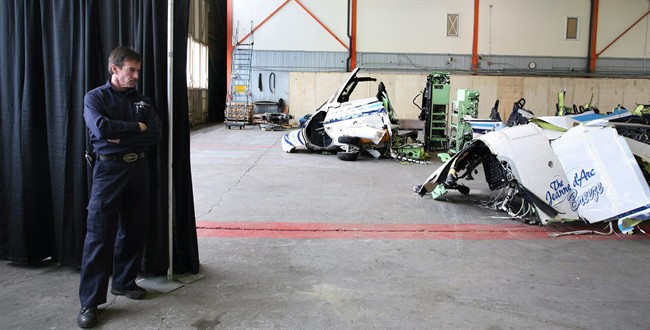
ST. JOHN’S, N.L. – An inquiry report into offshore helicopter safety off Newfoundland and Labrador says a proposed independent regulator should have “all-encompassing” oversight of chopper safety.

Commissioner Robert Wells recommends in his report released Monday that the safety regulator should be able to take any action it considers necessary to prevent the risk of injury or death.
His report is the second stemming from an inquiry that was launched after Cougar Flight 491 crashed east of Newfoundland on March 12, 2009, killing 17 of 18 people on board.
His first report, released in November, called for the establishment of an offshore safety body or an autonomous division within the Canada-Newfoundland and Labrador Offshore Petroleum Board.
Critics have accused the board of a conflict of interest because it is tasked with developing the province’s offshore resources to the maximum extent while also protecting workers and the environment.
The board declined comment Monday, saying it is reviewing the report and will make its position known once that’s complete.

Get breaking National news
Wells said the new agency he is calling for should take into account Transport Canada’s role, but also have the ability to take action independently on mechanical problems.
“The public does not compartmentalize safety into separate sectors, with air safety being a matter only for Transport Canada,” he said in his report.
“To express it bluntly, I envisage a safety regulator for the offshore as having a mandate to learn about the background of any equipment being used or to be used in the offshore, including helicopters.
“It should have the knowledge and authority to say when additional measures are needed and the duty to pursue improvements.”
He also calls for the creation of a board of citizens to advise the proposed regulator.
Wells said he agrees with the Transportation Safety Board of Canada finding that all helicopters be capable of flying for 30 minutes after losing oil – even if it means retrofitting older model choppers.
The U.S. Federal Aviation Administration has said it would not be practical to require all existing helicopters be equipped with main gearboxes that meet that 30-minute requirement, citing costs. But it said a rule change for gearboxes is proposed for future aircraft.
Wells, a retired judge with the Supreme Court of Newfoundland and Labrador, was asked to assess whether helicopter travel is as safe as possible to offshore oil sites more than 300 kilometres east of St. John’s.
A spokeswoman for Transport Canada said the agency is already working with industry and the offshore regulator to share information that enhances safety.
“The department will learn from the Canada-Newfoundland and Labrador Offshore Petroleum Board enquiry and recommendations, as it continues to work with all stakeholders on information sharing procedures that enhance safety,” wrote spokeswoman Maryse Durette in an email.
Wells said in an interview that he expects that the federal and provincial governments will move on his key recommendation to set up a separate agency with distinct safety powers.
The change would have to take place through a change to the Atlantic Accord, a federal-provincial agreement that sets up the powers of the offshore regulator.
“I think it will take some months. Governments … can’t move in a day or a week,” he said.
– By Michael Tutton in Halifax


Comments
Want to discuss? Please read our Commenting Policy first.