


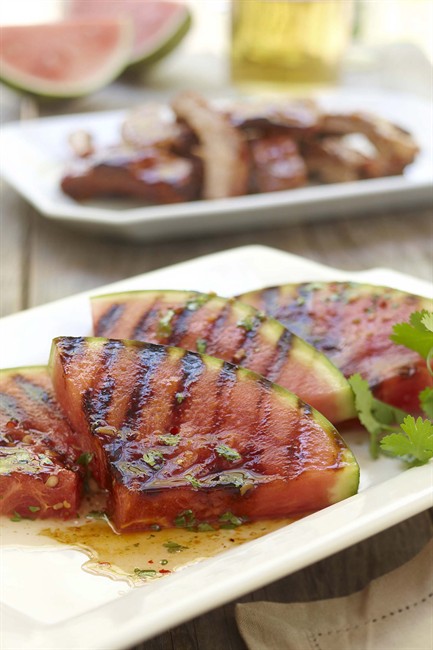
TORONTO – Nothing beats biting into a wedge of refreshing watermelon at a family barbecue or summer picnic when the temperature is soaring.

“My favourite way to eat watermelon is to have a whole triangular slice on a hot summer day,” says registered dietitian Cara Rosenbloom.
The fruit packs a healthy punch, with an antioxidant known as lycopene which gives it its deep pink colour, as well as vitamins A and C. Plus it’s low in calories and has no fat, sodium or cholesterol.
“What’s interesting about lycopene is we usually hear about it in relation to tomatoes, but watermelon is actually the lycopene leader among fresh produce. It has almost double the amount of lycopene on a cup-per-cup basis when compared with raw tomatoes,” Rosenbloom said in an interview.
Most of the research on the anti-cancer properties of lycopene have focused on prostate cancer, said Rosenbloom, who runs a nutrition communications business called Words to Eat By.
Other fruits that contain lycopene are pink grapefruit, apricots, guava and papaya. Strawberries are not included on the lycopene hit parade.
There is definitely a reason for the name given to watermelon – the fruit is 92 per cent water.
“It is a very hydrating fruit and that’s why it’s so good to eat it in the summer months because when you’re outside and it’s warm and you want something refreshing, watermelon is great,” says Rosenbloom.


“It’s especially good for kids who don’t always have a very well-honed sense of thirst. You often have to remind children to drink, but when you have watermelon around in addition to water you can be sure they’re hydrated,” says Rosenbloom.

Get breaking National news
A 500-millilitre (two-cup) serving of watermelon only has about 100 calories. “So when you compare that to those 100-calorie snack packs you’re not really getting much nutritional value from those, but with watermelon you’re getting vitamin A, vitamin C, antioxidants, lycopene, all the water.”
Much of the watermelon consumed in Canada is grown in the United States, which is the fifth largest producer following China, then Turkey, Iran and Brazil. Florida, Texas, California, Georgia, Arizona and Indiana are the lead producing states, Jason Hanselman, an analyst with the National Watermelon Promotion Board, said in an interview from Rochester, N.Y.
Relatively new in the marketplace are mini varieties, which weigh in at 1.5 to 2.2 kilograms (three to five pounds). “We find they’re exceptional for smaller households. They’re a lot more convenient. They fit in your fridge better,” Hanselman said.
There are also dozens of seedless and seeded varieties that can weigh in at up to nine kilograms (20 pounds). “We are seeing that more than 90 per cent are seedless nowadays at retail,” he noted.
There are also watermelons with yellow and orange flesh. “You get this connotation that yellow is not going to taste like watermelon, but you bite into it and it’s exactly the same if not a little bit sweeter,” Hanselman said. “So I think it’s more than just a novelty or decoration because they taste excellent.”


They have a little higher sugar content which boosts the sweetness, but they don’t contain the lycopene of the traditional red watermelon.
Don’t think you only have to eat watermelon for dessert. Rosenbloom, who is also a spokesperson for the National Watermelon Promotion Board, says you can enjoy the fruit in appetizers, salads and main courses too.
One of her favourite ways to eat it is in a salad with feta cheese, olive oil and balsamic vinegar.
“Olive oil actually helps bring out the lycopene and helps the body absorb it even better,” she explains. Balsamic vinegar and feta bring out the flavour of the watermelon.
Likewise, using watermelon slices as “bread” to sandwich cheese is another delicious way to enjoy the fruit. “It works really well with salty flavours like feta cheese. It just brings out this wonderful flavour in watermelon,” says Rosenbloom.
Combining chopped watermelon and tomato into a bruschetta-type topping gives a double boost of lycopene. Spoon it on top of crackers or crusty whole-grain bread.
For a slushy treat, try mashing watermelon flesh slightly and freeze it. When it is semi-solid, let it defrost slightly and eat it. “And because it has a high water content it does freeze well and defrost in a slushy manner which is fun.”
Watermelon holds its shape well in fruit salads. Creative cooks may scoop out the watermelon flesh and then carefully sculpt the rind into a vessel in which to serve the fruit salad.
Don’t overlook the watermelon rind, which is regarded as a delicacy by some. In China, for instance, it’s used in stir-fries like a vegetable. The first cookbook published in the U.S. in 1776 contained a recipe for watermelon rind pickles.
—
Online:
National Watermelon Promotion Board, http://www.watermelon.org.
Comments