


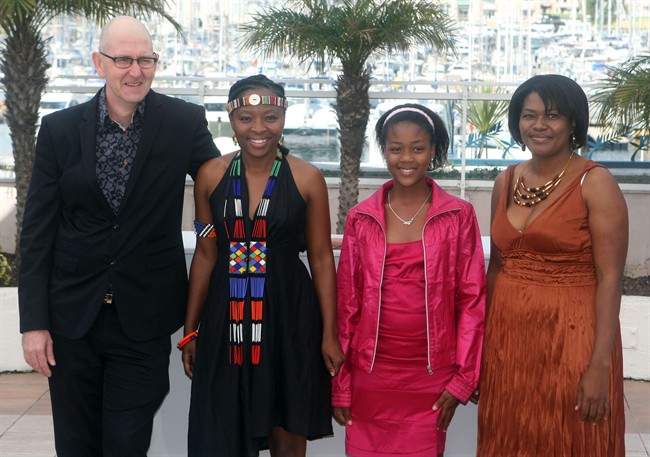
TORONTO – For many years, South African director Oliver Schmitz had thought about making a film about an issue like HIV/AIDS. But he didn’t find a story that was powerful enough – that is, until he read the 2004 novel “Chanda’s Secrets” by Toronto author Allan Stratton.

Schmitz was so moved by the young-adult book, about a young girl whose family is impacted by AIDS in Sub-Saharan Africa, that he adapted it into the big-screen tale “Life, Above All,” which opens Friday in Toronto and Montreal.
“This mother-daughter relationship is the thing which grabbed me in the book. It was so emotional,” Schmitz, who lives in Berlin, said in an interview at last September’s Toronto International Film Festival, where the film screened.
“This kid fighting for her mother and for her mother’s love and for her mother’s standing in the community – it was so powerful that I thought: ‘We have to do this.'”
Vancouver-based Dennis Foon, who is Stratton’s friend, wrote the screenplay for the film, which won the Francois Chalais Prize when it debuted at the 2010 Cannes Film Festival. The German-South African co-production was also South Africa’s official entry for the 2011 Academy Awards.
Khomotso Manyaka plays the lead role of Chanda, a 12-year-old who has to raise her younger siblings and battle stigma after her newborn sister dies and her mother (Lerato Myelase) falls gravely ill.

Get daily National news
Keaobaka Makanyane plays Chanda’s troubled best friend, Esther.
Schmitz said Manyaka and Makanyane live in a community a couple of hours outside Johannesburg and had never acted before shooting the film. He found them through his casting director.
“They both have a capacity to actually take those characters and internalize them and actually make them really come alive. I’m still astonished,” said the filmmaker, whose previous projects include “Hijack Stories” and “Mapantsula.”
“A lot of people we used came from that community…. Everybody there was very excited. They’d never worked on a movie before and were incredibly generous, I must say. It was a fantastic feeling.”
Schmitz shot the film in Elandsdoorn, a township about 200 kilometres northeast of Johannesburg. The film is subtitled as the cast spoke in the South African Pedi language.
Schmitz – who left South Africa in the 1980s because he didn’t want to do mandatory military conscription under apartheid – said he didn’t want to make a political film. Instead, he wanted emphasize the emotional impact on families where there are an estimated 800,000 AIDS-related orphans.
“I think what really works about the story is that anybody can watch it with their defences down about AIDS issues, about who’s responsible and so on, and the story kind of creeps up on you,” he said.
“I think that’s the power of it.”
Stratton also focused on the emotional impact, rather than the political issues, of HIV/AIDS in “Chanda’s Secrets,” which he wrote after meeting AIDS orphans during his travels around Africa.
The book has been published around the world and picked up for use in schools, most recently in Botswana, Zimbabwe, Lesotho and Swaziland.
Stratton said he recently received an email from a Namibian teacher whose village is full of kids who’ve lost one or both parents to AIDS but are ashamed to talk about it.
When the teacher put “Chanda’s Secrets” in the school library, a 14-year-old boy who’d lost both parents to AIDS a few years ago took it out.
“A few days later he said to the teacher, ‘Ma’am, I was lying on my bed reading the book and the sun was streaming through the window. I suddenly realized I was crying. Ma’am, I haven’t cried in two years,'” Stratton said in an email to The Canadian Press.
“He started reading it to friends who couldn’t read. That’s when the teacher began to teach it. She realized it was so true to the lives of her students that while they couldn’t talk about their own parents, they could talk about what happened to Chanda. It was a kind of grief therapy.”


Comments
Want to discuss? Please read our Commenting Policy first.