

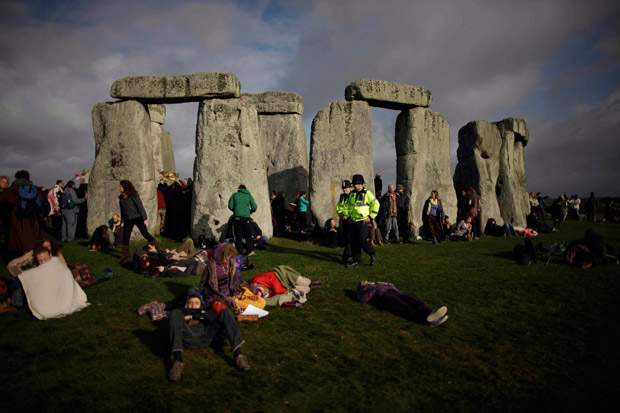
Neo-pagans, new agers, and sun worshippers celebrated the summer solstice at Stonehenge in England Tuesday morning.
The prehistoric monument has become a popular spot for summer solstice celebrations in the Neo-pagan community, particularly with Neo-druids, who promote harmony and worship of nature, and respect for the environment.
English Heritage reported more than 18,000 revellers gathered Tuesday at Stonehenge, about 130 km from London on Salisbury Plain, to witness traditional Pagan ceremonies, marking the longest day of the year.
A key feature of Stonehenge that attracts sun worshippers every year is the Heel Stone. Standing nearly five metres tall, just outside of the main entrance to the henge, the Heel Stone is also referred to as the “sun stone.” When standing inside Stonehenge, you can watch the sun rise above the heel stone at the summer solstice.
The reasons why Stonehenge has become a place of religious worship in the Neo-pagan community is not entirely clear. The monument is rooted in mystery and folklore.
A passage on the English Heritage website reads:
“Stonehenge’s orientation in relation to the rising and setting sun has always been one of its most remarkable features. Yet it remains uncertain whether this was because its builders came from a sun-worshipping culture or because – as some have asserted – the circle and its banks were part of a huge astronomical calendar?”
Stonehenge was erected in three stages between 3000 BC and 1600 BC. Over the years, numerous theories on how it was created, and what is was created for, have circulated. Recent theories hypothesize that it was used as a burial site, a place of healing, or a combination of both.
Stonehenge is one of Britain’s most popular tourist destinations, with over 850,000 visitors every year. Access to the monument is normally tightly controlled, but every year during the summer solstice the barriers surrounding Stonehenge come down.
With files from the Associated Press



Comments
Want to discuss? Please read our Commenting Policy first.