


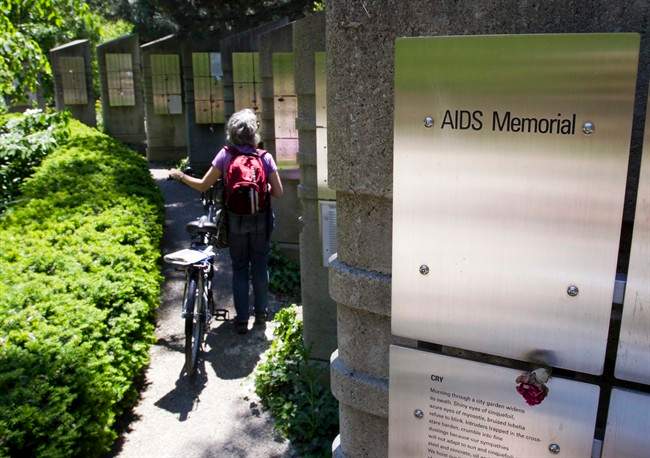
TORONTO – Tucked away in the heart of downtown Toronto, a memorial garden for those who have died of AIDS is a visual reminder of the epidemic that has sickened and killed tens of millions worldwide since the disease first struck three decades ago.

Twelve brick pillars curve along a leaf-covered walkway, 11 of them bearing brass plaques inscribed with the names of those claimed by the devastating illness. A single name graces the plaque for 1982, mounting to dozens and dozens annually as the years march forward: 1983, 1984, 1985 and so on.
The rollcall of names also provides a kind of chart tracing the disease, which began as a trickle and at its height had built to a tsunami.
Sunday marks the 30th anniversary of the first report by the U.S. Centers for Disease Control of five gay men in Los Angeles afflicted by a rare pneumonia. A report a couple of months later described others with an uncommon disfiguring cancer, Kaposi’s sarcoma.
Cases began to pile up, especially among homosexuals in large cities like New York City, Los Angeles, Toronto and Vancouver, leading to talk of a mysterious “gay plague” that lay waste to patients and baffled physicians.
Dr. Philip Berger, who began his downtown Toronto medical practice in 1978, remembers that time of almost helpless horror.
“People started getting really sick in the early ’80s and those were terrible years because there was an onslaught of life-threatening and fatal infections and tumours that were ferocious – and their deaths were ferocious,” he recalls. “And there was not much that doctors could do.”
In his practice alone, which included a large number of gay men, he saw up to six deaths a month, starting about 1984 and continuing for more than 10 years. In all, he estimates several hundred of his patients died from AIDS.
“I spent a lot of time doing house calls and death certificates. I carried, as many of us did, death certificates in our briefcases. We had them on us all the time.”
What Berger and a small group of other downtown doctors willing to treat AIDS patients didn’t have were the knowledge or tools to fight the emerging disease. All they could do was dispense sleeping pills, painkillers and kindness.
“I’ve seen stuff that no one sees anymore,” he adds, describing a young heterosexual street worker, who before his death developed an AIDS-related infection called progressive multifocal leukoencephalopathy, a condition that “punches holes in the brain” and caused the man to become violently psychotic.
Among the haunting memories are the patients with Kaposi’s sarcoma, whose faces and bodies could be covered with “hideous, grape-like lesions” that would erupt on the skin but also in the mouth, nasal passages and even penetrate internal organs like the lung and gastrointestinal tract.

Get daily National news
On one occasion, he was called to an apartment to see two IV-drug users, Berger says. “This one woman who was wasting away from AIDS hauled me into the bathroom and stripped her clothes off and said: ‘Look at me. Look at my wasted body!’ She was just desperate. She was just skeletal and died a few months later.”
The disease was renamed acquired immune-deficiency syndrome and in 1984 traced to a retrovirus – dubbed the human immunodeficiency virus, or HIV – which could be transmitted by blood, semen and even breast milk. The disease soon spread, infecting blood-transfusion recipients, heterosexuals and newborns through their mothers.
HIV could infect anyone – and it did.
It wasn’t until 1996-97 that years of frenzied research provided the first successful antiretroviral drugs for patients, commuting what was almost a sure death sentence and transforming HIV infection into an often chronic but manageable disease.
“It was a wonderful rescue for me,” says Allan, 56. “If they hadn’t been out, I wouldn’t be here.”
Allan, who asked that only his first name be used for privacy reasons, lives in a Toronto apartment run by Fife House, an organization that provides secure and affordable housing and support services for people with HIV.
Diagnosed at 30, Allan developed the classic fatigue, sweats and mononucleosis-like symptoms of HIV, but did not fall prey to AIDS-related infections like Kaposi’s and pneumocistis pneumonia carinii as many of his friends in the gay community did, although he has had his share of frightening health scares, including an episode when the virus attacked his brain.
For about two months, he lost the sight in one eye and the ability to speak, and he had no mobility on his right side.
“That was terrifying,” he says. “My fatigue was enormous, so I was really extremely disabled. But I came back, I came back pretty well full capacity.”
While he doesn’t like the term long-term survivor, Allan has been living with HIV for 26 years and is now seeing the accelerated aging effects born of the virus and the medications that keep him alive.
“I feel it inside and I know it biologically that my organs are five to 10 years older,” says Allan, who was successfully treated for lymphoma about 10 years ago and now has diabetes.
“It’s very hard for me to relate to this so-called manageable notion because we’re carrying a virus that is transmittable and that can destroy people’s lives, which is very different from diabetes or cancer. And the treatment is actually chemotherapy and it has high consequences on your quality of life. You’re at much higher risk for heart disease, for everything.”
Michael Blair, director of community programs and student placements at Fife House, says complex health issues occur for everyone as the years pile up – diabetes, heart conditions, high blood pressure.
“All of those things that come with aging, they’re also layered with people who are dealing with HIV,” he says. “And some of those aging conditions that we all experience are exacerbated and made more difficult because of the HIV, and some of that stuff occurs earlier than it might normally happen.”
As well, people who have lived with HIV for many years are prone to a number of cancers, among them lymphoma and bowel, pancreatic and anal cancers, he says. HIV-related dementia is also a concern.
Then there are the psychosocial issues, chief among them an overwhelming sense of loss, points out Keith Hambly, executive director of the organization.
“Folks who have been positive for a number of years, particularly from the early days, have witnessed a loss of friends and colleagues and community – and they survived,” he says. “But it’s also they didn’t expect to be living this long and in some of our residential programs … even though they may be with friends and staff, I think there is a bit of a social isolation that exists.”
“For many people, it’s been loss of their livelihood,” continues Blair. “Sometimes, there is the loss of relationships, loss of intimacy because (people say), ‘I’m now HIV-positive, who’s going to want to be with me?’ And whether that’s real or not, it can become how a person views themselves.”
And although it pales when compared to what early AIDS patients went through – many family doctors wouldn’t touch them and fully gowned, masked and gloved health providers would slide food under their hospital doors for fear of contagion – “stigma is still a huge issue,” says Blair.
And so, too, is fear about the future.
“I do worry, like all of us worry, about aging and money and living with dignity and having control over my life,” says Allan, who is too unwell to work but volunteers two days a week as a counsellor at a downtown community centre. “There is all this what if, what if, what if? What if my meds stop working?”
Still, never having expected to make it this far, he is quick to add: “If this is all I can do, the way I’m living now – fabulous.”
He is, indeed, one of the lucky ones.
By 2009, an estimated 65,000 Canadians had been infected with HIV and about 13,500 had died. Worldwide, close to 30 million people have died of AIDS since those first five cases were recognized in 1981 and today about 34 million people are living with the virus. The disease kills about two million people a year, mostly in poor countries with inadequate access to treatment.
Still, looking back, Berger calls the transformation of the epidemic over the last 30 years “unimaginable and spectacular,” at least in developed countries, though not in sub-Saharan Africa where the disease continues to ravage the population.
In the early days, such a treatment evolution was unthinkable, he says. “I’m still blown away when I see certain patients who had AIDS 18, 20 years ago and are still alive and doing well on drugs.”


Comments
Want to discuss? Please read our Commenting Policy first.