

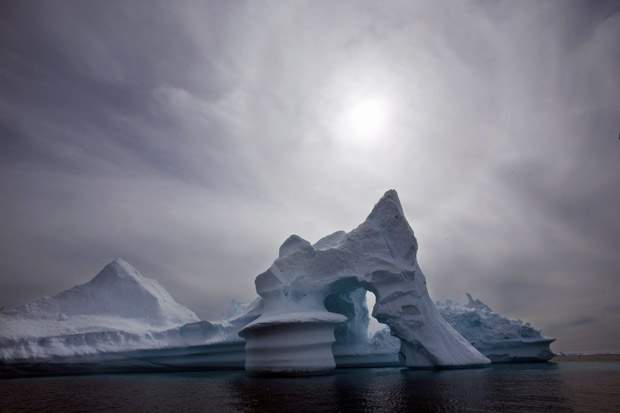
An ancient ice island the size of Bermuda is slowly moving closer to Canada’s East Coast.
The 62.5-square-kilometre slab of ice is not considered an iceberg because it is wider than it is deep.
The ice island, known as PII-A, has been on its southbound journey in the Atlantic Ocean since it broke off the massive Petermann glacier in northwest Greenland last August.
PII-A is steadily drifting along the coast of Newfoundland’s Northern Peninsula at an estimated pace of 0.6 kilometres per hour.
It’s believed PII-A, weighing between 3.5 billion and four billion tones, contains pure water. The glacial water is estimated to be around 110,000 years old.
Warmer weather is slowly chiseling away at PII-A. Large chunks of ice have broken off the island as it continues to move southward. If it does not get significantly smaller as it travels southward, the large ice island could pose a risk to ships and offshore oil rigs off Newfoundland.
About icebergs
Each year, roughly 40,000 icebergs migrate through Canada’s eastern waters.
Spring and early summer is high season for iceberg-watching.
The floating icy peaks typically originate from the North Atlantic Ocean near Baffin Island and Greenland.
As they travel south towards the Newfoundland cast, icebergs get smaller in number and size.
Icebergs that drift from the ice pack decay gradually by wave action and water and air temperature.
By the time they arrive at Newfoundland’s Grand Banks, most icebergs have lost about 85 per cent of their original mass.
Warming oceans affect marine life migration
Scientists say warmer waters are causing some marine species to migrate to oceans where they were once believed extinct.
The wandering species pose a danger to entire ecosystems.
“The new interactions in the new food web are… unpredictable and often turn out exhibiting extreme volatility, involving dramatic boom and bust cycles, the destruction of forage organisms or habitat cover needed for regular inhabitants of the ecosystem,” says Tony Pitcher, a professor in the Department of Zoology and the founding director of the Fisheries Centre at the University of British Columbia in Vancouver.
Newly introduced species do not have time to develop any resistance to their new surroundings.
What’s more, warming ocean waters and melting Arctic ice could disrupt food supplies, impacting many other species, from the tiniest algae and plankton to larger polar mammals higher up on the food chain.
“Reduction in this early spring bloom (of nutrition such as algae) can change the whole polar ecosystem, even threatening the survival of top carnivores,” he says.
Consequences of melting Arctic ice
Melting Arctic ice can upset the chemical processes in the ocean that affect climate change.
Chris Reid of the University of Plymouth in England believes the relocation of certain marine species to different oceans could largely be blamed on melting Arctic ice and warmer oceanic temperature.
Reid cites the return of plankton from the Pacific. The particular species disappeared from the North Atlantic about 800,000 years ago, but has since returned after migrating from the Arctic Ocean.
Scientists say climate change is the main reason behind the shrinking ice pack in the frigid Northwest Passage.
Last year, a 13-metre Pacific grey whale was spotted off the coasts of Spain and Israel. The particular species, which disappeared from the Atlantic centuries ago, is believed to have made its way to warmer waters thanks to the lack of ice coverage in the Arctic.
The Northwest Passage, which spans from Alaska to northern Canada, has been ice-free only twice before, in 1998 and 2007.
—
With files from The Canadian Press
A Youtube video of the ice island from late June was shot by a local fisherman. The footage shows the island drifting near Battle Harbour, Newfoundland and Labrador.



Comments
Want to discuss? Please read our Commenting Policy first.