

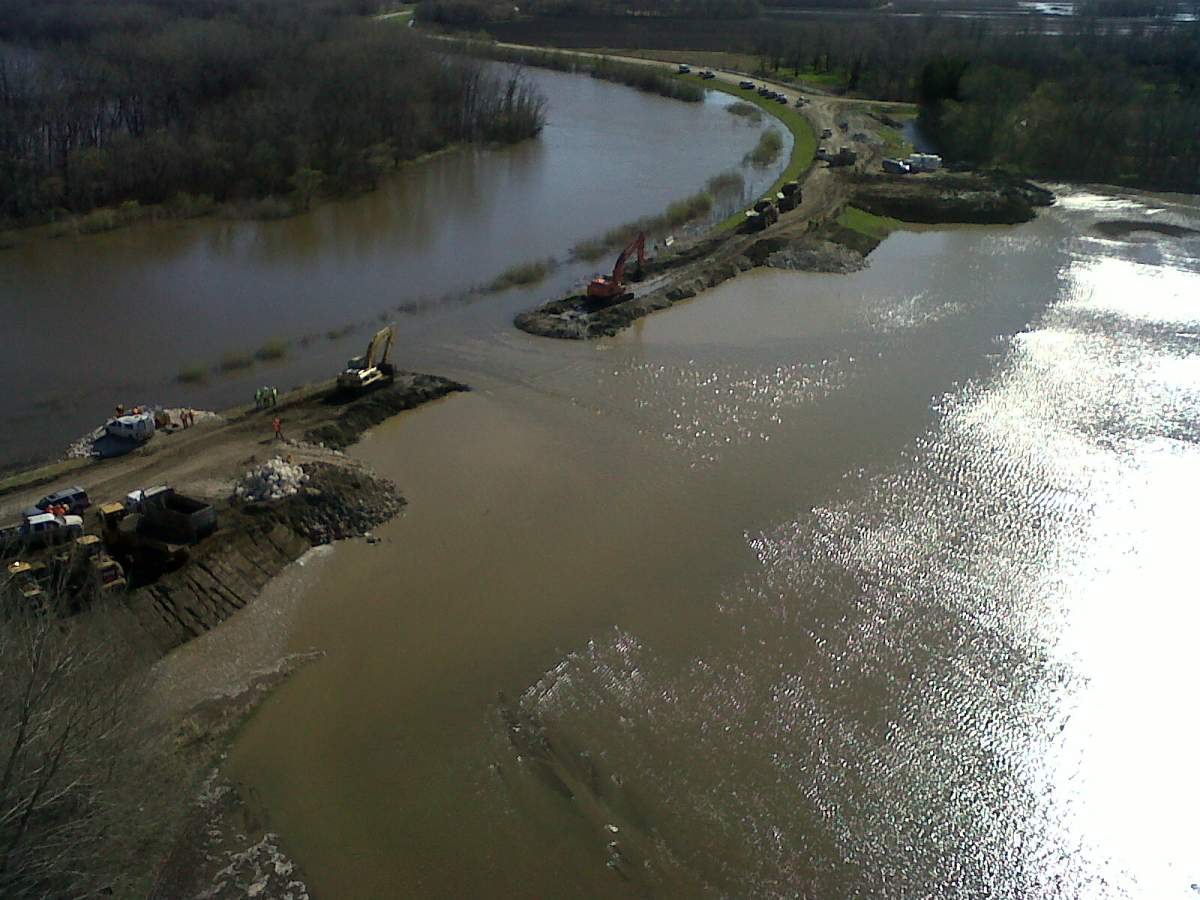
HOOP AND HOLLER BEND, Man. – Flood water was slowly inching across a swath of land in southern Manitoba – threatening some 150 homes in an effort to save hundreds more – after the province deliberately cut a dike Saturday holding back the swollen Assiniboine River.
The province broke the dike southeast of Portage la Prairie just after dawn Saturday, even as homeowners, Canadian Forces troops and volunteers sandbagged homes minutes away. Officials initially said the water was behaving as it should – dispersing across fields at a rate of one mile per six hours, over roads and ultimately end up in the La Salle River in about a week.
The controlled leak is intended to take pressure off the soggy dikes currently holding back the raging Assiniboine River.
But western Manitoba is far from safe. Premier Greg Selinger saidthe area is being monitored by air and on land 24 hours a day to avoid any catastrophic dike breaks.
"This is unprecedented territory," he said after touring the area by helicopter Saturday afternoon. "We’ve never seen this much water and things can happen."
Saturday’s controlled release is expected to flood 225 square kilometres and could affect at least 150 houses. People in the area have been frantically sandbagging around the clock as officials postponed the release a number of times this week in the hope it wouldn’t be necessary.
On Saturday, the cut was allowing water to flow at a rate of 500 cubic feet per second – about enough to fill an Olympic-sized swimming pool every three minutes. That could increase up to 3,000 cubic feet per second depending on how dikes hold up around the Assiniboine.
The result is not be a torrent of water, but a slow spreading-out over a wide, flat area, filling in low-lying sections between roadways – somewhat akin to maple syrup covering a waffle.
Joel Aberdeen, who lives less than a kilometre away from the Hoop
and Holler Bend where the cut was made, said he’s somewhat relieved
that a decision to cut the dike was finally made after days of
uncertainty.
But as reservists scrambled to sandbag around his house Saturday
morning, Aberdeen said no one has told him how much water to expect.
He and his wife Debra will stay in the house they’ve lived in for
32 years "until they throw us out."
"We may have to go kicking and screaming then," he said.
Homes that will be hit first from rising water levels were
evacuated days ago. But Robin Carter is staying put.
He lives on the Elm River near the bend and says the situation is
"surreal."
"It’s a beautiful day, a gentle breeze, ducks are playing in the
water," he said. "The only thing that spoils the whole view is the
sound of the equipment working."
Water is still a metre below what Carter calls "the danger
point" around his house but it is rising.
"I’m probably a lot better off than people who are downstream
from here," he said.
The province says every effort has been made to protect affected
homes in the area. It says redirecting the water will prevent 500
square kilometres and 850 properties further downstream from being
swamped.
The decision to deliberately break the dike was one of the most
difficult Selinger said he’s ever had to make. But he assured people
that those affected will be well-compensated. Although much of the
water is flowing over fields, it is fertile land many depend upon
for their livelihood.
"We’ll compensate people for the damage to their properties.
We’ll compensate them for income loss and we’ll have a program for
recovery of the land," Selinger said. "We are going to be very
fair about it and we’re going to do everything we can to make sure
people can carry on and make a living in this area."
Kam Blight, reeve of Portage la Prairie, has been nervously
eyeing the water and hearing from worried homeowners for the past
week. Now that the dike has been breached, Blight said he is feeling
a bit more confident.
"We do have people on top of things, monitoring where the water
is going and helping direct it to where it needs to be," he said.
"A lot of our properties are protected as we had hoped they would
be. Right now, I’m very pleased with what I’ve seen, all things
considered."
Doug McMahon, with Manitoba infrastructure and transportation,
said officials on the ground are monitoring the water closely and
will do what they can to nudge it in the right direction. But he
said the water’s speed will likely change as it flows across the
land so it’s hard to predict when it will arrive in neighbouring
communities.
"There are going to be municipal roads that are going to be in
the way. There is going to be heights of land – the topography is
going to indicate how fast it’s travelling."
In the meantime, some 1,400 soldiers and reservists are still
hard at work, helping to sandbag and reinforce dikes along the
river. The Assiniboine River is at record levels with officials
calling this a "one-in-300-year" flood.
Emergency Measures Minister Steve Ashton said the troops are
welcome because Manitobans are beginning to wear down.
"Fatigue is a huge factor," he said. "We’re getting lots of
reports from employees, volunteers, people across the board. People
are exhausted."



Comments
Want to discuss? Please read our Commenting Policy first.